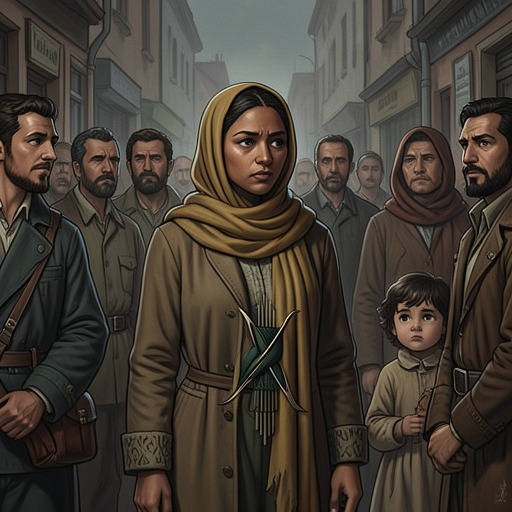
Molly’s Aboriginal ancestry
The Drover's WifeMolly’s Aboriginal ancestry is a family history long obscured by silence and racialized assumptions, brought into the open when Yadaka recognizes the clues in Molly’s life and tells her what Ginny May preserved. He identifies her mother as Mary, known in the district as Black Mary, and explains that Ginny May was Mary’s sister and held Molly as a newborn. The disclosure unsettles Molly’s sense of herself, but it also reveals kinship that reaches beyond the isolated life she has built with her children. In a society where Aboriginal people face displacement and violence, that newly named inheritance becomes both a source of belonging and a danger others may exploit.
Family History and Recognition
The revelation begins with fragments rather than a formal record. While Molly speaks of her mother, who died giving birth to her, Yadaka recognizes details he has heard from Ginny May. He connects Mary’s death, Ginny May’s visits, and the family story carried across generations; the pieces lead him to understand that Molly is the child of the woman in that story. Ginny May, he tells her, is his adopted mother, and she had held Molly after her birth while Molly’s father grieved Mary’s death.
Yadaka explains that Ginny May kept alive the story of her sister’s love for a Scotsman, a relationship rejected by the surrounding society. Mary had red hair and fair skin, but, as Yadaka tells Molly, her Ngarigo features were strong. She had worked as a cook for drovers, including Molly’s father. District people called her Black Mary and described her as the “Whitest gin around”; Yadaka uses that cruel label to show how racial identity was imposed on Mary despite her appearance. His conclusion is direct: Molly’s mother was Aboriginal.
The knowledge has been handed down through a chain of kinship and storytelling. Ginny May told the story repeatedly to her youngest son, Bulburai, who showed no interest in it because the relationship was forbidden by King Jimmy. She later told it to Yadaka, her adopted son. Yadaka understands the repetition as purposeful: Ginny May wanted someone to know. The account thus survives not through official recognition but through the persistence of a family story that Molly herself had never heard.
Molly’s Response and the Meaning of Kinship
Molly initially rejects the revelation. She slaps Yadaka and orders him away, unable at that moment to accept his account or absorb what it means. The news arrives amid the pressures of her precarious life, not in circumstances that allow her to consider it at leisure. She asks what good the knowledge can do and worries about what her children might face if they are associated with Aboriginal ancestry. Her immediate priority is protecting them.
Yadaka’s disclosure changes the meaning of Ginny May’s presence in Molly’s life. Molly had known her as someone who helped women in childbirth; she had not understood her as the sister of her mother and therefore part of her own family. Yadaka insists that Ginny May was there because Molly was kin, and that this connection extends to Molly’s children. The relationship makes the family history more than an account of descent: it identifies a living bond that Molly had not been able to name.
The revelation also links Molly’s private history to Yadaka’s own longing for home. Raised for a time in the household of Father Matthews, where he learned to read and write, he continued to yearn for his mother’s country in Far North Queensland and for his clan. His sense of family and belonging is shaped by a separation from Country and community; in recognizing Molly’s ancestry, he sees a possible connection between her and the people he hopes to rejoin. His invitation that she come with him is therefore also an invitation to understand herself through kinship rather than through the categories imposed by the district.
Racial Classification and the Threat to the Children
In the world surrounding Molly, ancestry is not simply private knowledge. Aboriginal people have been driven from their homelands, restricted from following seasonal ways of life, and subjected to an unofficial policy allowing white people to shoot them on sight. Yadaka explains that he is wanted because he is Aboriginal, not because his ancestry by itself proves wrongdoing. Molly recognizes the discrimination he describes: Aboriginal people nearby have been blamed, arrested, imprisoned, or driven away. His account of her own mother therefore enters a political reality in which racial identity can expose a person to state and settler violence.
That danger reaches Molly’s children through the language of official protection. Miss Shirley declares that Molly is sheltering a wanted Aboriginal man and calls Molly’s children “Octaroon,” presenting their ancestry as a reason they urgently need intervention. The judge signs an authorization for their removal. To Danny, the order means the possibility of being taken from his mother, whom he knows as loving and protective. The episode turns Molly’s newly revealed ancestry into a means by which others claim authority over her family: a history that Yadaka offers as kinship is recast by local power as evidence against the children’s place at home.
The ensuing legal framing deepens that distortion. At Molly’s trial, the Crown argues that her hostility toward the white men she killed is generational, deriving from knowledge of her ancestry and her mother’s suffering, supposedly imparted by Yadaka, whom the prosecution depicts as a murderer who encouraged revenge. The claim turns family history into an accusation and casts Yadaka’s act of telling as manipulation. The evidence instead presents Molly’s fear for her children and the vulnerability of an isolated woman within a society that treats race, gender, and legal standing as connected grounds for control.
Belonging, Country, and Cultural Continuity
After Molly has had time to hear the story, Yadaka invites her to join him. He says she is Aboriginal and that Ginny May was her family and her children’s family. Molly voices the difficulty of being both a woman and Aboriginal, a response that registers the additional burdens attached to her identity rather than accepting a simple, uncomplicated return to belonging. She goes inside but leaves the door open, and Yadaka gives her directions to the cave where he plans to stay through winter: a two-and-a-half-day walk northeast, beyond the Great Waterhole, a circular clearing, and three large boulders. He describes it as a place with food, blankets, and shelter, and, when spring comes, people—her people. Molly does not answer him then, leaving the invitation unresolved in that moment.
The later family story offers a wider view of what such belonging can mean. In the future, Danny and his brothers take part in a men’s-business ceremony learned in the high country with their Ngarigo family. Their uncle Bulbarai passes the ceremony on in haste because he fears that modern ways are invading and destroying practices the Ngarigo hold dear and believe necessary for survival. After Joe Junior and Henry James undergo initiation, Molly’s children return from the mountains. Danny and his brothers regard the knowledge as an inheritance from their Aboriginal family and take pride in carrying it forward.
Molly’s ancestry consequently binds several forms of continuity: Mary’s story preserved by Ginny May, Yadaka’s search for his people, and the later transmission of cultural knowledge to Molly’s descendants. Against a colonial order that treats Aboriginal identity as grounds for dispersal and child removal, the novel places kinship, Country, and storykeeping as sources of connection that survive silence and separation. The revelation cannot undo the danger surrounding Molly’s family, but it makes visible the family history and collective belonging that the district’s racial labels had concealed.