Robert Parsen
The Drover's WifeRobert Parsen is a stockman, drover, and experienced marksman whose life is shaped by two linked histories: the violence of the colonial frontier and the precarious fellowship of men who work its stock routes. Known in a boxing tent as “The Red Bull,” he carries his grievance over his mother’s death into a lifelong vendetta against Aboriginal people. When he visits Molly Johnson’s shanty looking for his missing friend Joe, his suspicion of Yadaka turns that history into immediate violence, with fatal consequences.
Identity and Background
Parsen is introduced among three stockmen moving thousands of sheep. He is powerfully built, with fiery-red hair and a full beard, and is described as built like a bullock. The scene also shows a gentler, less predictable quality: he carries a lamb that cannot keep up, speaks to it softly, and considers trying to reunite it with its mother or find it a home. His practical concern for the animal sits beside the brutality that defines his later conduct.
His family history reaches back to English convict stock. His great-grandfather arrived in Australia with the First Fleet, convicted of murder, and gained his freedom after rescuing a captain during an attack by local Aboriginal people. He killed three of them with his bare hands, acquired land for his actions, and became a farmer. Parsen’s father was born on that property, as were Parsen and his two brothers. In this family account, landholding and colonial violence are linked from the outset: violence against Aboriginal people is remembered as the route by which the family secured its place.
In 1847, Parsen’s family moved to Maryborough in Queensland with other colonial entrepreneurs to establish a pastoral station. Two years later, after a violent attack on the local Ginginbarra clan in which twenty-eight squatters were killed, Parsen’s mother died in the crossfire. The account makes clear that she was killed by one of her own side, not by the Aboriginal people against whom Parsen later directs his grievance. That distinction does not temper his response. At thirteen, he joined Gregory Blaxland and a vigilante party of about fifty squatters and station hands in an ambush at Bingera against a group of sleeping Gin Gin people.
Parsen had learned to handle a gun early and proved a marksman even as a boy. During the ambush he shot at people fleeing into the Burnett River; the slaughter was indiscriminate. The experience entrenched his ruthlessness and fixed his hostility towards Aboriginal people. He continued to blame them for his mother’s death, although she had been killed by a bullet from her own side. He declared that the violence had begun with them, and the narrative marks that moment as the last time he cried for anyone.
Droving Life and Relationships
After his mother’s death, Parsen’s already hard-drinking father became violently cruel towards his sons. The three brothers left home early and went their separate ways; Parsen was only fourteen. He turned to droving, travelling thousands of miles along eastern stock routes and sometimes into the Northern Territory. His few possessions are his horse, hat, and boots. Between drives, he stays in hotels or brothels in larger towns, returning to the road when another job comes along.
His life centres on livestock, fellow drovers, and the freedom of work on the move. He has never married and has no interest in giving up that independence. He is particularly close to John McPharlen and Joe Johnson, with whom he can spend months riding. Parsen befriended Joe a little over ten years before the events at Molly’s home; the men’s bond was cemented when they saved each other’s lives in an all-in brawl. Both had lost their mothers young and had fathers who turned their grief against their sons, a shared past that helps explain the strength of their mateship without erasing the very different choices Parsen makes.
Parsen and Joe favour drives through the alpine high country, drawn to its isolation and harsh beauty. Their skill is legendary among drovers: livestock losses under their care are rare, and they are known for reaching good grazing ground and market in time to secure better prices. Though Parsen has never officially met Joe’s wife, Molly, he respects her from afar. He tips his hat when she and the children follow Joe as he leaves for a drive, recognizing that she follows for the children rather than out of love for her husband. Joe has told Parsen that the marriage is one of convenience and status as well as family duty.
That working life also binds Parsen to the pastoral economy that sustains the district. Joe’s usual drives take sheep from Queensland into the high country for three months and back before the first snowfall, following a pattern maintained for nearly eight years. The sheep industry is already badly affected by the economic depression, and the prospects of droving work are tightening. Elsewhere, the Edwards family’s wool business, which sells local wool in Melbourne to overseas markets and has financed work for farmers and drovers, is also losing ground as the depression spreads. These pressures do not excuse Parsen’s violence, but they locate his livelihood in a fragile network of sheep, labor, sale days, and markets.
Public Persona and Racial Prejudice
At the sale-day boxing tent, Parsen appears as one half of a stockman team billed as “Robert ‘The Red Bull’ Parsen” and John “The Joker” McPharlen. He warms up bare-chested, drinks with McPharlen, and enters a tag-team bout against Aboriginal sideshow boxers. The event frames the stockmen as entertainment and local celebrities, while Aboriginal men are presented to the crowd as part of the sideshow. Parsen’s nickname turns his size and force into a public persona, but his earlier history gives that force a more consequential context.
The sale-day crowd also brings him into contact with the institutions of the town. After a drunken night, Parsen and McPharlen approach Trooper Spencer Leslie’s desk, where a pile of arrest papers has accumulated. They are regulars in the lock-up at sale time; on this occasion their drunken handling of a gun had been dangerous enough that the troopers detained them for their own safety. When Parsen remarks on the unusual number of papers, Nate Clintoff explains that the records are a precaution for tracking crime and suspects. Parsen’s presence in this episode connects his rough stockman’s life to the growing administrative reach of the settlement, but the record-keeping does not anticipate the violence he will later bring to Molly’s home.
His prejudice is not confined to his past. In the later confrontation, he treats Yadaka’s identity and appearance as grounds for suspicion and force. Earlier, Yadaka explains to Molly that Aboriginal people are arrested, imprisoned, or driven away, while white settlers have unofficial permission to shoot them on sight. The scene places Parsen’s individual hostility within a larger system of colonial persecution; his conduct is personal, but it is enabled by a frontier order that leaves Aboriginal people exposed to violence.
The Visit to Molly’s Shanty
Parsen rides to Molly’s shanty because Joe, who has driven with him for years, is absent from the latest drive for the first time in eight years. He says he felt obliged to check that his old mate was all right. He arrives armed, and his first response to Yadaka is threatening. Molly steps forward to demand his business, while Yadaka remains ready to defend himself but tries not to provoke a fight. Parsen gives his name and says the troubling circumstances have made him more than a little worried.
The immediate source of his suspicion is Joe’s worn boots on Yadaka’s feet. Parsen recognizes the worn heel and accuses him of having taken them. Molly says she gave the boots to Yadaka in return for work, but Parsen refuses to accept her explanation. He has already found Joe’s horse running with a herd of brumbies, and considers a man’s absence from his horse evidence that something is wrong. He states that a local man goes nowhere without his horse, hat, and boots unless he is dead. Joe is in fact dead nearby, and Molly and Yadaka know it, but neither reveals the truth.
Parsen’s inference is accurate, but it does not make his response an act of justice. He attacks Molly and Yadaka, then orders McPharlen to bind Yadaka. When Parsen’s weapon fails to fire, Yadaka tries to defend himself, but Parsen overpowers him. The struggle leaves Yadaka incapacitated. Molly also tries to intervene, but Parsen turns on her. His certainty about Joe’s fate, his loyalty to his missing friend, and his hatred of Aboriginal people converge in the yard; instead of seeking an explanation, he takes control through violence.
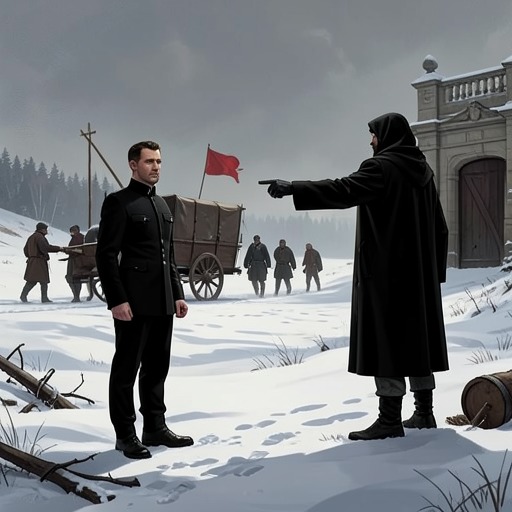
McPharlen arrives during the confrontation carrying one of Yadaka’s killing spears and behaving mockingly towards Aboriginal culture. After Parsen points to Yadaka and orders him tied up, McPharlen binds him. Parsen’s response to Joe’s disappearance has thus enlisted his younger companion in the same threat, while Molly and Yadaka are left to face the consequences of a secret that Parsen has partly uncovered but not learned from them.
Character and Narrative Significance
Parsen’s biography shows how grief can become a justification for violence when it is organized by racial prejudice. His mother was killed by a bullet from her own side, yet he maintains a vendetta against Aboriginal people and participates in an indiscriminate ambush as a teenager. The contradiction matters: the story neither denies his loss nor treats his version of its cause as true. It shows how he converts personal bereavement into a lasting rationale for harming others.
His relationship with Joe complicates, rather than softens, that portrait. Parsen’s loyalty is genuine enough to prompt the visit to Molly, and he correctly notices the horse and boots that signal Joe’s absence. Yet the same loyalty gives way to suspicion and force as soon as Yadaka becomes a target. His own biography offers one account of grief and male fellowship; the treatment of Molly and Yadaka exposes whose safety that fellowship does not protect.
As a stockman, Parsen belongs to an economy organized around sheep, long-distance drives, and access to grazing and markets. As a settler whose family acquired land through violence, he also embodies the frontier’s entanglement of economic expansion with Aboriginal dispossession. The scale shifts from his great-grandfather’s seizure of land, through the vigilante massacre at Bingera, to the armed visit at Molly’s shanty. Across these episodes, violence recurs not as an isolated rupture but as a practiced means of asserting control. Parsen’s significance lies in that continuity: the private story of a bereaved boy becomes inseparable from the public history of colonial force.