Samuel Adrian Clintoff
The Drover's WifeSamuel Adrian Clintoff is the son of Louisa Clintoff and Nate Clintoff, and the family’s move to Australia places him in situations where his dependence on his parents is inseparable from the dangers they face. Still young enough to sleep in a cot, he is also the point around whom Louisa and Nate organize their decisions: first as they leave London, then as they struggle through a flooded river, and finally when his curiosity helps connect their family with Molly Johnson’s children. His later question about the word used to classify Molly’s children makes him a bearer of news that turns a bureaucratic threat into an immediate family crisis.
Identity and family
Samuel is introduced in London as the Clintoffs’ young son. On the morning of the family’s departure, Louisa sees him asleep between herself and Nate; his cot and room have already been packed for what she calls the Big Move. His presence gives the emigration an intimate, domestic scale: the journey is not an abstract adventure for the adults, but a change of home undertaken with a small child in their care.
The family is leaving during a global economic depression, and Louisa acknowledges that her father regards their plan as foolish. Nate, a former British Army sergeant seeking a career beyond administration, and Louisa nevertheless decide to go, with the Victorian government guaranteeing their safe passage. Samuel thus enters the narrative as part of a family making a consequential move amid economic uncertainty, rather than as an independent traveler.
The river crossing
The journey becomes dangerous when the Clintoffs attempt to cross a swollen river. Nate has misjudged the current, and the horses cannot manage both the rushing water and the wagon’s weight. The family is swept away, putting Samuel in immediate dependence on his parents’ efforts to get everyone to safety.
When the wagon is brought to a sudden halt, Nate reaches its rear and finds Louisa sitting in water up to her waist, holding Samuel. The possessions around them are floating, and the child is too frightened to do anything but cling to his mother. Nate embraces them and explains his plan for leaving the wagon. Louisa makes a sling from her petticoat fabric and secures Samuel high on Nate’s back; she and Nate then enter the water with him still attached to his father.
Nate’s plan requires Louisa to hold on to a horse’s mane and let the current carry her. As Nate releases the wagon’s horses one by one, Louisa and Samuel are separated from him in the flood. The sequence presents the family’s survival as a coordinated but perilous effort: Louisa must trust Nate’s instructions, Nate must manage the horses and carry their son, and Samuel’s safety depends on both adults acting under pressure. The book later returns to the crossing through Nate’s memory when a cry from inside the wagon brings him back to the present.
At Molly Johnson’s shanty
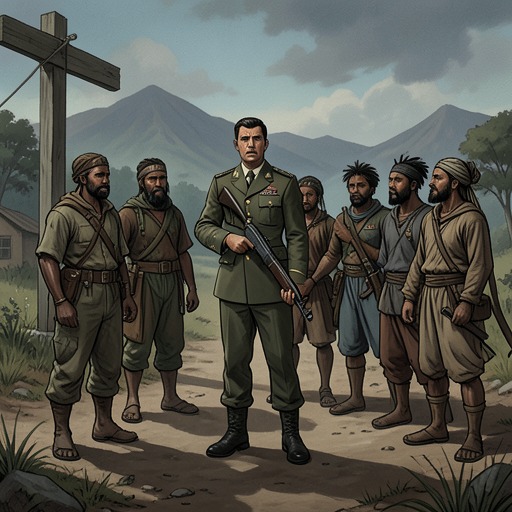
After the ordeal, Samuel springs into Nate’s arms when his father opens the wagon at Molly Johnson’s shanty. Nate helps Louisa out as well, and the family, relieved to be on dry ground, approaches Molly’s home. Molly has initially watched them warily, her shotgun beside her: she and her children are isolated, unaccustomed to visitors, and accustomed to treating strangers as possible threats.
Samuel’s curiosity changes the encounter. On the verandah, he pokes his fingers through a hole and a gap in the wooden slats. Laughter comes from inside, and Molly’s four children run out. Samuel is delighted to see them; Louisa is moved by the sight of Molly’s family. Molly, who had been holding her ground against the newcomers, smiles for the first time and motions the Clintoffs inside. Samuel does not negotiate with Molly or understand the stakes of her welcome, but his unguarded play provides the moment through which the two groups begin to meet.
The removal threat
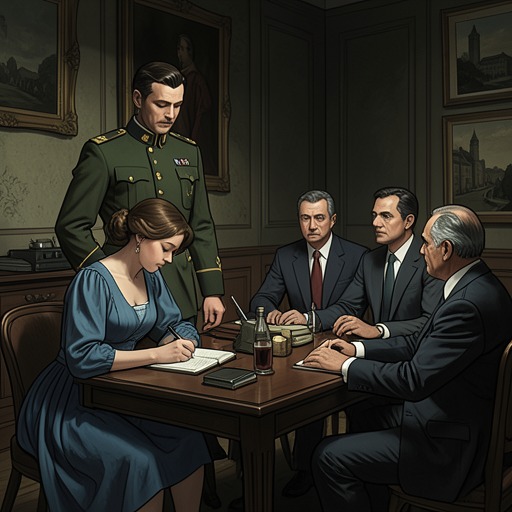
Later, Samuel is among the children placed at risk by official action against Molly’s family. Miss Shirley invokes the label “Octaroon” and urges Judge Eisenmangher to intervene. The judge signs a letter authorizing the children’s removal, ostensibly for their safety. The decision turns a racial classification into practical power: a judge’s signature makes separation from their mother an imminent possibility.
When Samuel returns to Molly and she realizes the other children are missing, he tells her that Miss Shirley called them “octaroons” and asks what the word means. His question is brief, but its effect is substantial. Molly recognizes the term from her own childhood, when she heard that racial labeling could be used to send a mixed-heritage child away. The memory helps her understand the threat to her own children and connects her past with the present danger facing Samuel’s siblings.
Molly confronts Miss Shirley and Father McGuinness, takes the removal document, and burns it before leaving with her children. Samuel’s report therefore supplies the immediate information that allows Molly to recognize what the official order means for her family. His role is not to resolve the danger but to make its meaning legible to his mother: what officials describe as protection is, from the family’s perspective, a threat of forced separation.
Narrative significance
Samuel’s scenes place childhood vulnerability beside adult decisions made under pressure. During the river crossing, his dependence makes the consequences of Nate and Louisa’s choices concrete; at the shanty, his play interrupts Molly’s suspicion and helps create an opening for hospitality. In the later removal crisis, he is again a link between events and their consequences, this time bringing home the language used by officials and the knowledge it carries for Molly.
The character’s significance also lies in the contrast between the ordinary forms of family care surrounding him and the authority that threatens to divide another family. Louisa and Nate protect Samuel through practical cooperation, while Molly’s effort to keep her children with her is challenged by a decision made in their absence. The novel gives Samuel no independent account of these political forces; instead, his position as a child lets the consequences emerge through dependence, play, and a question addressed to his mother.