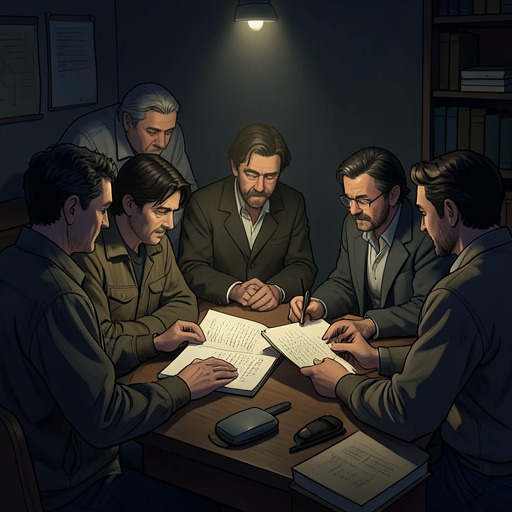
Someone needs to know
The Drover's Wife“Someone needs to know” is the principle behind the transmission of a forbidden family history in which Yadaka becomes both its recipient and its keeper. First spoken by Ginny May to explain why she entrusted him with her sister’s story, the phrase gathers force as that inherited knowledge helps Molly understand her ancestry and the danger facing her children. In a novel where official labels can turn kinship into grounds for separation, remembering is not passive: it is a responsibility passed between generations.
A story entrusted to Yadaka
Yadaka learns the story after finding refuge among people gathered for ceremony to celebrate the bogong moth. The elders permit him to stay and be adopted by Ginny May, a woman in her early sixties whom he is to call Mother. Her adoption is an act of welcome, but it also gives her a way to share something she has been forbidden to tell within her clan.
The story concerns treachery, broken lore, and forbidden love. Ginny May considers it unlucky or unsuitable to share, yet she chooses Yadaka to keep it alive. She had told it repeatedly to her youngest son, Bulburai, who showed no interest because the story was forbidden by King Jimmy. When Yadaka asks why she tells him about her sister again and again, her answer is that someone needs to know. The words define his new responsibility: he is not merely hearing an account of the past but receiving a story intended to survive its silencing.
From inherited memory to Molly’s history
Years later, Yadaka recounts what he has learned to Molly. He explains that Ginny May preserved the story of her sister’s great love for a man of the wrong skin, despite the prohibition surrounding it. He recalls that Ginny May’s son would not take up the story, making its transfer to Yadaka more consequential: the act of telling carries knowledge across a break in its transmission.
Molly initially struggles to accept the account as her own history. She is already preoccupied with the safety of her children, and learning about her heritage opens further questions about what they may face. Yadaka’s telling does not simply disclose a family connection; it gives Molly a way to make sense of the stigma attached to her identity and to connect her past with the present peril of her family.
Knowledge and the threat of removal
The phrase’s urgency becomes concrete when Danny tells Molly that Miss Shirley called the children “octaroons.” Molly recognizes the term from an earlier conversation she overheard as a child: Miss Shirley had discussed sending a mixed-heritage child away and using a racial classification to secure that outcome. The recovered memory makes the threat legible to Molly. The story Yadaka told and the word Danny brings home fit together, revealing how the past bears directly on the children’s future.
Miss Shirley invokes the children’s supposed need for help and asks Judge Eisenmangher to act. He signs an authorization for their removal. The language of protection thus accompanies a decision that would separate the children from their mother. Molly ties Miss Shirley and Father McGuinness, takes the signed paper, and burns it before leaving to reach the children. Her action answers the threat with immediate protection; the inherited story has helped her recognize what the official document means.
Storykeeping as resistance
The novel sets Ginny May’s chosen act of preservation against institutions that classify people and authorize the displacement of children. The contrast is not between memory and a neutral absence of knowledge: the story is forbidden within its own community, while racial labels are used by authorities as a basis for intervention. Yadaka’s responsibility to remember and Molly’s determination to keep her children with her show different consequences of that struggle over who may tell a family’s history and who may decide its future.
The phrase also resonates with the novel’s account of history-making beyond its fictional events. In the author’s note, the writer describes researching history and listening to elders’ oral stories to recover cultural knowledge that government policy had prevented her mother and grandparents from passing on. That reflection echoes Ginny May’s decision to entrust Yadaka with her story: telling and listening become means of carrying knowledge forward when its transmission has been obstructed.