Stanlow Inn
The Drover's WifeStanlow Inn is a recurring landmark in Everton whose changing role links the town’s public spectacle to its private violence. Its doors open onto a gathering place for stockmen and onlookers, while the ground beside it becomes the site of Molly Johnson’s direct confrontation with John McPharlen. The inn thus marks both a point in Nate Clintoff’s pursuit of men connected to the Johnson family and a threshold on Molly’s desperate route out of town.
Setting and Public Life
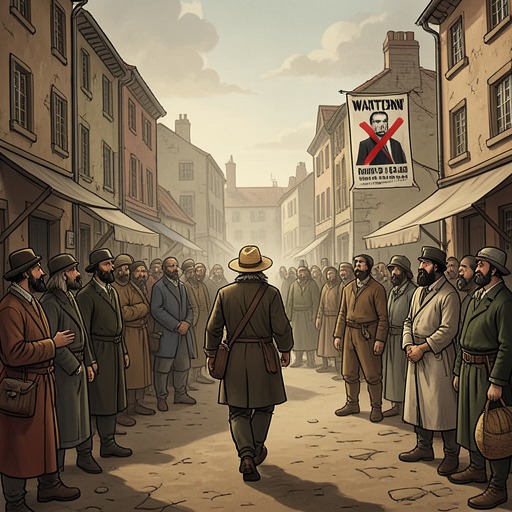
The inn is introduced as a hotel across the way from where Nate encounters Martha Murray, who prefers to be called Marti. From there, the two watch three stockmen arrive and are promptly surrounded by women hoping to earn money from the men’s visit. Marti identifies Robert Parsen, John McPharlen, and Joe Johnson among them, describing the three as close associates. They pass through the swinging doors into a dingy, smoke-filled room, where Nate knows he will have to wait before approaching them.
The inn’s entrance makes the men’s arrival visible, but the interior removes them from Nate’s immediate reach. Its social traffic is transactional and conspicuous: the stockmen arrive together, women gather around them, and the men disappear behind the doors. For Nate, the hotel is at once a recognizable meeting place and an obstacle in an investigation that depends on finding the right moment to act.
A Stage for Nate’s Authority and Pursuit
Stanlow Inn also supplies an audience for Nate’s new authority in Everton. In a separate street-side confrontation, its clientele gather on the platform outside to cheer as Nate fights two drunken stockmen. Nate has thrown the first punch after one of the men challenged his authority in the high country; he knocks that man out, then sends another stumbling into a water trough. The crowd’s applause, and a woman’s wolf whistle, turn the altercation into a public test of whether the new sergeant can defend his position. The inn is not merely background to the fight: its patrons become spectators whose approval makes the display of authority communal and theatrical.
Later, on the town’s main thoroughfare, Nate continues searching through the darker corners of buildings and reaches the inn just as McNealy is thrown out through its swinging doors. Nate lunges after him, but his injured leg gives way; McNealy gets up and escapes into the dark. The recurrence of the swinging entrance sharpens the contrast with the earlier arrival of Parsen’s group: the doors first conceal men Nate wants to question, then suddenly eject a fugitive he is trying to catch. In both encounters, the inn’s threshold shapes the pursuit without guaranteeing Nate control over its outcome.
The Inn on Molly’s Route
Near the end of Molly’s escape, the Stanlow Inn is the last establishment she and the children must pass before they can be safely out of town. Seeing McPharlen there, Molly recognizes the man who assaulted her; Danny recognizes him too as the man he saw harm his mother and as one of those involved in Yadaka’s hanging. The sight transforms a final stretch of escape into a confrontation with violence that has followed the family through the story.
Danny’s grip tightens around the spear beside him, but Molly’s immediate response is to face McPharlen herself. She leaves the wagon and finds him around the side of the inn in the early morning. He has stepped outside to urinate, and the rising sun is still blocked by the mountain range. Molly stands before him despite her fear. When he directs his urine at her feet, she does not move; when he wipes roughly at her tears and grabs her jaw, his contemptuous touch precipitates the decisive reversal. Molly castrates him, and he collapses, bleeding, as snow begins to fall and the flakes turn pink on the ground.
Narrative Significance
The scenes associated with Stanlow Inn move between public performance and bodily vulnerability. Nate’s fight is watched, cheered, and understood as a demonstration of law-enforcement authority. Molly’s encounter, by contrast, takes place beside the building rather than before its assembled crowd: she stands alone with the man who assaulted her, and the encounter ends in his death. The same landmark that gathers townspeople around violence also borders an act of resistance that the public spectacle does not contain.
Its repeated thresholds give the inn a structural role in the plot. Men enter its smoke-filled room beyond Nate’s immediate reach; McNealy bursts back through its doors and evades capture; Molly passes its frontage on the way out of Everton, only to stop and settle her confrontation with McPharlen at its side. The change from entrance to escape route to place of reckoning makes the inn a compact map of the novel’s shifting relations between visibility and concealment, official authority and personal survival.