Storykeeping and oral memory
The Drover's WifeStorykeeping and oral memory is both a subject within the novel and one of its principal narrative structures. Stories preserve family and cultural knowledge that colonial violence, social pressure, and personal trauma threaten to silence. The book follows memories as they move between conversation, a notebook, song, dance, and children’s play: transmission does not merely repeat the past, but gives it new witnesses and a continuing life.
Family stories and everyday memory
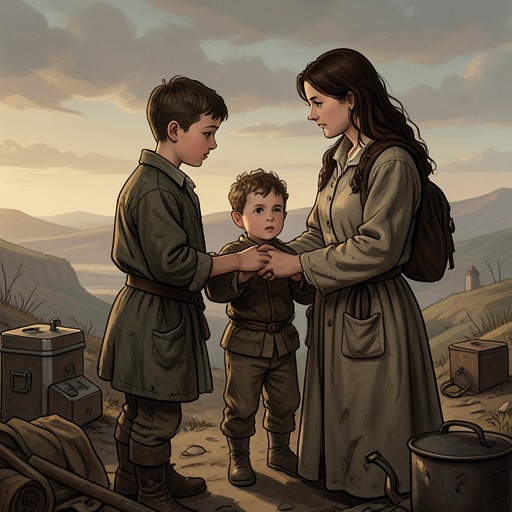
For Molly Johnson, storytelling belongs to ordinary family life. During walks with her children, she makes room for questions about her own childhood and the life she shared with her father, Jock Stewart. Away from the house, she finds herself telling them what she knows and what remains unknown. She recalls walking with her father to his various jobs, meeting people on the road, and learning to distinguish truth from invention in the stories people exchanged. Her recollections also reveal the limits of family knowledge: Jock told strangers that Molly’s mother had died in childbirth, but Molly herself knows little more about her mother’s death. Storytelling can preserve what a family has been told while leaving the gaps in that inheritance visible.
The children ask Molly to tell her trials and tribulations, though they have heard the stories many times. Repetition is not treated as needless duplication. Retelling keeps family history present for children who will outlive its original witnesses. Their regular walks make the landscape a setting for this exchange: the children follow familiar paths, play games, and ask questions, while Molly speaks about her past. Their shared stories also teach and entertain. In one remembered encounter, a snake approaches breastmilk beneath a bed and the dog Alligator intercepts it; Molly later recalls Danny’s pride in the dog. The recollection holds danger and reassurance together, preserving a particular family incident as part of what the children know about their lives.
The teller, the listener, and the burden of keeping
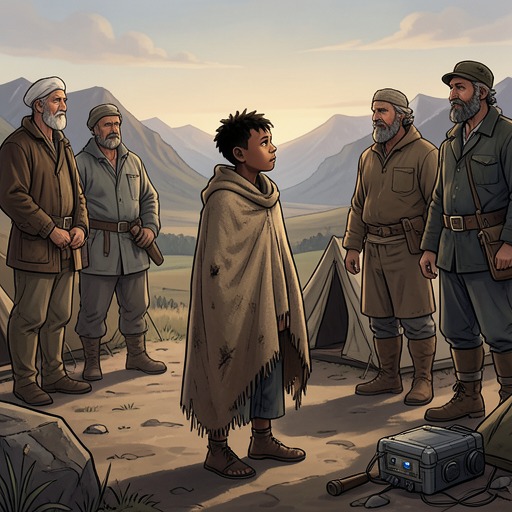
The novel places particular responsibility on Yadaka as a story keeper. On the run from authorities, he meets Molly and exchanges kindness for shelter; their brief time together gives her access to a concealed truth and another way to imagine her future. Yadaka’s own calling is tied to a story entrusted to him by Ginny May, the woman who adopted him as her son. She had been forbidden to share the story within her clan because it was regarded as unlucky and improper. Adoption gave her a person to whom she could tell it, and made Yadaka responsible for keeping it alive. Its subject—treachery, broken lore, and forbidden love—comes back to him in fragments rather than chronological order. Recovering it requires time and, he hopes, ancestral guidance.
This responsibility is not separable from the precarious conditions in which Yadaka lives. He has seen the written records of people who employed or arrested him, left open without consideration that he could read them. Those books reveal a history of persecution and official attitudes that his people’s lived knowledge also records. At a moment of exhaustion and despair, he considers the future available to him in a country where Aboriginal people are hunted, dispersed, and treated as targets. Against that written colonial record, storykeeping safeguards knowledge carried by those whom its authors disregard. The novel presents these forms of memory in tension without suggesting that the violence Yadaka records is overcome simply by telling it.
The story of Waraganj also reaches the reader through an intimate act of transmission. On the night she decides to leave her clan rather than go to the man promised to her, she tells her mother about a dream of a narrow, difficult path leading away. Her mother agrees not to raise the alarm until after sunrise, and the two exchange declarations of love before Waraganj leaves. The mother’s final words connect her presence to the rustling treetops; the exchange gives Waraganj strength as she departs. Here, a story shared between mother and daughter is not simply a record of the past: it accompanies a dangerous choice and preserves a bond across separation.
Writing, trauma, and the retrospective frame
The book’s larger structure makes remembering an action performed years after the events. At thirty-two, Daniel Johnson sits on the verandah of a renovated homestead with a sixteen-year-old notebook, its pages holding sketches, poems, and memories. He began recording what happened when he and his siblings ran into the mountains, and what he learned during the four years that followed. The knowledge he encountered was ancient, but time and society constrained what could be passed on. The notebook preserves his account without making it complete: Daniel recognizes that there was only so much the people who taught him could share.
Writing also offers a private form for experiences Daniel has not told even his siblings. Louisa Clintoff, a newspaper proprietor and friend, once suggested that he write a poem to ease pain and loss, without needing to show it to anyone. Daniel remembers the advice as the origin of a poem and reads his old pages in later life, returning to memories that remain difficult to disclose. The novel frames his notebook as both evidence and shelter: it lets him put an experience into words while showing that recording it does not necessarily mean he is ready to share it.
That delay matters when Danny recalls hearing his mother being beaten by Joe. As a child, he watched from a crack by the door, remembering an earlier occasion when trying to intervene had left him injured. He does not tell Nate Clintoff what he remembers; he disguises it as an ordinary night. Years later, the violence is part of the experience he has kept to himself. The narrative thus distinguishes between witnessing, immediate speech, and later testimony. Memory returns, but its first appearance is withheld behind a child’s protective silence.
Story performed and inherited
Yadaka helps turn one family memory into a shared performance. When Danny describes the enormous grey bullock that threatened his siblings, Yadaka jumps up and imitates it through Aboriginal dance. Danny continues the account while Yadaka follows its action with his feet. This exchange makes the boy’s recollection visible and bodily; the story is no longer only a report of what Molly did to protect her children, but a performance shaped by the listener’s participation. Its later name, the Bullock Story, marks how a particular remembered incident can become a repeatable family narrative.
The Ngarigo subsequently incorporate Danny’s account into their practices of mimicry and dance, building it with song and movement. They honour Molly’s bravery and recognize her plight, bringing her into the clan’s remembered story. Danny and his siblings take pride in seeing the community perform it, as the story allows the clan to remember Molly and to share her history. The shift in ownership is significant: an incident from one household enters a collective cultural form, without ceasing to be the children’s account of their mother.
In the final family scenes, transmission continues in altered forms. Daniel tells his own children that the story he lived is the story he will keep telling and pass down. Their evenings include family narration, stories told by their mother about the land, and re-enactments. They perform the Bullock Story in a simplified version: one child pretends to raise a shotgun, another urges her on, and Daniel plays the bullock. The Ngarigo performance had involved people dressed and painted for the story; the children’s version uses play instead. The form changes, but the narrative remains recognizable and affectionate, centered on their grandmother Molly’s courage.
Storykeeping therefore connects testimony to cultural continuity without flattening the differences between them. Molly’s recollections preserve a family history marked by both knowledge and absence; Yadaka receives a story whose telling had been restricted; Daniel’s notebook holds memories he has not yet spoken aloud; and the Bullock Story passes from a child’s account into communal dance and later family play. The novel ends not with memory sealed in an archive, but with children gathered to hear and enact it. What survives is not an unchanged version of the past, but a story repeatedly entrusted to new listeners.