Survival and cultural continuity
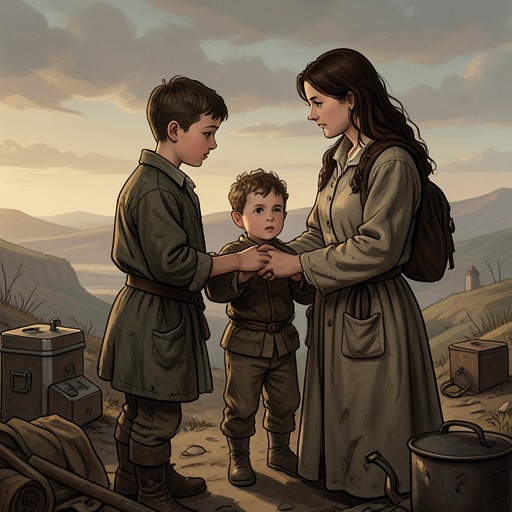
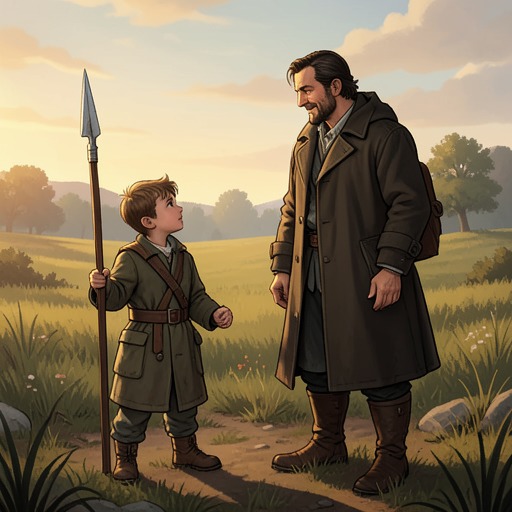
The Drover's WifeSurvival and cultural continuity are linked in the novel: staying alive matters, but so does keeping family, memory, and cultural knowledge alive in the face of colonial violence and attempted displacement. The Johnson children’s escape toward Yadaka’s cave opens a chance to remain together and find extended kin; in the later family frame, Danny turns what the family lived through into a story, a communal dance, and an inheritance for his children. The narrative’s answer to threats of dispersal is not only escape, but the sustained work of remembering, teaching, and belonging.
Survival Under Colonial Pressure
For Molly, survival is a practical and urgent calculation. After losing her baby girl, she tells the injured Yadaka that she needs him to leave: if he goes into town seeking the reward, troopers may come to her doorstep. Her concern is sharpened by the knowledge that trouble surrounds the mountains and that her family is already vulnerable. Yadaka hears the fear beneath her insistence and hopes to recover before he must move on. Their exchange makes clear that survival is not a private matter: helping a wanted Aboriginal man could place Molly and her children in further danger, while sending him away would leave him exposed.
The iron collar around Yadaka gives that danger a personal meaning. When Molly assumes he must have done something wrong to wear it, he answers that his only crime is existing while black. She understands the accusation because she has seen Aboriginal people blamed, arrested, imprisoned, or driven away; the local white population has unofficial permission to shoot them on sight. In that setting, his fugitive status is not simply the result of an individual conflict with authority. It reflects a system in which Aboriginal presence itself is treated as a threat, and survival requires continual attention to where a person can safely stand, travel, or seek help.
That system also acts through apparently procedural decisions. Trooper Spencer Leslie tells Nate Clintoff that it will be two days before a party can reach Molly, even if it leaves immediately, and that the authorities’ responsibility for her welfare would then be over. The delay turns official concern into a narrow administrative measure, leaving Molly and her family to face immediate danger on their own. Later, Miss Shirley calls Molly’s children Octaroons and urges Judge Eisenmangher to remove them, presenting racial classification as a reason to intervene in their family. The judge authorizes the removal. The threat to family continuity thus comes not only from violence in the landscape but from a legal order able to redefine separation as protection.
Escape, Kinship, and a Possible Future
Yadaka offers Molly a route that is also an invitation into community. He gives her precise directions to the cave where he will spend the winter: it lies north-east, two and a half days’ walk away, beyond the Great Waterhole, a bald patch, and three boulders that resemble emu eggs. He promises food, blankets, shelter, and, in spring, people—her people. His offer does not erase the hardship of reaching or living at the cave. It gives Molly and her children a chance to remain a family while approaching an extended Aboriginal kinship network from which colonial pressure has distanced them.
The escape later unfolds with those directions as its practical guide. Molly conceals the children beneath a horse blanket and tells them to appear ill if anyone stops the sulky. As the horses move through a dark back street, Danny repeats the route Yadaka gave her. The detail matters: knowledge entrusted in one conversation becomes usable across danger because it has been remembered and passed on. The journey is not assured, but it creates the possibility of survival, family unity, and a place where the children can learn who they are among their wider family.
The later account establishes that Molly’s children do come back down from the mountains after Joe Junior and Henry James complete their initiation. Their return does not mean the end of cultural practice; they bring knowledge from the high country with them. The story’s arc therefore resists a simple opposition between escape and return. A dangerous separation from the settler town makes another form of belonging possible, and what the children learn can travel back with them into the family’s future.
Telling and Embodying the Story
The story of the wild bullock first becomes a shared act between Danny and Yadaka. Danny recounts how the animal appeared, threatened his siblings, and forced his mother to act. Yadaka does not merely listen: he rises and mimics the bullock in an Aboriginal dance, using movement to enter Danny’s account. Danny responds with greater excitement and continues his performance of the event. This exchange makes storytelling more than a report of what happened. Danny supplies the remembered sequence; Yadaka answers through embodied knowledge, giving the story a form that can be acted, learned, and carried forward.
Danny later tells the story to the Ngarigo, who add it to their established practices of mimicry and dance, developing it through song and movement. The change in ownership is important without erasing the family’s experience. The story remains about Molly’s bravery and the danger faced by her children, but it becomes part of a wider cultural practice. The Ngarigo honour the family’s account and, through it, bring Molly into the clan’s story. For Danny and his siblings, this is a way to remember their mother and a way for the clan to share in her history.
That adoption also has consequences for the family’s understanding of itself. Danny is proud to see men, women, and children dress and paint themselves to perform the story for his family. A particular act of maternal courage, first preserved in a child’s recollection, becomes a communal performance. Its meaning expands: the tale carries family memory into Ngarigo cultural life, while that cultural recognition gives the family a place within a larger collective memory.
Survival as Inherited Memory
At the later point in the narrative, Danny is thirty-two and tells his family how people described Molly as a mad, hateful woman after the family came down from the mountains. He remembers hearing the account given in Louisa Clintoff’s story, and answers it with his own understanding: survival. He speaks as Molly’s eldest son, who lived the story, told it, and intends to pass it down. The contrast matters because the public account reduces Molly to a hostile stereotype, while Danny’s testimony restores the circumstances and purpose of her actions to family memory.
The scene makes that transmission concrete. Danny sits with his pregnant Aboriginal wife, Nell, and their six children, whose skin tones and features vary. Their evening storytelling includes both the family’s history and Dreaming stories from the land. Some nights the children reenact the beloved Story of the Bullock, making inherited memory a repeated household practice rather than a single account preserved in the past. Danny’s children learn not only what happened to their grandmother, but how her story belongs to the family they are part of.
The next generation also receives cultural knowledge through men’s business. When Danny’s eldest son, Mirribi, approaches his twelfth birthday, the family expects him to undergo the final stage of his ceremony. Danny and his uncles learned the ceremony in the high country with their Ngarigo family; their Uncle Bulbarai passed it on in haste because he knew that modern ways were threatening ancient practices. The ceremony makes cultural continuity an obligation enacted through teaching and initiation. Danny and his brothers feel honoured to carry this knowledge from their Aboriginal family and stand their ground in defending their culture and countrymen.
A Story That Changes Through Performance
The novel shows the Story of the Bullock in several forms, each serving a different kind of continuity. At home, the children make a simplified version without paint, singing, or traditional instruments. Molly-Mary plays her grandmother, and Danny takes the part of the bullock, repeating the physical mimicry Yadaka once performed. When Molly-Mary shouts and pretends to fire, Danny falls as the animal did in the children’s version; the others applaud and crowd around him. Their play is affectionate and familiar, but it also keeps the remembered event available to another generation through gesture as well as words.
The differences between the Ngarigo performance and the children’s game do not cancel the story’s importance. One form joins the account to communal dance and song; the other adapts it for family play. In both, the story is carried by bodies and repeated actions, not only by a written record. That capacity to change form helps it endure while allowing it to remain recognizably tied to Molly, Danny, and the family’s shared past.
The closing family gathering connects this inheritance to the place where it is lived. Molly’s old shanty has become a larger family home; the snow gum still stands outside, while the once-thick scrub around the property has been cleared. The children’s play, the household’s storytelling, and the family’s continuing connection to the mountains take place in a landscape transformed over time. The novel does not present cultural continuity as untouched stasis. It presents it as a practice sustained through kinship, ceremony, story, and performance, even as the surrounding world changes.
From Private Survival to Collective Continuity
The concept’s central movement is from survival as immediate protection to survival as a shared future. Molly’s choices and Yadaka’s directions give the children a chance to escape separation and remain together. Danny’s later telling then makes the family’s experience available to people who did not witness it, including his own children and the Ngarigo community. The story’s circulation does not undo the danger or restore what was lost, but it prevents the family’s history from being defined solely by colonial authorities or hostile public descriptions.
That movement also clarifies why the novel treats cultural practice as inseparable from family survival. The cave offers more than physical shelter: it promises people and belonging. The initiation carries knowledge learned with Ngarigo kin into a new generation. The bullock story turns a mother’s act of protection into a communal performance, then into a children’s game that can be told again. Across these forms, continuity depends on relationships—between parent and child, teller and listener, clan and family—and on the repeated work of carrying knowledge forward.
The ending leaves that work in progress rather than complete. Danny’s children are learning and reenacting; Mirribi is approaching a further stage of ceremony; Danny continues to tell and retell the story. Survival has become more than having escaped a particular danger. It is the continuing ability to remember Molly truthfully, to maintain cultural knowledge, and to make room for the next generation within family and community.