The covered wagon
The Drover's WifeThe covered wagon is the Clintoff family’s essential vehicle on their journey from Melbourne to Everton, but it becomes more than a means of transport when a swollen river sweeps it and its occupants into danger. Mud, flood marks, and the family’s shaken arrival make the wagon a material record of that crossing; later, it carries provisions and children between isolated households, joining survival on the road to the intimate work of family care.
Journey and the river crossing
The Clintoffs’ wagon reaches Molly Johnson’s property along a barely visible, rocky track after a journey already marked by hardship. Inside, Louisa Clintoff holds her sleeping son, Samuel, amid belongings stained by floodwater and mud. The cover bears water marks, and debris remains caught in the wheel spokes. These traces lead Nate Clintoff to recall the accident that happened a few weeks earlier, before the family arrived at the shanty.
Nate was unfamiliar with the land and misjudged the force of a swollen river. The horses could not manage the current while pulling the wagon’s weight, and the family was swept away. The danger threatened not only the wagon but the lives of Nate, Louisa, and Samuel, as well as the horses and most of their possessions. They survived, although the wagon’s battered condition shows that reaching dry ground did not erase the ordeal.
In Nate’s account of the crossing, the wagon first acts as a perilous, waterlogged enclosure: Louisa is trapped in its back with Samuel and their belongings floating around her. Nate reaches them after the wagon stops against an obstruction. He and Louisa then use the horses and the wagon as part of their escape plan, releasing the animals from the harness and relying on the current to carry them toward safety. Louisa secures Samuel to Nate’s back with a sling made from her petticoats; the wagon is left behind as the family commits itself to the river crossing. Its importance thus shifts from shelter and transport to an obstacle whose occupants must abandon its usual protections to survive.
Arrival at Molly Johnson’s shanty
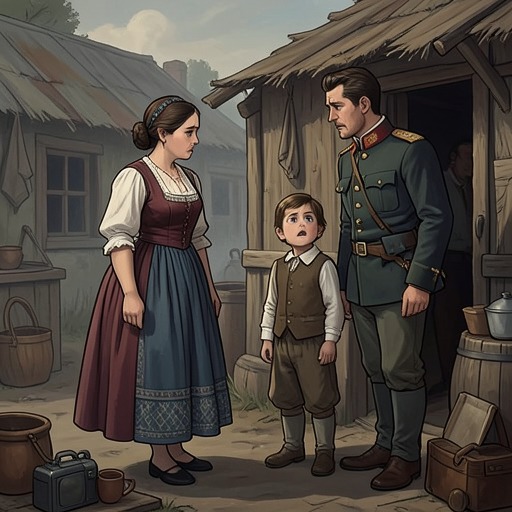
After the crossing, the wagon continues to Everton despite the family’s exhaustion. Louisa is coughing and appears unwell; Nate is worn out from the long trip and limps as he moves around the vehicle. When Samuel calls from inside, Nate opens the back and lifts his son out, then helps Louisa down. The family reaches dry ground alive, and the wagon—with its flood damage still visible—makes the journey’s cost legible before they approach Molly’s home.
The arrival is not automatically welcome. Molly watches from her verandah with her Cowles & Dunn shotgun beside her, while her children peer through gaps in the shanty walls. Visitors are unusual, and she has reason to be wary of strangers. The wagon therefore marks an intrusion into her secluded household as well as a possible connection to help: Louisa recognizes that Nate has found assistance, but Molly initially regards the vehicle and its occupants with caution.
Carrying provisions and children
Once the Clintoffs have received Molly’s hospitality, the wagon becomes the means by which Molly sends her younger children on to town. At the shanty, the children climb into the back carrying small parcels of clothes and food. Meat for trading is packed in beside them; Molly offers it to the Clintoffs, who initially refuse, but she insists rather than let it spoil. The practical loading of supplies sits alongside a tender farewell as Molly kisses and tidies the children before they leave.
The departure is particularly significant for Delphi, who has never before been away from her mother. She is upset but also excited by the adventure and by the prospect of meeting the baby Molly is expecting. As the wagon pulls away, Louisa looks back and waves; Molly answers with a nod, then calls further instructions to her sons. Her emotions rise as she watches the vehicle travel down the track, but she also feels relief at having time alone before the birth. The wagon carries the children out of sight, making the separation visible while preserving their immediate purpose: to travel together and return to Molly.
Material trace and narrative function
The wagon recurs at turning points in the Clintoffs’ and Molly’s domestic lives. Its flood-stained interior records a recent emergency; its arrival brings the exhausted Clintoffs to Molly’s door; and its departure takes Molly’s children away with food and clothing for the journey. The object links distant travel and local household survival without making the two families’ circumstances identical: the Clintoffs arrive as visitors after a dangerous passage, while Molly entrusts her children to their wagon because she needs time before giving birth.
The account also changes the wagon’s meaning through narrative order. The reader first encounters its worn, muddy aftermath at Molly’s property, then enters Nate’s recollection of the earlier flood. The vehicle’s visible damage prompts a retrospective account of how the family reached safety, so the ordinary transport becomes evidence of an event not yet narrated. Later, as it carries Molly’s children away, the same wagon signifies a temporary separation rather than a perilous crossing. Its repeated appearances bind danger, assistance, and departure into one material thread.