The murder of the Edwards family
The Drover's WifeThe murder of the Edwards family is the violent discovery that turns a family’s absence into a public accusation. When Frank Edwards returns from Melbourne, he finds his wife and three children dead beneath a tree, arranged with rose petals around them. Nearby, he encounters the wounded fugitive Yadaka and immediately blames him. The scene binds private grief to the novel’s wider climate of colonial suspicion, while leaving the accusation distinct from proof.
Discovery at the Edwards property
Frank returns to the Edwards property expecting his children to race down the track and greet him. Instead, the house is silent. He initially mistakes the still family beneath a tree for a picnic, calling to Ulla and the children; as he approaches and recognizes what has happened, the illusion collapses. His wife and three children are dead, their bodies arranged around the tree with rose petals scattered nearby. The little basket Leaellynn had used to collect the petals lies close at hand. The scene’s careful arrangement contrasts with the family’s absence of life, making the discovery at once intimate and bewildering.
Frank drops to his knees, then runs to his horse and rides toward town for help. His response establishes the immediate consequence of the killings: a bereaved father becomes the first accuser, and his grief drives the story into a confrontation with someone already marked as dangerous by the authorities.
The accusation against Yadaka
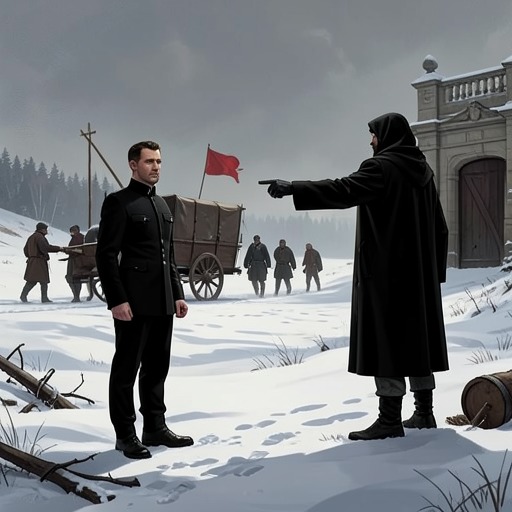
On the track near the property, Yadaka is trying to continue north toward Guugu Yimithirr country, his mother’s country. He has been running for days, has not had time to eat, and is carrying a serious wound. When Frank arrives, Yadaka is exhausted and in pain. Frank sees his dark skin, the iron collar around his neck, and his bloodstained clothing, then reaches for his pistol and accuses him of murdering the family. The encounter establishes the accusation as Frank’s immediate conclusion, not as a demonstrated account of who killed the Edwardses.
Yadaka throws debris into Frank’s face and retreats into the trees. Frank follows only tentatively, then becomes disoriented and returns to his horse. He rides toward Everton still insisting that Yadaka killed his family and will be hanged. His certainty, formed in the shock of discovery and reinforced by Yadaka’s appearance and custody marks, gives the murder an unresolved dimension: the person blamed is also a pursued man seeking to reach home.
Suspicion and the wider climate of danger
The encounter grows out of a landscape in which accusation can carry consequences before evidence is established. Yadaka’s iron collar and government-issued clothing mark him as a man who has been in custody; his own account is that his only crime is existing while Black. Molly Johnson recognizes the larger pattern behind his remark: Aboriginal people in the district are blamed, imprisoned, or driven away, while whites have unofficial permission to shoot them on sight. Frank’s readiness to interpret Yadaka’s appearance as proof therefore belongs to a wider colonial order in which racialized suspicion makes the fugitive immediately legible as a culprit.
That order also turns the killings into an urgent threat beyond Frank’s grief. Sergeant Nate Clintoff notes that a check on Molly Johnson may take two days even if troopers leave their outpost immediately, and that official responsibility for her welfare would then be considered over. The delay matters because the search for the Edwards family’s killer intersects with Yadaka’s flight and with the danger faced by those sheltering him. The murder thus sets in motion not a simple pursuit supported by settled facts, but a conflict in which the state’s attention, its limits, and its assumptions shape who is exposed to danger.
Frank’s grief and the turn toward accusation
The discovery leaves Frank Edwards with no immediate explanation, only the certainty that his family has been taken from him. He drops to his knees and sobs; his cries across the range shift into shouts of frustration and pain. Then he runs back to his horse and races to town for help. The movement from mourning to action carries the killings beyond the Edwards property: Frank’s loss becomes a public matter, and his response sends the search for help into motion.
The accusation takes shape almost at once. Nearby, Yadaka is trying to make his way north toward Guugu Yimithirr country, his mother’s country, after days of flight without food and while carrying a serious wound. When Frank confronts him, he sees a Black man, an iron collar, and bloodstained clothes, reaches for his pistol, and calls him the murderer. The novel presents this as Frank’s conclusion in the immediate aftermath of finding his family, not as proof of Yadaka’s responsibility for their deaths.
Yadaka throws debris into Frank’s face and escapes into the trees. Frank follows tentatively, then turns back and rides toward Everton, still declaring that Yadaka killed his family and will be hanged. The killing therefore produces not only grief but a pursuit founded, in the evidence presented here, on accusation. Yadaka’s flight and Frank’s certainty set the family’s deaths within a wider conflict over whose appearance and status are treated as evidence.
Consequences and unresolved meaning
The murder’s consequences extend beyond the immediate pursuit. At the property, the killings leave Frank grieving without an explanation; on the track, his accusation turns Yadaka into a suspect before the account establishes any proof of responsibility. Yadaka’s flight continues toward his mother’s country, while the authorities’ concern for people exposed to danger is constrained by distance and delay: Sergeant Nate Clintoff is told that troopers cannot check on Molly Johnson for two days, and that their responsibility would then be considered over. The search for the killer thus unfolds alongside the vulnerability of those connected to Yadaka and the people who might shelter him.
Later, the case against Molly Johnson invokes the Edwards family’s deaths as part of a racialized argument about motive. In court, Miss Shirley labels Molly’s children as mixed-blood and urges their removal, while the Crown’s closing statement claims that Molly’s hostility toward the white men she killed was generational and had been encouraged by Yadaka. That account treats her heritage and her mother’s suffering as grounds for suspicion, rather than establishing the truth of the Edwards murders. The family’s deaths therefore remain consequential not only as the loss Frank discovers, but as an accusation repeatedly shaped by colonial assumptions about Aboriginal identity, criminality, and danger.