Wanted poster portrait
The Drover's WifeThe Wanted poster portrait is a stencil copy of Trooper Spencer Leslie’s drawing of Yadaka, issued during the search for the man blamed for the Edwards family murders and other killings. More than an identifying image, it makes official suspicion visible: Leslie gives Yadaka an enraged, murderous expression, and the poster’s circulation encourages townspeople to treat that racialized representation as the truth. Its contrast with Danny’s knowledge of Yadaka exposes how a wanted image can turn a person into a public threat before he is recognized face to face.
Creation and Circulation
Leslie draws the portrait from Frank Edwards’ description of the Aboriginal man wanted for the Edwards family murders. The image is an uncanny likeness of the man sheltering with Molly, but the resemblance is not neutral: Leslie takes liberties by giving his subject the eyes of a murderous savage. The drawing thus combines recognition with interpretation, embedding the authorities’ and settler public’s judgment in the face it purports merely to record.
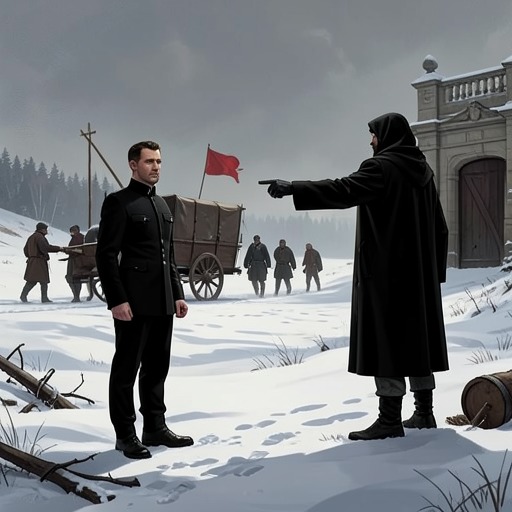
After receiving a telegram reporting that a prisoner had killed a trooper and a Native Policeman while being moved, and that the prisoner had been wounded in the lower back, Sergeant Nate Clintoff studies the portrait with Leslie. The telegram links the wanted man to additional deaths and confirms the wound, but the image supplies a more immediate and emotionally charged version of the accusation. Nate asks why the man has returned to the mountains, while Leslie recommends bringing in troopers and trackers from nearby outposts. The portrait becomes part of the practical machinery of pursuit.
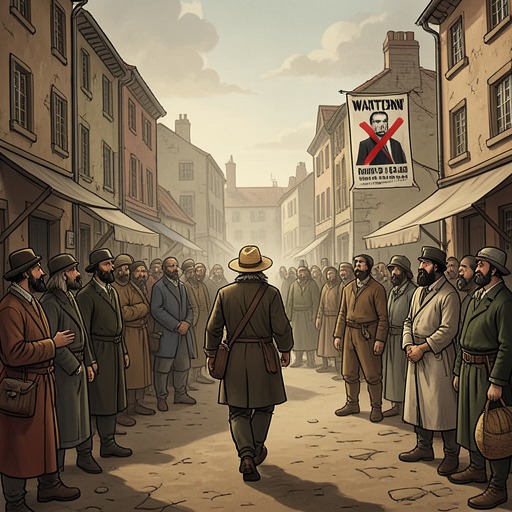
Nate orders copies of Leslie’s drawing posted around town. By sale day, posters appear on shopfronts and posts along Everton’s main street, where visitors can inspect the image amid the festivities. The town’s public space becomes a display for the wanted man’s alleged identity, making the search visible to residents and outsiders alike.
The Image and the Racialized Gaze
The portrait’s framing echoes a society in which Aboriginal people are collectively blamed, arrested, imprisoned, displaced, or exposed to unofficial permission for whites to shoot them on sight. Yadaka names the injustice directly when Molly challenges his iron collar: his only crime, he says, is existing while black. The poster’s violent expression gives visual force to precisely the kind of racial suspicion that makes that statement legible. It presents an individual wanted for specific alleged crimes through an image that also draws on a broader stereotype.
The public response shows how readily the drawing is read through that stereotype. Thomas McNealy joins a group of well-dressed people studying the posters. One calls the depicted man a heathen savage; another says that a dead black is a good black. A third qualifies the claim by recalling a supposedly docile and trustworthy Aboriginal man. These reactions treat the poster not simply as a request for identification but as an occasion to voice racial judgments, with approval, contempt, and conditional praise all resting on the assumption that Aboriginal people can be classified and discussed as a group.
The portrait also serves the authorities’ pursuit in ways that touch Molly’s household. Nate considers a route through the Johnson property and says he hopes Molly’s husband will be home when the party arrives. Leslie observes that Molly will be checked on, but that it will take two days for the party to reach her, and frames the obligation to her welfare as ending then. The wanted image is therefore connected not only to the search for Yadaka but to the prospect that the search will bring armed authorities to Molly’s home, where she has reason to fear their presence.
Recognition and Contradiction
The poster’s most consequential appearance in the narrative comes when Danny sees it on a wall. He recognizes Yadaka, but the fierce, enraged, murderous eyes in the drawing do not match the friendly eyes he knows. The moment makes the portrait’s central contradiction personal: Danny can identify the man and at the same time reject the image’s account of him. His knowledge comes from a relationship, while the poster offers a public identity shaped by accusation and hostile interpretation.
Later, Spencer recognizes Yadaka when moonlight falls across his face. Yadaka understands from the trooper’s reaction that he has been identified and attempts to remain calm, while Spencer orders him not to move. The portrait has prepared Spencer to see the man in front of him as the wanted murderer and offers the prospect of professional credibility if he captures him. What began as a drawing therefore helps structure a live confrontation: recognition activates the pursuit, and the man represented by the poster is treated as the figure it has already defined.
Bureaucratic Consequences and Narrative Significance
The image’s power extends into the struggle over Molly’s children. Miss Shirley argues that Molly is harboring the wanted man and tells Judge Eisenmangher that the children, whom she labels octaroons, need urgent help. The judge authorizes their removal. When Danny later tells Molly what was said, she connects the classification to the threat she once heard directed at her own childhood and understands that the official language of help can conceal separation from family. The episode broadens the portrait’s significance: the search for Yadaka supplies a charge against Molly, while racial classification supplies a bureaucratic means of threatening her children.
At Molly’s trial, the Crown’s closing statement presents her hatred of the white men she killed as generational and connects it to what she learned from her heritage and her mother’s experience, as told by the wanted Aboriginal man. It characterizes Yadaka as a callous murderer who encouraged revenge. The portrait’s construction of Yadaka as a murderous figure thus finds a verbal counterpart in the prosecution’s account: his presence is used to cast suspicion on Molly’s motives and to frame her actions for the court. The all-male jury, the declaration of her mixed heritage, and the absence of Danny as the witness to her truth leave that account with grave consequences.
Molly ultimately ties Miss Shirley and Father McGuinness, takes blankets and food for her children, and burns the removal order. The paper bears the judgment that the children are octaroons, that removal is necessary, and that permission has been granted. The poster is not itself the removal order, but the wanted-man accusation belongs to the same chain of institutional pressure that reaches Molly and her family. As a recurring image, it links public spectacle, racialized judgment, police pursuit, and the threat of family separation; Danny’s recognition of the difference between the drawn face and the person he knows prevents that official image from standing as the novel’s uncontested truth.