Yadaka reveals Molly’s Aboriginal ancestry
The Drover's WifeYadaka’s revelation that Molly’s mother was Waraganj, known as Black Mary, alters Molly’s understanding of herself and turns an inherited family story into an immediate danger for her children. The disclosure connects a private history of kinship and love to the racial classification and colonial power that shape the family’s present; Yadaka insists that telling the story is not an intrusion but a responsibility to preserve it.
The Story Behind the Revelation
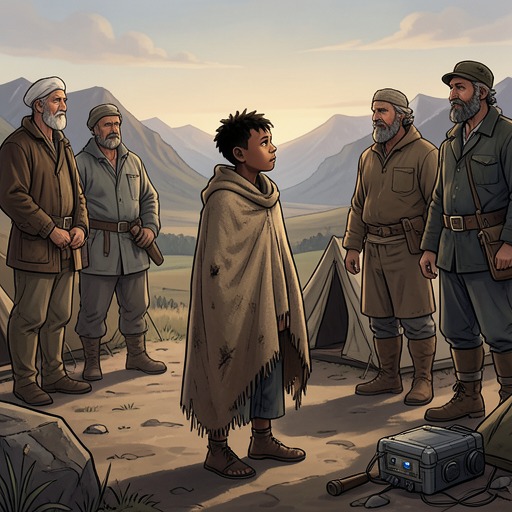
As he listens to what Molly has told him about her mother, Yadaka recognises a pattern in the scattered details. Molly says that her mother died giving birth to her. Yadaka connects this with Ginny May’s visits and tells Molly that Ginny May, who helped her, is his adoptive mother. He recalls what Ginny May told him: on the night Molly was born, she held the baby while Molly’s father grieved for his dead wife.
Yadaka explains that Ginny May had kept alive the story of her sister’s love for a man of different skin. That sister was Molly’s mother. The district had called her Black Mary, though she had red hair and fair skin as well as Ngarigo features. She had worked as a cook for drovers, and Molly’s father was one of them. Yadaka makes the family connection explicit: Molly’s mother was Aboriginal.
The account also carries a second, more hostile version of the past. Yadaka says he heard from an old white farmer that local men used Black Mary’s name to mark her as Aboriginal and make her vulnerable to their abuse. The farmer’s recollection includes talk of a Scottish man and of the social prohibition against marrying an Aboriginal woman, even where relationships might otherwise be tolerated. These details show that Molly’s parents’ love existed within a community that denied it public acceptance and treated her mother’s identity as a source of danger.
Resistance, Kinship, and Storykeeping
Molly does not receive the disclosure as a welcome explanation. She is shocked, slaps Yadaka, and orders him off her land. His insistence that he must continue despite her anger makes the encounter a conflict over who can tell her history, and how. Yadaka recognises that the account may feel disrespectful, but says he has been entrusted with it and may not have another chance to pass it on.
His claim is grounded in the relationship between Ginny May and her sister. Ginny May repeatedly told the story to her youngest son, Bulburai, although he showed little interest and understood that such love was forbidden by King Jimmy. When Yadaka asked why she kept repeating it, Ginny May answered, “Someone needs to know”. For Yadaka, the story is part of shared lore: keeping it in circulation allows the dead to remain present in the knowledge of those who follow. He describes Waraganj as a woman who lived fully despite the brevity of her life, and frames the telling as a means of carrying that life forward.
The encounter is not simply a disclosure of ancestry. It brings together two forms of authority: Molly’s immediate right to refuse a painful account, and Yadaka’s understanding that stories held by a community must be transmitted. His appeal does not erase her anger or compel instant acceptance. Instead, the scene leaves the knowledge with her, even as he argues that it belongs to a wider inheritance as well.
Ancestry Under Colonial Pressure
The revelation changes the stakes because Molly is raising children in a society that marks Aboriginal people for exclusion and violence. Earlier, when Molly warns Yadaka that a search for a reward could bring troopers to her door, he answers that his only crime is existing while black. Molly understands the danger he names: Aboriginal people are blamed, arrested, imprisoned, driven from their homes, and subjected to an unofficial policy that permits settlers to shoot them on sight. Their exchange makes clear that Yadaka’s fugitive status and Molly’s vulnerability as an isolated mother belong to the same hostile social order, though they expose them in different ways.
Molly’s fear turns quickly to her children. After hearing that her mother was Aboriginal, she thinks of the stigma attached to her own ancestry and of what her children may have to endure. That fear is later given formal force when Miss Shirley labels the children “Octaroon” and urges Judge Eisenmangher to authorize their removal. The judge signs the order, presenting removal as a measure for their safety. The sequence demonstrates how racial classification can convert family history into a bureaucratic threat: a story that might restore kinship also supplies the category used to separate children from their mother.
The threat is sharpened by the limits of colonial protection. Nate Clintoff knows that it will take two days for troopers to reach Molly, even if they leave immediately, and that the authorities would then consider their responsibility for her welfare over. The delay exposes how little practical safety the system offers her. The later court case further distorts the revelation: the Crown argues that Molly’s hostility toward white men was generational and derived from her heritage and her mother’s history, and claims Yadaka encouraged her to seek revenge. The court thus turns family knowledge into evidence against her, while the account of her circumstances is filtered through a biased hearing and an all-male jury.
From Private Knowledge to Cultural Continuity
Yadaka’s telling also belongs to a larger struggle over land, movement, and the survival of Ngarigo life. The Edwards settlers had learned the high country’s hidden tracks from Ngarigo people, even as increasing settlement, fences, and displacement restricted Indigenous people’s seasonal lives. Against this history, the story of Molly’s mother is more than a genealogy: it preserves a relationship and a person’s life within a world intent on controlling Indigenous land and kinship.
The narrative later places such transmission within a continuing family practice. At a later gathering, Danny and his brothers carry forward knowledge learned with their Ngarigo family in the high country, including the final stage of Mirribi’s men’s-business ceremony. Their uncle Bulburai passed the practice on while time remained, because modern changes were threatening traditions central to Ngarigo survival. This later continuity echoes Yadaka’s insistence that an entrusted story must be told: memory, ceremony, and kinship each require people willing to carry them forward.
The revelation therefore has consequences beyond Molly’s changed understanding of her mother. It exposes the contradiction at the heart of the story: learning one’s Aboriginal ancestry can recover a family connection while making a family more vulnerable to a colonial state that classifies and claims authority over its children. Yadaka offers the past as belonging and living memory; the institutions around Molly turn the same past into grounds for suspicion and removal. The disclosure leaves both meanings in view, without making knowledge itself a simple escape from danger.