Yadaka’s cave
The Drover's WifeYadaka’s cave is a mountain refuge that gives Molly Johnson and her children a possible way out of the danger closing around them in Everton. Its significance lies in more than its shelter: Yadaka’s directions make it reachable, and his promise of supplies and people offers the children a chance to remain together and to learn about their extended family and identity. The cave becomes a destination where survival and cultural connection might meet, even as the journey there exposes how precarious that hope is.
Setting and purpose
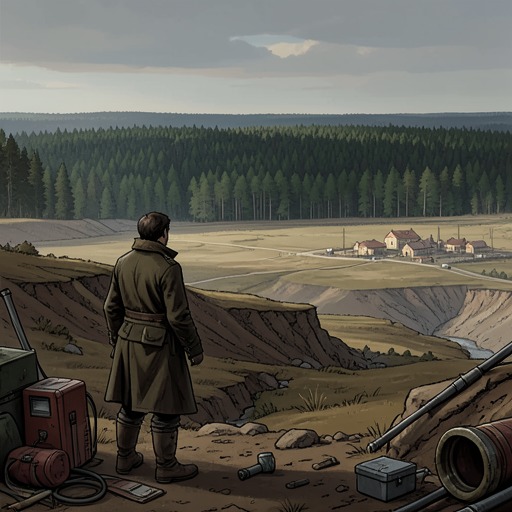
The cave is located by a distinctive group of three boulders, which Yadaka describes to Molly as resembling giant emu eggs. Danny later repeats the route: head north-east, keep to the right at the Great Waterhole, then left at a bald patch, and continue to the three boulders. These landmarks turn a remote destination into a practical route the family can follow without Yadaka beside them.
The cave is associated with supplies and with people expected in spring. Danny remembers that promise as part of the information Yadaka gave Molly: the destination offers immediate material support, but its fuller promise is company and community after the winter. The seasonal detail matters. Yadaka has explained that his people come down from the mountains and travel north when the first valley mist appears, seeking warmer conditions; his continuing presence near the cave is not for lack of trying to leave. The refuge is therefore part of a wider pattern of seasonal movement rather than an isolated shelter detached from the lives of a people.
A refuge against colonial danger
The cave’s importance is sharpened by the danger beyond it. Ngarigo people and neighbouring nations face land seizure, fences, displacement from homelands, and restrictions on seasonal movement. Settler authorities permit the shooting or dispersal of Aboriginal people, while the language of development presents that violence as a condition for establishing a town. Under those conditions, a place where Molly’s family might survive beyond the reach of immediate pursuit carries both practical and political weight.
Yadaka articulates the racial basis of his own persecution by explaining that his crime is simply being Black. Molly understands that Aboriginal people in the district are blamed, arrested, imprisoned, moved on, or shot. She also fears that if he goes to town seeking a reward, troopers will come to her home. The cave’s promise is thus set against a landscape in which both Yadaka’s freedom and Molly’s ability to protect her children are constrained by colonial authority.
That threat becomes concrete when Miss Shirley classifies Molly’s children as “Octaroon” and urges the judge to authorize their removal. The judge signs the order on the stated grounds of their safety. Later, Nate reflects on Molly’s trial: an all-male jury hears a case shaped by the declaration of her mixed heritage, while Danny, the only witness to her truth, is absent. The cave offers a route away from a system that threatens to divide the family, though the text does not present the destination as a guarantee of safety.
The journey and its cost
When Molly and the children leave Everton, she conceals them beneath a horse blanket in the sulky and tells Danny to appear ill if anyone stops them. Danny supplies the directions Yadaka gave her, guiding the family toward the cave while they travel through town and out into the dark. The careful concealment and the need to pass back through Everton make clear that reaching the refuge depends on avoiding attention as well as knowing the route.
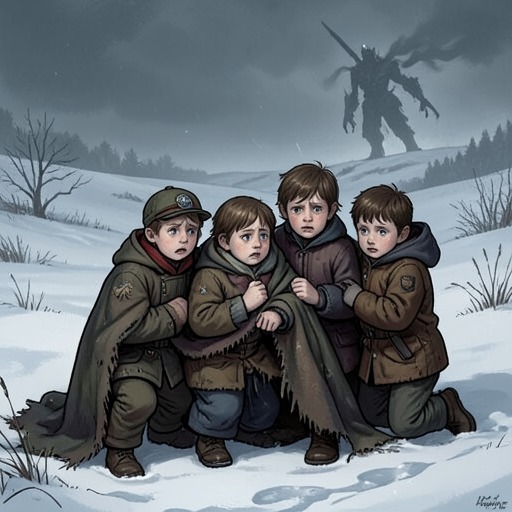
The journey through the mountains is severe. The children move through deep snow, exhausted and dangerously cold; Henry James falls, and Danny carries Delphi, whose condition leaves it uncertain whether she is asleep or dead. Danny searches for the three landmark boulders while bearing responsibility for getting his siblings to safety. The promised haven is therefore not an easy escape: the same mountain setting that can shelter a family also makes the approach physically perilous.
At last Danny sees the three boulders and recognizes that he has found the place. He points it out to his brothers, who respond with a child’s humor, wondering whether the formations look more like wombat droppings than emu eggs. Their exchange briefly restores a measure of playfulness after the strain of the crossing. The cave is just beyond the boulders, and Danny’s successful navigation fulfills the task he undertook for his mother.
Family, belonging, and narrative significance
For Molly, sending the children toward the cave means trusting Yadaka’s directions and the possibility of a community she cannot yet join them in. As they depart, she tells Danny to identify himself as Black Mary, a name by which the people there will know who he is. The instruction links the children’s immediate refuge to Molly’s own history and to the kinship and identity from which colonial society has separated them.
The narration frames the destination as a chance to survive without ceasing to be a family, and as a chance to discover who they are within a larger extended family. That hope remains qualified: the conditions may be harsh, and the arrival does not erase the violence that has driven them into the mountains. Yet the cave represents something the authorities’ removal order cannot offer—the prospect that the children will be received among their people and that, when spring brings people to the refuge, they may find care and belonging as well as shelter.