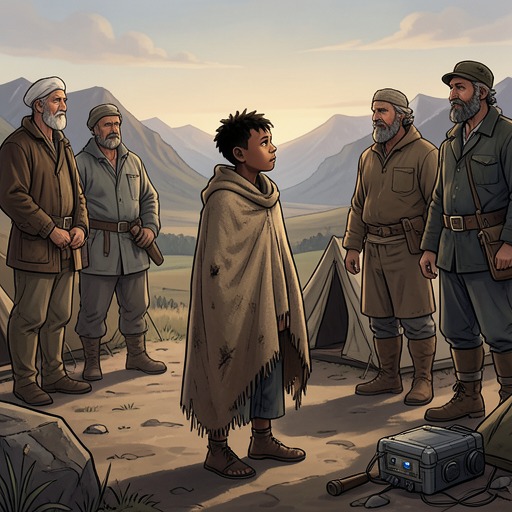
Yadaka’s family is ambushed and massacred
The Drover's WifeYadaka’s family is ambushed and massacred is the defining loss behind Yadaka’s long separation from home and his refusal to pursue payback. He tells Molly Johnson that his wife, children, and elders were killed in a planned attack: his family was driven into a river and fired upon from both banks. The disclosure brings Yadaka and Molly together through their shared grief, while situating private bereavement within the wider colonial violence and racialized coercion that endanger Aboriginal people and Molly’s children.
The attack and its aftermath
Yadaka recounts the massacre while splitting wood at Molly Johnson’s property. He begins with the moment he returned home and found his wife dead; remembering her, he describes her as beautiful and recalls her dancing. His account then widens to include his children and the old people of his community. The river, which should have offered a route to safety, became part of the attackers’ plan: reading the tracks, Yadaka understood that his family had been forced toward the water, where its slower movement left them exposed to gunfire from both banks. He calls the assault calculated and murder, not an accidental consequence of conflict.
The killing did not end with the immediate loss of his family. Yadaka says his tribe put him out because he would not go with them for payback. He judged retaliation futile in a changed balance of power, with too many white people and too many guns. His refusal therefore carries two connected consequences: he does not join a retaliatory action, and he loses the protection and belonging of his community. The family massacre is not presented as an isolated tragedy that he can leave behind, but as the event from which his prolonged exile and vulnerability follow.
Disclosure to Molly Johnson
The story emerges during a brief pause in physical work. Yadaka has been staying at Molly’s property only a short time, and she listens as he turns his memory into a story. His recollection of his wife is intimate and affectionate; when he explains the killings, the telling becomes a disclosure of both the attack and its cost. He has not felt safe enough to share the story with anyone before. Speaking to Molly marks a change in their relationship, as he risks entrusting her with a grief he has kept private.
Molly responds without disputing or minimizing what he tells her. She knows the brutality and injustice directed at Aboriginal people, but the scale of Yadaka’s loss leaves her without words. She eventually expresses sorrow for his loss, and the two connect through grief for loved ones and children. The significance of the exchange lies not in a solution to his trauma, but in the recognition he receives: Molly listens, acknowledges the loss, and treats his account as something deserving of care.
Colonial danger and racialized authority
Yadaka’s family’s fate belongs to a world in which violence against Aboriginal people is reinforced by official and unofficial coercion. Earlier, while explaining why he fears being returned to authorities, Yadaka describes his only crime as existing while black. Molly understands the treatment he means: Aboriginal people are blamed, arrested, imprisoned, or driven away, while white people have unofficial permission to shoot them on sight. Her understanding gives context to Yadaka’s fear and to his judgment that armed retaliation would achieve little.
The threat extends from Yadaka to the next generation. When Miss Shirley labels Molly’s children octaroons and asks Judge Eisenmangher to intervene, the judge signs an authorization for their removal. Danny Johnson later tells Molly what the children have been called; she recognizes the word as connected to the racial classification used against her when she was a child. She understands that the order threatens to separate her family. Molly burns the removal paper, rejecting the authority that has classified her children and declared their removal necessary. The episode does not equate her children’s threatened removal with Yadaka’s family’s massacre; instead, it shows distinct forms of coercion within the same racialized system, with family and community continuity placed at risk.
Memory, kinship, and the novel’s framing
Yadaka’s account changes the meaning of his separation from home. He has been away for almost twenty-three years and wonders whether the place he remembers, or any family and way of life there, still exists. His uncertainty follows from both the massacre and the wider development that has transformed Aboriginal people’s access to home and Country. The story thus makes return more complicated than a journey: the place to which he might travel may no longer offer the life or kinship he lost.
The novel also places this fictional history in conversation with the author’s account of family history, research, and oral stories from elders. The author explains that government policy prevented her mother and grandparents from passing on their culture, and that listening to elders helped her piece together history and find a spiritual foundation. This framing underscores the stakes of Yadaka’s act of telling: violence damages families and communities, while the transmission and reception of stories preserve knowledge that official accounts may leave out. His disclosure to Molly is therefore both a personal movement toward trust and part of the novel’s larger concern with memory, kinship, and cultural continuity.