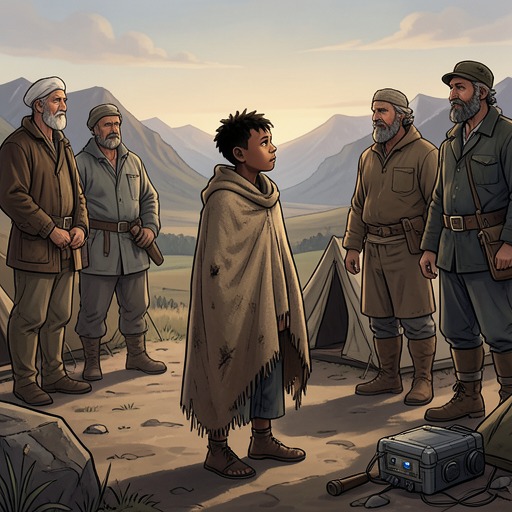
Yadaka’s winter cave
The Drover's WifeYadaka’s winter cave is a refuge in the mountains that Yadaka offers as a destination for the coming winter and a possible path back to community for Molly and her children. Its importance lies not only in its shelter but in what it promises beyond the season: food, blankets, and, in spring, people he calls their people. The cave turns an invitation into a practical route, then becomes the goal toward which the children struggle through life-threatening snow.
A winter refuge and a seasonal route
Yadaka describes the cave while explaining the seasonal movement of his people. When the first mist rises in the valleys, they leave the mountain and head north for winter so their feet will not grow cold. Danny points out that the first mist has already come and asks why Yadaka is still there. Yadaka answers that leaving has not been for lack of trying, connecting the cave and its seasonal journey to his delayed escape and difficult circumstances.
The cave is north-east of Molly’s property, a two-and-a-half-day walk away. Yadaka gives Molly a sequence of landmarks rather than an abstract direction: she must reach the Great Waterhole and keep to the right, then find a bald patch like a perfect circle and keep to its left. Beyond that are three large boulders shaped like emu eggs; the cave lies just past them. These instructions make the refuge legible through close attention to Country, where water, cleared-looking ground, and distinctive stones serve as a navigational map.
Shelter, sustenance, and belonging
Yadaka describes what awaits there in concrete terms: food, blankets, and shelter. The offer answers the immediate hardships of travel and winter, but its promise extends beyond physical survival. In spring, he says, there will be people—Molly’s people. The cave is therefore presented as a seasonal refuge connected to kinship and belonging, rather than as an isolated hiding place.
That invitation carries particular weight because Molly has lived apart from the family Yadaka names. He tells her that Ginny May is her family and her children’s family, and gives her the choice to follow him. He does not claim that she has accepted: after he says he will be at the cave, silence comes from inside the shanty. Molly’s eventual response is indirect. As Yadaka starts away, she asks him to take Joe’s boots for his safety; the exchange offers practical care without resolving whether she will join him.
The cave as an ordeal’s destination
The cave’s directions return with force when Danny and his siblings cross the snow-covered mountains. Exhausted and frighteningly cold, the children are dwarfed by the landscape. Danny carries a frostbitten Delphi on his back, her eyes closed beneath tiny icicles, while Henry James falls in the deep snow and Joe Junior helps him up. The route to the cave has become a test of whether the children can keep moving and protect one another.
At the circular bald patch Yadaka described, Danny searches from boulder to boulder for the three stones shaped like emu eggs. Though he has reached the right kind of landmark, he cannot find the precise formation. The directions that made the cave seem reachable now sharpen the uncertainty of the children’s predicament: they are close enough to recognize the place, but still without the final marker that would lead them to shelter. The cave’s narrative significance rests in that tension between a carefully offered route and the peril of following it through winter.