Event 1
The Clintoffs’ emigration to Australia
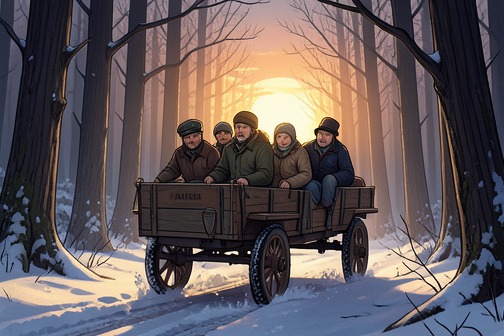
[The Clintoffs’ emigration to Australia](entity:event-recall-event-the-clintoffs-emigratio-8593c6f9062f) is the family’s passage from [London](entity:location-recall-location-1bfd335cdd1b) to [Melbourne](entity:location-recall-location-c8e23ab07219) and onward toward the [New South Wales](entity:location-recall-location-1a8c72f5c6af) highlands, where Nate is to serve as the new keeper of the peace in [Everton](entity:location-recall-location-3506ce81dd30). The move is both a personal wager and a narrative threshold: Louisa leaves familiar family and domestic life for a country she has never seen, while the journey places the Clintoffs on a path toward the novel’s frontier conflicts and the Johnson family’s story.
## Causes and Decision
The departure takes place during a global economic depression, a circumstance Louisa’s father considers reason enough to question the move. Louisa nevertheless sees [Australia](entity:location-recall-location-29432536e761) as an opportunity. The [Victorian government](entity:organization-recall-organization-08f96a0b4e90) guarantees the family’s safe passage, and Nate is eager to find a career beyond administrative work for the [British Army](entity:organization-recall-organization-british-army-26b1d8de3be5). For Louisa, the decision is consistent with her self-image as an adventurer and risk-taker, though excitement does not cancel her fear of what lies ahead.
The move also has a defined professional destination. Everton, in the alpine country of New South Wales, was formerly an outpost called Cresthill. Nate is to become the newly formed town’s keeper of the peace, a role Louisa imagines as a chance to uphold the law and help establish a town. Thinking of Everton as his town gives her a renewed sense of purpose and makes the long journey more than a change of residence: it is the beginning of a new public life for the family.
## Leaving London
Before dawn, Louisa wakes excited and frightened. Her husband and young son, Samuel, are still asleep; Samuel’s cot and room have already been packed for what Louisa’s mother calls the Big Move. Their housemaid, Clara, has finished working for the family and has cried during their farewells. The departure therefore involves more than trunks and transport: Louisa is leaving familiar domestic arrangements and people whose presence has helped structure her daily life.
After breakfast and preparations, the family sets off by horse-drawn carriage through London toward Portsmouth, about sixty miles away. They travel without saying goodbye to Louisa’s parents, having decided against a formal send-off to keep things calm for Samuel and to avoid adding to Louisa’s anxiety. Louisa’s account catches an unexpected lightness in the city that morning: the streets seem less forbidding, and passersby appear unusually cheerful. The altered impression belongs to the charged moment of departure, when anticipation changes how she sees the place she is leaving.
The carriage is delayed by an overturned cart, an injured person, and produce scattered across the street. Rather than wait for the road to clear, the family takes an alternative route because their ship will depart on schedule. The practical urgency of the journey is sharpened by Louisa’s awareness that delay could make them miss the voyage. Her excitement is therefore inseparable from the timetable and the family’s dependence on a long, carefully organized chain of transport.
## The Voyage
The family travels first class aboard the SS Aberdeen, whose departure is treated as fixed whether they reach the port in time or not. Nate explains that it is a single-screw, triple-expansion steamship, capable of twelve knots and carrying up to 695 passengers. Refurbished in 1892, the ship is a major practical reassurance, though Louisa’s account also records how little she understands of its technical description. She follows the proposed route on a map: down Africa’s west coast, around the Cape of Good Hope, east toward Australia, and onward to Melbourne. With favourable winds, the direct voyage is expected to take about eight weeks; the family has also been warned of rough waters, particularly in Bass Strait.
The passage is uneventful in its larger course, but demanding in its day-to-day care. Louisa spends much of it settling Samuel and comforting Nate, who suffers seasickness for almost the entire journey before recovering. The family reaches Melbourne alive, having crossed the Southern Ocean and Bass Strait. Louisa describes the southern coastline as the most beautiful sight of the trip and treats arrival beneath the imagined edge of the world as a relief as well as a triumph: the family has made it to the land she and Nate had jokingly called down and under.
## Arrival and New Prospects
After landing, the Clintoffs stay in a Melbourne guesthouse for a week before continuing toward the New South Wales highlands. Louisa’s preparations extend beyond the crossing: provisions must be bought and sorted, the onward route planned, Nate briefed, and trunks checked. She takes an active role in managing these arrangements, while also caring for Samuel and anticipating Nate’s return with a requested trunk. The brief stay is a staging point between arrival in Australia and the more remote life awaiting them in Everton.
Melbourne offers Louisa an initial impression of the country through its parks and eucalyptus trees. She is struck by the greenery and by the trees’ beauty, while also learning about their danger to people seeking shelter beneath them. That mixture of attraction and caution echoes her wider response to the move: Australia is promising, but unfamiliar and not risk-free. Nate, meanwhile, seems invigorated by the air and by the prospect of organizing a new life; his leg is holding up as he continues physical therapy, and Samuel has energy to run in the parks.
Louisa also begins to consider the political and social possibilities of her new surroundings. She observes the wealth and loyalty to the monarchy among the women she meets in Melbourne, but finds some of them less engaged in politics and public causes than she had expected. Rather than treating this first impression as conclusive, she questions her own judgment and considers encouraging women of influence to support equal rights and a possible monthly women’s journal. The emigration thus opens a space for ambitions beyond Nate’s appointment: Louisa is already imagining ways to participate in Australian public life.
## Narrative Significance
The account of the crossing establishes a contrast between movement and uncertainty. The family has official support for its passage, first-class accommodation, and a clear destination, yet the journey depends on hurried decisions, physical endurance, and Louisa’s effort to contain her private fears. Her optimism is not presented as certainty; she acknowledges the possibility of failing to meet the demands placed on her while choosing to continue toward the future she and Nate have planned.
The relocation also brings the Clintoffs into contact with the novel’s wider colonial order. Later, Nate’s position as a peacekeeper will place him within the authority that responds to Molly Johnson and to [Yadaka](entity:character-recall-character-yadaka-ab02449e856b), a wanted Aboriginal man. The emigration is therefore not an isolated travel episode: it establishes the household, appointment, and geography from which those later encounters become possible. The family’s new beginning carries both personal promise and a place within the systems of law and power that govern the frontier.
Event 2
The Edwards party’s assault on Ngarigo women
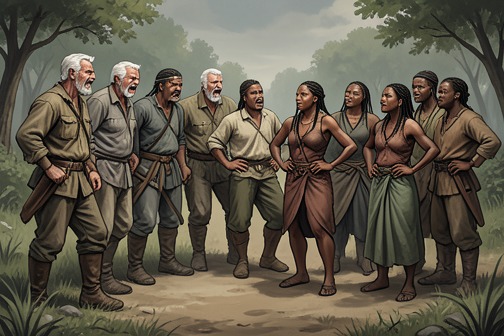
[The Edwards party’s assault on Ngarigo women](entity:event-recall-event-the-edwards-party-s-ass-c4fcbc15a02a) exposes the sexual violence beneath the settlers’ claims to authority on [Ngarigo](entity:organization-recall-organization-ngarigo-b672143f0280) [Country](entity:concept-recall-concept-country-e417da8c27f3). The assault provokes Ngarigo unrest and a call for punishment, but the perpetrators have already left; its consequences also shape [Waraganj](entity:character-recall-character-waraganj-9d63d5a20eaa)’s birth and the family history that later returns to the plot through [Black Mary](entity:character-recall-character-black-mary-ba7d9fc543ca)’s identity and the threat against Molly Johnson’s children.
## Background and unequal power
During the Edwards party’s stay in the area, the white men regard the Ngarigo as uncivilised, while the Ngarigo see the newcomers as ignorant of the land and its lore. The imbalance becomes more than a difference in outlook: the settlers use weapons and force to silence the women they assault. The episode thus makes the colonial encounter intimate as well as territorial, showing how the authority claimed by white men is exercised over Ngarigo women’s bodies.
The narrative places this violence within [Charles Edwards](entity:character-recall-character-charles-edwards-2d9b50fc22df)’s own conduct and family secrets. Charles knows that his youngest son, Neville, has previously harmed women and has paid to keep the consequences quiet. Charles himself assaults a young Aboriginal woman that night. His concealment of Neville’s conduct and his own violence links the household’s private impunity to the wider settler power that leaves Ngarigo women without recourse.
## Assault and the demand for justice
The assaults prompt an immediate response when a young Ngarigo warrior finds his wife distressed and learns what has happened. He summons other men, and the community holds council. They decide to confront the white men and demand punishment, treating the assault not as an isolated private wrong but as an offence requiring accountability. By the time they are ready to act, however, the white men have left. The demand for justice is therefore established at the moment the possibility of enforcing it has disappeared.
That absence of redress resonates later when [Yadaka](entity:character-recall-character-yadaka-ab02449e856b) explains to Molly Johnson that his only crime is being Black. Molly recognises the pattern: Aboriginal people in the district are blamed, arrested, imprisoned, or driven away, while white settlers have unofficial permission to shoot them on sight. Her warning that the mountains are dangerous and that troopers may come to her property makes the continuing risk concrete. The novel connects the earlier assault and failed confrontation to a broader system in which Aboriginal people face violence while colonial power determines whose actions count as crimes.
## Waraganj and the concealed consequence
Charles’s assault results in the pregnancy of the young woman, who is about fourteen and is [King Jimmy](entity:character-recall-character-king-jimmy-1067b20760a3)’s youngest promised wife. When the baby is born with fair skin and fine features, King Jimmy fears that she may not belong within the clan. The child’s mother leaves the newborn beneath her birthing tree, asking the ancestors to watch over her; survival will determine whether the girl is considered strong enough to be included. Waraganj’s exposure is thus a consequence of the assault, compounded by the racialized judgment imposed on a child conceived through violence.
Charles does not know that the young woman is King Jimmy’s promised wife, but the narrative does not let that ignorance erase his responsibility. The child’s uncertain standing and the mother’s forced separation from her newborn show how the effects of the assault extend into kinship and belonging. The family secret persists into the later story: [Miss Shirley](entity:character-recall-character-miss-shirley-29fbc349d68f) declares that Black Mary’s father was Charles Edwards, and uses the claim about her ancestry to characterize Molly Johnson’s children as needing removal. The historical violence is therefore carried forward not only through memory but through an official act that threatens another family’s separation.
## Narrative and political significance
The assault sits within a history of dispossession. As settlers take land, establish fences, and drive Aboriginal people from their homelands, Charles Edwards advocates developing the outpost of Cresthill and argues that Aboriginal people must be managed. The town’s eventual development and the Edwards family’s commercial influence unfold alongside that prior violence, making prosperity and settlement inseparable from the coercion on which colonial expansion depends.
The later economic pressures of droving and wool trading do not cancel that history. [Joe Johnson](entity:character-recall-character-joe-johnson-18bf90a2b2bb)’s work takes him away for months with large sheep drives, while the depression damages the sheep industry and local livelihoods; [Frank Edwards](entity:character-recall-character-frank-edwards-fe813961be12)’s wool business and [Everton](entity:location-recall-location-3506ce81dd30)’s development are also hit by the downturn. Against this material landscape, the assault remains a foundational injury rather than a closed episode: its perpetrators leave, the Ngarigo demand for punishment goes unanswered, and the resulting family history is later invoked by white authority to threaten the removal of Molly Johnson’s children.
Event 3
Waraganj’s birth and exposure
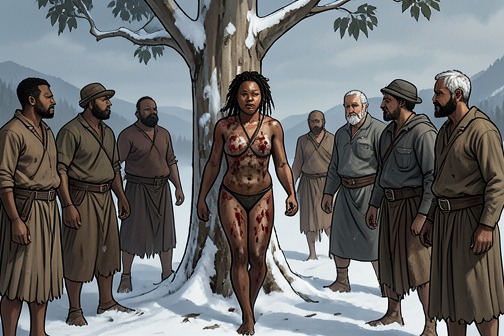
[Waraganj’s birth and exposure](entity:event-recall-event-waraganj-s-birth-and-ex-f6d2932706a1) mark the beginning of a life shaped by colonial violence, contested belonging, and the precarious place assigned to mixed-heritage children. Born after [Charles Edwards](entity:character-recall-character-charles-edwards-2d9b50fc22df) forced himself on her young Aboriginal mother, she is left beneath a snow gum overnight so that her survival can determine whether she is accepted into the clan. Her survival wins her a name and a place, but not lasting security: she and her mother are later banished before returning when her mother is pregnant by [King Jimmy](entity:character-recall-character-king-jimmy-1067b20760a3).
## Violence and the circumstances of her birth
Charles Edwards’s assault on [Waraganj](entity:character-recall-character-waraganj-9d63d5a20eaa)’s mother occurs amid other violence against [Ngarigo](entity:organization-recall-organization-ngarigo-b672143f0280) women by white men. The account makes clear that the young woman was about fourteen, was promised to King Jimmy, and did not choose to go with Charles. She became pregnant as a result. Her experience is part of a wider pattern that prompts Ngarigo men to seek punishment from the perpetrators, only to find that the white men have already left.
The child’s birth turns the violence inflicted on her mother into a question of the newborn’s place in the community. When the baby is born with fair skin and fine features, King Jimmy regards her as a possible bad omen and initially wants her killed. The narrative also distinguishes his suspicion of the child from his view of the mother: what the community has learned about white men’s treatment of Aboriginal women suggests that the young woman was not a willing participant.
## Exposure beneath the snow gum
The baby’s mother is left with no choice but to place her newborn beneath the tree where she was born. She asks the ancestors to watch over the girl and give her strength. Survival through the night is made the condition for the baby to be considered strong enough for inclusion in the clan, so the exposure is not simply abandonment: it is a perilous test conducted within a world where her kinship and safety are under pressure.
Before dawn, the mother returns and finds the baby alive. The girl is named Waraganj after the snow gum. That naming joins her life to the place of her birth, while her survival establishes the strength that the test was intended to determine. Yet this recognition does not end the dispute over her belonging.
## Banishment and return
Some members of the tribe, particularly King Jimmy’s other wives, blame the young mother for becoming pregnant by a pale-skinned intruder and consider her unfit. Mother and daughter are banished and live on the outskirts of the tribe for several years. Their exclusion shows that Waraganj’s survival alone cannot secure a lasting place: her status remains entangled with the circumstances of her conception and her mother’s position within the community.
The mother eventually returns while pregnant with King Jimmy’s child and demands a place beside him and his other wives. The tribe allows her and her two-year-old daughter back. Waraganj’s return therefore comes through her mother’s renewed claim to kinship, not through any resolution of the violence that preceded her birth. The episode establishes a pattern of conditional acceptance that helps explain why Waraganj later feels like an outsider even while she loves her family and belongs to its life.
## Narrative significance
Waraganj’s birth and exposure link personal identity to the consequences of colonial violence without reducing her to the circumstances of her conception. The snow gum gives her a name; her survival answers the immediate question of whether she is strong enough to be included. But subsequent banishment demonstrates how racialized difference can continue to place a child’s belonging in doubt, even after a community has accepted her back.
The episode also resonates with the novel’s later threat of child removal. [Miss Shirley](entity:character-recall-character-miss-shirley-29fbc349d68f) labels Molly Johnson’s children as octaroons, and [Judge Eisenmangher](entity:character-recall-character-judge-eisenmangher-12251c75ab87) authorizes their removal in the name of their safety. Molly recognizes the danger behind that classification and destroys the order. Waraganj’s infancy and the later threat to Molly’s children are distinct events, but together they show how adults and institutions claim power to decide where mixed-heritage children belong. The author’s note grounds the novel’s concern with cultural continuity in the author’s own account of government policy preventing her mother and grandparents from passing on their culture, as well as the work of recovering history through elders’ oral stories.
Event 4
Waraganj leaves her clan
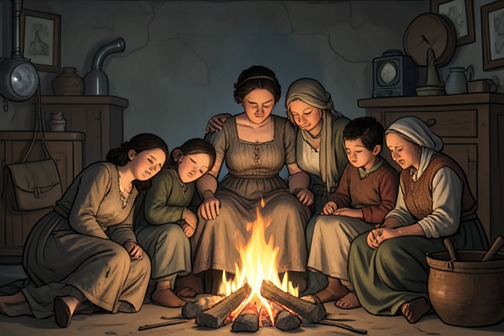
[Waraganj leaves her clan](entity:event-recall-event-waraganj-leaves-her-cla-78a650f0ee0d) rather than enter a marriage arranged for her, choosing a difficult, uncertain path away from the life her family and community had prepared. The departure is neither a simple escape nor a rejection of her mother: it is a decision shaped by a long-standing sense of difference, a dream that gives form to her resolve, and her mother’s painful willingness to let her go. Its consequences reach beyond the night itself, as her mother dies soon afterward and [Waraganj](entity:character-recall-character-waraganj-9d63d5a20eaa) never learns of that loss.
## The choice to leave
Waraganj had been promised to a man from a coastal clan. After sixteen winters, the time came for her to travel to his country. On the night before the journey, however, she served him a meal, sat with him during council with [King Jimmy](entity:character-recall-character-king-jimmy-1067b20760a3), and then spent time with her mother and younger siblings around the family fire. The household shared the younger children’s stories of the day, told through song and dance. When the others had gone to sleep, Waraganj asked her mother to stay with her a little longer. The quiet family gathering makes the impending separation intimate: she leaves not in anger after a quarrel, but after one final evening among those she loves.
Waraganj’s mother had once been banished with her as a baby, after King Jimmy’s other wives objected to the young mother’s child by a white man. Mother and daughter lived on the edge of the tribe for several years before Waraganj’s mother returned, pregnant with King Jimmy’s child, and was accepted back with her two-year-old daughter. Waraganj’s departure thus occurs within a history of precarious belonging, even though her mother and siblings love her. She is an accomplished dancer who makes her family proud and often makes them laugh at storytime, yet she also feels like an outsider. Other women taunt her for her mixed ancestry, and the narrative observes that her life within the tribe might have been different had King Jimmy been her biological father.
Her difference is not presented as a reason she lacks family ties. Rather, the history helps explain the pressure surrounding her place in the clan and the expectations attached to her future. She is due to join a husband in another clan, but chooses instead to leave the community that has offered her both kinship and protection. Her mother and siblings blame her rebelliousness on her “tainted blood,” while continuing to love her; the tension between that accusation and their affection marks the limits of any simple account of why she runs.
## The dream and her mother’s consent
Before explaining her decision, Waraganj tells her mother of a dream. She stands on a cliff in her promised husband’s country, with water below, and feels a new world weigh on her chest and make breathing difficult. Her mother reassures her that this feeling is normal, but Waraganj continues: in the dream she sees a path on the side where her heart lies, leading away from the cliff. It is narrow, close to the edge, rugged, and obstructed by large boulders, yet it stretches far into the distance.
Waraganj interprets the path as the one she must take. She tells her mother she will not go to the promised husband and must leave. The decision carries danger, and mother and daughter cry together, aware that refusing the marriage may cost Waraganj her life. Her mother does not try to override her choice. Instead, she promises not to raise the alarm until well after sunrise, granting her daughter time to depart unseen. That promise converts maternal understanding into practical protection, even as both know that it will end their life together as they have known it.
Their farewells affirm a bond that exceeds the immediate household. Waraganj’s mother tells her that her love is as ancient as the land and asks her to recognize it in the rustling treetops. Waraganj answers by describing her own love as lasting and strong, and credits her mother with giving her life, willing her to live, and standing by her. She says that her mother’s belief in her is part of what enables her to choose this path. Their exchange makes departure an act of self-determination grounded in, rather than severed from, maternal care.
## Departure and its immediate cost
As she prepares to leave, Waraganj’s mother repeats a familiar gesture: she steadies her daughter with a hand on her arm, touches her fist to Waraganj’s forehead, and blows through it. The words that accompany the gesture are recorded as “[Always with you](entity:expression-recall-expression-always-with-you-b18fef8dd22c).” Waraganj takes strength from this reassurance and slips away at night. There is no full moon, and the darkness helps conceal her pale skin. The scene links her departure to both an inherited practice of care and the practical need to avoid being seen.
Waraganj does not see her mother’s heartbreak as she goes. She never learns that three days later her mother is found dead beneath an old snow gum. The account presents the death as the outcome of grief, and the gap in Waraganj’s knowledge gives the separation an irreversible cost: the daughter leaves with her mother’s blessing, but cannot know that the parting will become permanent. The tree also recalls Waraganj’s birth, when she survived the night beneath a snow gum and was named for it. That recurrence connects the beginning and loss of the mother-daughter relationship through the same landscape.
## Colonial pressure and the meaning of movement
Waraganj’s story sits within a broader account of colonial expansion that constrains Indigenous movement. The [Ngarigo](entity:organization-recall-organization-ngarigo-b672143f0280) have ancient connections to their country and knowledge of its hidden tracks, but settlers arrive, take land, fence it, and drive Aboriginal people away. The narrative describes communities forced to live for survival and remain out of sight, under an unofficial policy that permits white men to shoot Aboriginal people on sight or disperse them. In this setting, leaving one’s community and moving through country are not neutral acts: access, safety, and belonging are increasingly threatened by settler power.
The contrast continues through the novel’s later storylines. [Yadaka](entity:character-recall-character-yadaka-ab02449e856b) longs to return to his land and mother’s country in Far North [Queensland](entity:location-recall-location-485892ef3322), and, after escaping from the Matthews household at twenty-five, travels north through the ranges toward a gathering of nations and clans. He describes his enduring urge to return to his people. Later, he gives Molly directions to a winter cave, describing a route by the Great Waterhole, a cleared circular patch, and three large boulders. Beyond the shelter and food, he promises the possibility of people and belonging in spring. These episodes echo the significance of Waraganj’s departure without making her journey identical to theirs: movement may be chosen in response to personal need, but colonial conditions make return to land and community increasingly precarious.
The story also follows the consequences of cultural disruption into a later generation. [Danny](entity:character-recall-character-danny-318bc697472f) and his brothers learn a men’s-business ceremony in the high country with their Ngarigo family, and their uncle passes it on quickly because he fears that modern ways are destroying practices the Ngarigo need for survival. The family’s return from the mountains follows the initiations of [Joe Junior](entity:character-recall-character-joe-junior-a8d521c74d3d) and [Henry James](entity:character-recall-character-henry-james-6211b5b63ac1). The ceremony’s continuation offers a counterpoint to the departures and losses in Waraganj’s history: separation can be devastating, yet kinship, cultural teaching, and connection to country endure through transmission. Waraganj’s flight is therefore both a personal refusal of an imposed future and part of a wider narrative about who can move, who can remain, and what it takes for family and culture to survive.
Event 5
The development of Everton
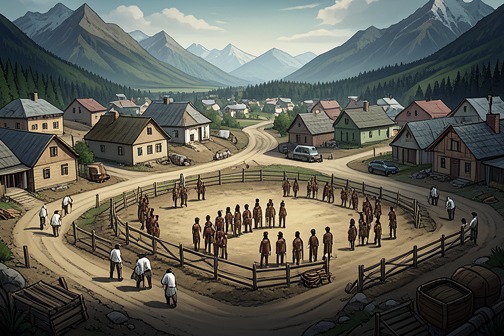
[The development of Everton](entity:event-recall-event-the-development-of-ever-35c94851e9cd) is a gradual process through which an alpine outpost becomes a planned town and stock-selling centre. Its beginnings are tied to district plans for removing Aboriginal people from their homelands; its later construction is financed by Edwards family wealth and organized around the pastoral economy. The same expansion that promises roads, services, and commerce thus carries a history of dispossession, while a worldwide economic depression puts the town’s unfinished future at risk.
## Plans for a Settler Town
As more white settlers arrived, the [Ngarigo](entity:organization-recall-organization-ngarigo-b672143f0280) and neighbouring nations faced fences, loss of land, and pressure to leave their homelands. The account describes a colonial policy that treated Aboriginal people as obstacles to settlement and sanctioned shooting them on sight or driving them away. Seasonal movement and residence on [Country](entity:concept-recall-concept-country-e417da8c27f3) became increasingly dangerous, while survival depended on staying out of view. This political climate forms the background to [Everton](entity:location-recall-location-3506ce81dd30)’s proposed development: the town is not introduced as a neutral project, but as part of a colonial effort to clear and claim land.
[Charles Edwards](entity:character-recall-character-charles-edwards-2d9b50fc22df) regularly attended district meetings and often led their discussions. He proposed that the outpost of Cresthill be marked for possible development, reasoning that the existing stock route and the arrival of more farmers and settlers could support a town. He also offered to help finance it, while insisting that Aboriginal people had to be managed. The proposed town therefore joins commercial calculation to coercive administration: the stock route offers a practical foundation for growth, and the proposed removal of Aboriginal people is treated by the meeting as a condition of that growth.
The district consensus was approved and implemented with haste. The account links the decision to the clans of the alpine country, whose ability to remain on and move through their homelands was directly threatened by the settlement programme. Everton’s development consequently begins before construction: it is first an agreement among settler authorities about who will control the district and who will be displaced.
## From Outpost to Stock Centre
Over the years, the Edwards family accumulated wealth and contributed to local development, gradually putting the plans for a town into effect. The settlement was initially to be named Evelyn, after the Edwards family matriarch. By then, the area had become a busy stock route and a destination for sales, drawing people from elsewhere on sale days. The need for a town was presented as practical, but turning that need into a functioning settlement took time.
Pastoral trade supplied the economic logic for the new centre. The district’s livestock routes brought drovers and stock to sale, and the town’s proposed infrastructure was designed in part to serve that traffic. The account also shows how the business of moving sheep shaped household circumstances beyond the town site: the economic depression severely affected sheep production, while droving and the sale of stock remained vital sources of work and income. Everton’s development is therefore connected to a wider chain of labour, livestock, and markets rather than to construction alone.
## The Edwards Fortune and the Depression
Two generations after [Black Mary](entity:character-recall-character-black-mary-ba7d9fc543ca) stood on the [Edwards property](entity:location-recall-location-edwards-0a92db959255), the family’s commercial position was carried forward by [Frank Neville Charles Edwards](entity:character-recall-character-frank-neville-charl-5193354e6319), the only son of Eleanor and Neville. Frank’s business, which sold local wool in [Melbourne](entity:location-recall-location-c8e23ab07219) to overseas markets, had increased the family fortune and helped keep other farmers and drovers employed and financed. But the worldwide economic depression was weakening that business. The Edwards family was also in difficulty, and the downturn affected the final stage of Everton’s development.
The town’s name changed during this later phase. The all-male council preferred Everton to Evelyn, considering the masculine name more appropriate. The local community, anxious that Frank might move his money elsewhere, wanted him to remain in the district; he and his wife, Ulla, had at one point discussed leaving. The naming decision and the dependence on Frank’s investment show that the emerging town was shaped both by local political authority and by the fortunes of a single family’s enterprise.
Frank had been educated in Melbourne and was more drawn to city life than to the high country, but he had promised his dying grandfather that he would complete Everton and keep the property prospering as he saw fit. Despite harder conditions, the property was doing reasonably well in the depression, and construction finally began. The account marks a new phase through the arrival of infrastructure: plans were drawn, work started, and draught horses hauled telegraph poles along the newly formed street. The growing settlement added a jailhouse, former troopers’ quarters, the [Stanlow Inn](entity:location-recall-location-stanlow-inn-d34ebef14031), a general store, and a postal house.
## The Saleyards and the Meaning of Expansion
Among Frank’s priorities was the construction of new saleyards, which he wanted named before the district’s next major sale day. He planned a public celebration for the first of the thousands of sheep expected to pass through the gates of the [Charles Edwards Saleyards](entity:location-recall-location-charles-edwards-sale-68c9dc5e410f). The project gathers the town’s economic purpose into a single piece of infrastructure: the stock route that had helped justify development now led into a purpose-built market bearing the Edwards name.
Everton’s progress is thus marked by both practical provision and concentrated power. Telegraph poles, a store, a postal house, and an inn make the settlement more connected and serviceable; the jailhouse and former troopers’ quarters also embody the authority through which the district was governed. Meanwhile, the proposed town arose amid the dispossession of the Ngarigo and neighbouring nations, whose access to Country and seasonal movement were being restricted. The development of Everton presents settlement not simply as a sequence of buildings, but as a reorganization of land, commerce, and authority whose costs fell unequally.
The depression leaves that process incomplete and uncertain. Frank’s wool business loses traction, local people fear the loss of his investment, and the final stage of construction remains exposed to wider economic conditions. Yet work proceeds, and the planned saleyards promise to connect the town more firmly to the pastoral trade. Everton’s emergence is therefore both an achievement of settler infrastructure and a record of the political and economic pressures that made such expansion possible.
Event 6
Waraganj is expelled from the Edwards homestead
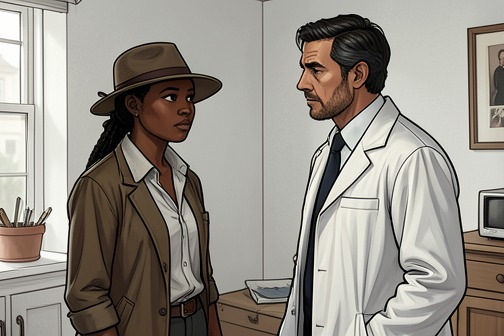
[Waraganj is expelled from the Edwards homestead](entity:event-recall-event-waraganj-is-expelled-fr-122197c71a7f) after [Charles Edwards](entity:character-recall-character-charles-edwards-2d9b50fc22df) recognizes that she may be the daughter he fathered during an earlier expedition into [Ngarigo](entity:organization-recall-organization-ngarigo-b672143f0280) country. His decision converts the settlers’ concealed violence into a new act of dispossession: the young woman who had found shelter and a place in the household is abruptly cast out by the man who may be her father. The episode also establishes the name [Black Mary](entity:character-recall-character-black-mary-ba7d9fc543ca), by which the district comes to know her, and foreshadows the racialized threat later directed at Molly Johnson and her children.
## Causes and Recognition
After nearly eight months away, Charles returns to the homestead. Florence and Eleanor describe [Waraganj](entity:character-recall-character-waraganj-9d63d5a20eaa) as a hardworking and capable helper who has become part of their household. Their welcome contrasts with Evelyn’s reserve: she has kept the young woman there until Charles returns, having recognized a resemblance that she had not disclosed to Florence.
Evelyn draws Charles aside. When he looks again at Waraganj, he sees that she resembles his younger daughter, Bertha. The resemblance recalls his earlier expedition with the Ngarigo, when he took a young woman at gunpoint. Charles understands that Waraganj may be the child conceived through that assault; her age and appearance reinforce his suspicion. The recognition is a turning point, but it does not lead him to acknowledge her as kin or take responsibility for her. Instead, his mother’s reaction and his own knowledge make the household’s hospitality collapse.
## Expulsion from the Homestead
The next day Charles orders Waraganj to leave. Eleanor and Waraganj embrace and cry, while Evelyn and Charles disapprove; Florence is stunned by her husband’s severity, but he has the final say. The contrast between the women’s grief and Charles’s command makes clear that Waraganj’s place in the home depends not on her labor or the ties she has formed, but on the authority of the man who controls the property.
Charles personally marches her down the track and out through the gates. During the expulsion, her small carved wombat falls from her bundle. She retrieves the treasured object, and Charles drives her onward, warning her never to return. The keepsake is the only possession singled out in the scene: amid the abrupt severing of her household ties, it remains something she can gather up and carry away. Waraganj leaves quickly and does not look back.
## From Waraganj to Black Mary
The district comes to know Waraganj as Black Mary, a name attached to the rejection that has cut her off from the Edwards household. She also becomes known as the whitest gin around, and as a woman of striking beauty, sharp wit, and a feisty nature. White men call her an untamed filly and desire her; the narrative presents her intelligence and bravado as qualities that help her survive in a society that has already marked her by race and denied her security.
The name Black Mary carries a lasting irony. Charles has recognized the possibility of his own paternity, yet expels Waraganj rather than publicly claim her. The resemblance to Bertha exposes the family connection to him, but it does not secure Waraganj a place within the family. Her subsequent reputation is formed outside the gates, among people who know her by a name that records racial difference while obscuring the paternal history Charles refuses to face.
## Colonial Power and Later Echoes
The expulsion takes place against the wider dispossession of the Ngarigo and neighboring peoples. Settlers fence land and drive Aboriginal people from their homelands; official and local power treats their movement and survival as subject to white authority. Charles is not only a father who rejects a possible child: he is a wealthy settler whose family has helped establish itself on Indigenous land. His authority over the homestead gives immediate force to a rejection that echoes the larger colonial removal of people from [Country](entity:concept-recall-concept-country-e417da8c27f3).
The event’s pattern recurs in the later threat against Molly Johnson’s family. [Miss Shirley](entity:character-recall-character-miss-shirley-29fbc349d68f) presents Molly’s children as removable on the basis of their mixed heritage, and [Judge Eisenmangher](entity:character-recall-character-judge-eisenmangher-12251c75ab87) authorizes their removal under the language of safety. When [Danny](entity:character-recall-character-danny-318bc697472f) reports that the children have been called octaroons, Molly recognizes the danger; she later burns the authorization. These later events do not make Waraganj’s expulsion identical to a state order, but they connect the episodes through the power of racial classification to define who belongs and to separate children from maternal or Indigenous family ties.
The novel’s author’s note situates its fictional world within a broader history of cultural loss under government policy, while describing research and listening to elders’ oral stories as ways of recovering that history. In this context, Waraganj’s expulsion is both a decisive personal rupture and part of the novel’s account of colonial power: a possible family bond is subordinated to a settler household’s authority, while Waraganj’s survival and later identity unfold beyond the home that rejects her.
Event 7
Molly’s assault by the stockmen
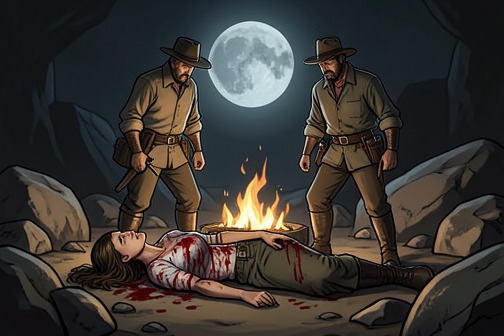
[Molly’s assault by the stockmen](entity:event-recall-event-molly-s-assault-by-the-6cfa816d2406) opens the novel’s action with a collision between colonial frontier violence and a mother’s determination to protect her children. At her isolated two-room shanty in the [Snowy Mountains](entity:location-recall-location-snowy-mountains-272412481a74), two stockmen beat and threaten her while restraining an unconscious man. Though injured and outnumbered, Molly intervenes on his behalf; the attack leaves her unconscious, but does not extinguish her resolve to survive for her children.
## Setting and Immediate Circumstances
The scene is dated late May [1893](entity:time-recall-time-1893-90c32dac9dd0), a few hours before midnight. Molly lies badly beaten in the yard of her home, trying to regain enough strength to decide what to do. Her first consideration is survival: she has children to live for and knows she is no match for the two men. The narration makes her isolation part of the danger. The mountain range may echo her anger, but there is no one nearby to hear or care about her opinion.
The moonlight lays bare a sparse, enclosed homestead: boulders behind the hut, white sallees at its perimeter, and a fire pit beside an old log. Beyond a woodheap, a snow gum stands apart, its curved trunk likened to a woman’s form. Someone watches the assault unseen from behind it. The tree’s sentinel-like presence contrasts with the absence of any visible protection for Molly, while the hidden witness establishes that the violence is observed even as Molly appears abandoned.
## Molly Intervenes
The men are not merely passing through: one has tied the legs of an unconscious man behind the log, while the red-bearded stockman drinks from the water barrel Molly and her children fill by carrying water from the Murrumbidgee. Molly’s instinctive concern for the captive competes with her awareness that she must protect herself and remain alive for her children. Her vulnerability is sharpened by the ordinary resources of the homestead being used around her: the water gathered for her family becomes the assailant’s drink, and the yard’s firewood and chopping block become the setting for the confrontation.
Molly picks up an axe and tries to drive the stockmen away. The younger man flees, but the older man raises his shotgun and threatens to shoot her. When he calls her a disgrace for risking her life for the unconscious stranger, Molly does not put down the axe. She strikes the chopping block instead, then retreats as the two men aim their weapons. Her effort fails to disarm or defeat them, but it makes clear that she will not willingly abandon the captive.
## The Assault and Its Stakes
The older stockman grabs Molly and strikes her until she falls. As she pleads for her children, the younger man approaches her where she lies on the ground. The narration moves from the immediate attack into Molly’s fading consciousness, briefly turning toward a remembered image of her five-year-old daughter and a crown of wild daisies. That intrusion of family life into the scene gives concrete form to what is at stake: Molly’s fear is not only of injury or death, but of being taken from her children.
The episode also recalls the pressures surrounding her life before the attack. About a month earlier, Molly was eight months pregnant, washing clothes by the river while [Danny](entity:character-recall-character-danny-318bc697472f), [Joe Junior](entity:character-recall-character-joe-junior-a8d521c74d3d), [Henry James](entity:character-recall-character-henry-james-6211b5b63ac1), and [Delphi](entity:character-recall-character-delphi-94e35d8e8dc9) were nearby. The brief domestic scene shows her managing the children’s arguments and the demands of daily life in difficult weather. Set against the opening assault, it underscores how the danger at the shanty threatens an already precarious family life, rather than interrupting a secure one.
## Consequences and Narrative Significance
The attack does not resolve into Molly’s death. Later, when Molly goes into labor in the mountains, she encounters the same injured man who was present during the assault. In the course of that emergency, she recognizes the risk of accepting his help but ultimately frees him by breaking the iron collar from his neck. She reasons that he had helped with her stillborn daughter and had essentially saved her life; she also needs assistance while recovering from the difficult birth. Her decision to release him gives the earlier confrontation a consequence beyond the immediate violence: the man she defended becomes someone she chooses to trust, despite the danger that his presence may bring.
The assault’s central conflict returns in the novel’s later flight. Molly and Danny ride away beneath the full moon, carrying supplies; [Joe’s boots](entity:object-recall-object-250854122637) are tied to Molly’s duffel, and Danny holds the killing spear [Yadaka](entity:character-recall-character-yadaka-ab02449e856b) gave him. The scene’s opening image of Molly struggling to stay alive for her children thus resonates with a later, deliberate escape. The stockmen’s violence establishes the vulnerability of a woman isolated on the frontier, while Molly’s interventions and eventual flight show her repeatedly acting within that danger to protect her family and determine what happens next.
Event 8
The mountain flood
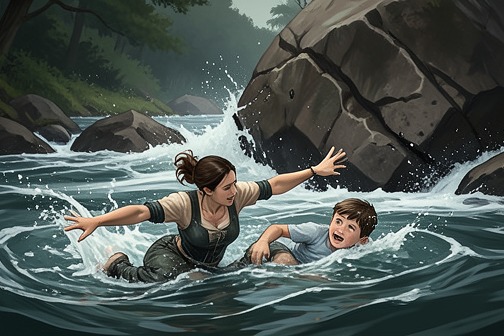
[The mountain flood](entity:event-recall-event-the-mountain-flood-878742bbba43) is a life-threatening disaster in which rising water separates Molly from [Danny](entity:character-recall-character-danny-318bc697472f) and puts her unborn child and the other children at risk. Its turning point is double: Molly is swept under while trying to reach her son, then finds the will to fight back to the surface; Danny, carried downstream on a broken tree, survives the boulder that threatened to crush him. The episode makes the river an immediate force of separation, but also shows the family’s survival depending on both Molly’s determination and the children’s ability to endure what they cannot control.
## Causes and Setting
After weeks of heavy rain, floodwater rushes down from farther north into the river beside the family’s resting place. The rise is difficult to read at first: [Delphi](entity:character-recall-character-delphi-94e35d8e8dc9) is absorbed in making mud cakes, while her rag doll lies near the water’s edge. The mud begins to wriggle beneath her hands, and then the doll is swept away as the current grows stronger. Those small changes are the first signs that the river has become dangerous.
A rumble and the sound of cracking and tearing wake Molly. In the swollen river she sees a boulder more than six feet high rolling with the flood, breaking through whatever lies in its path. The children are on boulders in the water’s course. [Joe Junior](entity:character-recall-character-joe-junior-a8d521c74d3d) recognizes how quickly the flood has crept up, but Molly immediately understands that they must get off the rocks and onto the bank. Her practical knowledge of the danger gives the children a clear instruction; the rising water leaves little time to act.
## Separation and Rescue Attempt
Once the children are on the bank, Molly realizes Danny is missing. The brown water obscures him until the others point him out: he is clinging by his fingertips to a boulder, with [Delphi’s rag doll](entity:object-recall-object-delphi-s-rag-doll-cf44cc3105fe) held in his mouth. A fallen tree caught between rocks has so far kept him from being swept away. That precarious refuge is also in the path of the massive boulder, which is moving toward him and sending turbulent water ahead of it.
Molly’s panic gives way to action. She calls to Danny to hold on, then plunges into the fast-moving river. She loses her footing and the current carries her under. At the same time, the boulder strikes the submerged debris. The impact breaks the tree apart and frees Danny, who is carried downstream with it instead of being crushed. The event separates mother and son at the very moment each is in danger: Molly cannot reach Danny, and the other children can only watch from the bank.
## Molly Beneath the Water
Underwater, Molly loses her sense of direction and struggles to reach the surface. Debris presses against her as she tries to protect her pregnant belly. A branch catches her dress and holds her fast; struggling only tightens the fabric around it. As she loses the ability to keep herself from breathing in water, her thoughts return to her children, especially Danny.
At that point Molly sees a fair-skinned Aboriginal woman with red hair and dark eyes. The woman appears calm and, through her gaze, urges Molly to fight and live. Molly reaches toward her just as the branch holding her dress breaks. The current carries Molly away, and the woman disappears; only a small piece of material remains visible in the water. The account presents the encounter as a vision within Molly’s near-drowning, not as a rescue by another person. Its consequence is immediate: Molly keeps struggling to live for her children.
## Aftermath and Significance
That night the children wait in the shanty beneath a wooden plaque bearing the family name, JOHNSON. Molly and Danny lie pale beside one another on a homemade stretcher-bed, while Delphi asks whether they will wake. Joe Junior reassures her that they are resting after a bad day. Molly eventually stirs and puts an arm over Danny, holding her eldest close; both have survived the flood, though the children’s anxious watch shows how uncertain their condition had seemed.
Survival does not end the family’s hardship. The cupboards and food boxes are nearly empty: only a little flour remains, and there are no vegetables or meat. The flood therefore leaves more than immediate danger behind; it returns the children to the material conditions of hunger and dependence that shape their lives. The scene also belongs to a wider landscape where movement and survival are closely tied to seasonal conditions. Later, [Yadaka](entity:character-recall-character-yadaka-ab02449e856b) explains that his people leave the mountain for the north when the first mist appears in the valleys, a seasonal journey intended to keep their feet warm. Against that knowledge of moving with the land, the flood marks a violent interruption: the river’s sudden rise sweeps Molly and Danny away from one another, and the family can only wait to learn who has survived.
Event 9
The Clintoffs’ river accident
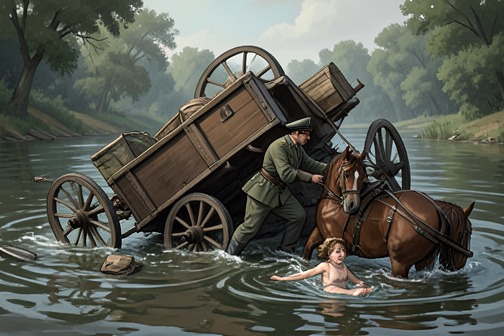
[The Clintoffs’ river accident](entity:event-recall-event-the-clintoffs-river-acc-cad2042d8e91) is a flood crossing that transforms the family’s journey to [Everton](entity:location-recall-location-3506ce81dd30) into an immediate fight for survival. Sergeant [Nate Clintoff](entity:character-recall-character-nate-clintoff-7adc2f6a84ce)’s misjudgment of a swollen river sweeps away their wagon and most of their possessions, forcing him and Louisa to risk separation in the current while protecting their son Samuel. The family survives, but the ordeal leaves Louisa coughing and apparently feverish; its aftermath brings them to [Molly Johnson’s shanty](entity:location-recall-location-molly-johnson-s-shan-862e2f9409bd), where rescue and wary hospitality meet.
## Causes and Circumstances
A few weeks before the family reaches Everton, Nate and Louisa attempt to cross a swollen river with Samuel, their horses, and the covered wagon. Nate is not a man of the land and misjudges the current’s pull. The horses cannot overcome both the rushing water and the wagon’s weight, and the whole party is swept away. The accident is not a sudden misfortune detached from the journey: it exposes the danger of reading a powerful river incorrectly while traveling with a loaded vehicle and family in tow.
The current carries the wagon and horses as Nate tries to keep the team attached for as long as possible. He hopes that either the wagon or the horses will reach a sandbank or snag on a branch. Instead, a wheel strikes something and abruptly stops the wagon. Nate jumps into the water, holds on, and works his way to the rear flap. Inside, Louisa sits waist-deep among their floating belongings, clinging to Samuel, who is too frightened to do anything but hold on to her.
## Nate’s Rescue Plan
Nate pulls himself into the wagon and embraces Louisa and Samuel, kissing their brows as he tries to comfort them, though he doubts the actions he is about to take. His plan depends on separating the family’s progress from the wagon. Louisa tears fabric from her petticoats and knots it into a sling so Samuel can ride high on Nate’s back. She then strips to her undergarments, following Nate’s instruction so that the weight of her wet dress and petticoats will not drag her under.
The three enter the cold, raging water. The current forces them against the wagon cover, and they make their way carefully toward the horses at its front. Nate tells Louisa to grip one horse’s mane, let the animal find ground, and float with the current rather than fight it. Her horrified expression registers the danger of trusting the plan, but she nods. Nate kisses her and promises to find her and that she will be fine. His assurance is an act of love and resolve, not proof that he can control where the flood will carry them.
## Separation and Survival
To free Louisa, Nate reaches underwater and pulls the leather harness straps from the first horse. The animal drifts away with the current, carrying Louisa as she clings to its wet mane. She looks back at Nate and Samuel, aware that this may be their last sight of one another, but forces a brave smile so that he will not be haunted by fear on her face. Nate watches her turn toward the river’s danger and tighten her grip, positioning herself higher in the water.
Nate releases the second and third horses so that Louisa will not get too far ahead. Holding firmly to the fourth horse with Samuel secured on his back, he cuts the leather strap and frees that animal from the wagon. The flood carries it away. The rescue therefore hinges on surrendering the family’s transport and possessions, and on entrusting each other to the current rather than remaining together in the stranded wagon. The scene’s central reversal is from the wagon as a means of travel and shelter to a perilous obstacle the family must leave behind.
## Aftermath and Narrative Significance
The novel later frames the accident as a memory prompted by the water marks on the covered wagon, the mud and debris still caught in its wheel spokes, and the physical exhaustion of the journey from [Melbourne](entity:location-recall-location-c8e23ab07219) to Everton. In the remembered scene, a small cry from inside the wagon interrupts Nate’s recollection: Samuel springs into his father’s arms, and Nate helps Louisa out. The family has come through the crossing alive, though Louisa rubs her aching body, coughs, and hugs herself as a fever seems to be coming on.
On dry ground, Louisa sees Molly Johnson’s shanty and realizes Nate has found help. They kiss, share a smile at being alive, and approach together, breathing in the smell of Molly’s roast lunch. Their arrival is not simply a safe ending to the river ordeal. Molly waits on the verandah with her [Cowles & Dunn shotgun](entity:object-recall-object-cowles-dunn-shotgun-674efad0de3a) beside her; her children watch through gaps in the wooden walls, and visitors have more often been foes than friends. The accident thus carries the Clintoffs from environmental danger into a socially charged encounter, where their need for assistance meets Molly’s hard-earned caution.
The crossing also belongs to the novel’s larger pattern of human movement shaped by water, weather, and unequal knowledge of the land. Molly’s children later face a separate flood as a boulder over six feet high rolls through the swollen river, and [Yadaka](entity:character-recall-character-yadaka-ab02449e856b) describes the seasonal journey from the mountains northward when the first mist rises in the valleys. These distinct episodes place the Clintoffs’ accident within a world where rivers and seasons govern mobility, but do not make every traveler equally prepared: Nate’s misjudgment nearly costs his family their lives, while survival depends on quick improvisation, cooperation, and the willingness to abandon what the current has made dangerous.
Event 10
The Clintoffs meet Molly Johnson
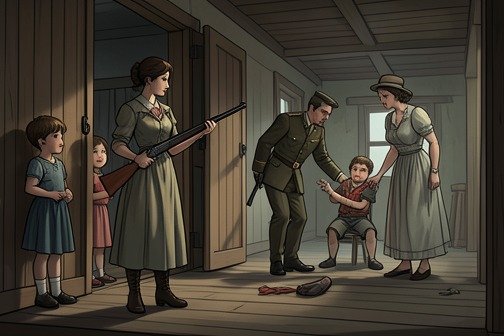
[The Clintoffs meet Molly Johnson](entity:event-recall-event-the-clintoffs-meet-moll-c40fde118b64) when a flood has left them stranded without provisions and seeking help on the way to [Everton](entity:location-recall-location-3506ce81dd30). The encounter begins as a test of danger: Molly watches from her verandah beside her shotgun, while Sergeant [Nate Clintoff](entity:character-recall-character-nate-clintoff-7adc2f6a84ce), his wife Louisa, and their young son Samuel approach cautiously. Its decisive turn comes not through official authority or persuasion alone, but through the children, whose easy contact prompts Molly to admit the travelers into her home.
## Arrival After the Flood
Nate and Louisa have survived a dangerous river crossing, and the covered wagon bears the waterline that confirms their account. Their provisions were lost in the flood, and they have not eaten for days. Once the family reaches dry ground, they smell Molly’s cooking and approach her shanty, where she waits on the verandah with her [Cowles & Dunn shotgun](entity:object-recall-object-cowles-dunn-shotgun-674efad0de3a) at her side. Her four children watch from inside through gaps in the wooden walls.
Molly is accustomed to visitors being potential foes, not friends. She and her children keep to themselves, following the guarded rule she associates with her father: “No one’s business but ours; we are all the family we need.” With only two bullets left, she has reason to measure the strangers rather than welcome them. She notes that the Clintoffs appear to be city people without guns, and that Louisa’s presence, Nate’s injury, and the family’s travel-worn condition may make them less dangerous. These observations do not erase her suspicion; they give her grounds to keep listening.
## A Negotiation at the Woodheap
When the travelers reach the woodheap, Nate calls hello. Molly raises her gun and demands that they state their business. Nate identifies himself as Sergeant Nate Clintoff, introduces Louisa and Samuel, and admits that the smell of Molly’s roast has drawn them over. His bluntness embarrasses Louisa, who apologizes for him and explains that they have been traveling for nine and a half weeks, from [London](entity:location-recall-location-1bfd335cdd1b) by way of [Melbourne](entity:location-recall-location-c8e23ab07219), and lost their food in the river crossing.
Louisa asks whether the family may share a meal, offering to take a single plate and not intrude at Molly’s table. Nate’s remark that they can see Molly does not have much makes matters worse: Molly responds defensively that her family manages. The exchange reveals the tension between need and dignity. The Clintoffs are genuinely hungry, but Molly is not obliged to treat their hardship as a claim on her household. She holds the conversation on her own terms, taking time before asking whether they are bound for Everton. Their confirmation gives her a practical reason to consider letting them in, without making her caution disappear.
## The Children Change the Encounter
While the adults negotiate, Samuel reaches the verandah and pokes at a hole and the gaps between the wooden slats. Laughter comes from inside. He tries again, and Molly’s four children rush out to join him. Samuel is delighted, and Louisa responds warmly to the children, telling Molly how blessed she is. In the presence of the children, the strangers are no longer only hungry travelers at the edge of Molly’s property: they have become a family her children are already meeting on their own terms.
Molly squares her shoulders and smiles for the first time in the encounter. She motions the Clintoffs inside, ending the standoff with an act of hospitality that remains her choice. The shift is small but consequential: a household organized around privacy and watchfulness makes room for another family after the travelers’ need has been established and the children have crossed the boundary between them.
## An Encounter Reframed by Later Events
The meeting takes place within a wider world of hardship and unequal power. The economic depression has struck the sheep industry, tightening household resources and threatening work connected to droving. The Clintoffs’ journey, Molly’s guarded self-reliance, and their shared reliance on family all take shape amid this material insecurity, though the meeting itself is not a resolution to those pressures.
Later developments make the first visit more precarious in retrospect. [Yadaka](entity:character-recall-character-yadaka-ab02449e856b) explains that his only crime is existing while Black, in a region where Aboriginal people face arrest, displacement, and the threat of being shot. Nate’s station plans for Molly to be checked on, but the check may be delayed by two days, exposing the limits of official concern for her welfare. Later still, [Miss Shirley](entity:character-recall-character-miss-shirley-29fbc349d68f) labels Molly’s children as mixed-heritage children in need of removal, and a judge authorizes their removal. Those events do not change what happens at the shanty: the Clintoffs arrive as flood-stranded travelers, Molly tests their account, and she lets them in. They do show how a moment of chosen hospitality sits beside systems capable of treating Molly’s family not as a household to respect, but as a problem to manage.
Event 11
Molly sends her children to Everton
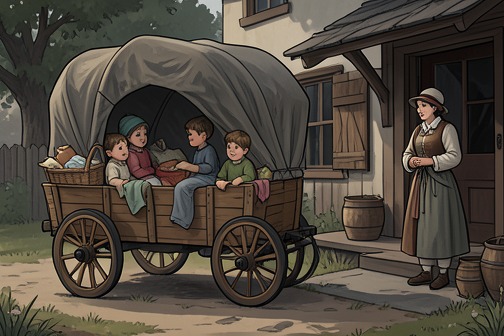
[Molly sends her children to Everton](entity:event-recall-event-molly-sends-her-childre-38f280e87a43) with Nate and [Louisa Clintoff](entity:character-recall-character-louisa-clintoff-3db7831651e8), entrusting them with a practical errand and a temporary home while she remains behind, heavily pregnant. The departure is at once an act of maternal care and a painful separation; the journey also carries the children into reach of authorities who will seek to remove them from her.
## Arranging the Journey
The opportunity comes as Louisa is about to leave Molly’s shanty. Molly sets aside the possibility of friendship and quickly asks for a favour: a ride to [Everton](entity:location-recall-location-3506ce81dd30) for the children. She is delighted that a way to town has finally opened, and notes that luck has lately seemed to turn in her direction. The immediate reason for the trip is practical, but the arrangement depends on the trust developing between the two women and on Nate and Louisa’s willingness to help.
The children wait in the covered wagon with small parcels of clothes and food for the journey. Molly adds meat for them to trade, having first offered some to the Clintoffs for their trouble; she insists when they refuse, because she does not want it to spoil. The supplies show that the children are not being sent away empty-handed: Molly has planned for their needs and for the exchanges they will have to make in town.
## A Mother’s Instructions and Farewell
Before the wagon leaves, Molly gathers her children for kisses, embraces, and last-minute tidying. She clears gravy from [Joe Junior](entity:character-recall-character-joe-junior-a8d521c74d3d)’s mouth and smooths [Henry James](entity:character-recall-character-henry-james-6211b5b63ac1)’s unruly hair with spit on her fingertips. [Delphi](entity:character-recall-character-delphi-94e35d8e8dc9) clings to her for an especially long moment. It is Delphi’s first time away from her mother. She is upset, but the adventure ahead—and the prospect of returning to a new baby—helps balance her sadness.
Molly tells the children that she loves them and reminds them to mind their manners at the McGuinnesses’ residence. She performs a small parting ritual: a clenched fist to each child’s forehead, a breath released through it, and the words, “[Always with you](entity:expression-recall-expression-always-with-you-b18fef8dd22c).” Nate and Louisa watch, puzzled. The gesture gives the farewell a meaning beyond the practical journey: Molly makes their physical separation answerable to a promise of continued closeness.
She draws [Danny](entity:character-recall-character-danny-318bc697472f) aside and gives him responsibility for his younger siblings and for the trade. He is to exchange the meat for fresh vegetables, obtain a donkey or horse but not an old one, collect other supplies, and remember that ammunition is running low. Molly puts a written list in his shirt pocket. Her instructions make Danny an active caretaker and messenger, not simply another child in the wagon. Nate hears her say that her husband will bring supplies, but lets the matter pass without question.
Molly encourages Danny to get cakes and sweets from [Miss Shirley](entity:character-recall-character-miss-shirley-29fbc349d68f), recalling the comfort her own father used to offer when he left her with Miss Shirley while he went droving. Then she tells him to come straight home because she will need help. Molly’s pregnancy makes that instruction urgent: Danny is apprehensive about the coming birth, which will be his first delivery. When Delphi was born, he had already taken his younger brothers to stay at the McGuinnesses’ and brought them home safely the following week. Molly has told him that, because of her age, she needs him with her at the birth.
As the wagon pulls away, the children wave and call their goodbyes. Louisa looks back with a gracious smile; Molly answers with a nod, then calls out another reminder not to fight. She watches the wagon disappear along the barely visible track. Her emotions rise, then give way to pronounced relief. She needs time alone before the baby comes, and the departure gives her that space, though the narrative also signals that her relief has another, unstated dimension. The mountains remain ahead of the travelling children, while Molly’s home recedes behind them.
## The Journey and Its Reversal
On the road, Danny looks back towards home, worried about his mother, even as his siblings talk excitedly with Louisa. She tells them about travelling by ship from [London](entity:location-recall-location-1bfd335cdd1b) to [Melbourne](entity:location-recall-location-c8e23ab07219); the younger children are enthralled, and Danny is quietly interested too. His backward glances register the tension built into the trip: the children are curious about a wider world, but their connection to their mother and home remains immediate.
The errand’s temporary separation becomes a much more serious threat when Miss Shirley tells [Judge Eisenmangher](entity:character-recall-character-judge-eisenmangher-12251c75ab87) that Molly is harbouring a wanted Aboriginal man and labels the children “Octaroon.” The judge signs a letter authorizing their removal, supposedly for their safety. Danny hears the decision and is frightened, unable to understand where the children would be taken or why anyone would separate them from their mother. The official language of protection conceals the force of the decision: a label imposed on the children becomes the basis for overriding their family ties.
When Danny returns to Molly, he tells her that Miss Shirley called the children “octaroons” before the judge. The word recalls Molly’s own childhood: at eight, she overheard Miss Shirley discussing the possibility of sending her away because of her mixed ancestry. Molly recognizes that the same racialized classification now threatens her children. What began as a journey to obtain supplies and stay with trusted adults has exposed them to a system capable of turning a family’s identity into grounds for separation.
## Consequences and Significance
After learning of the order, Molly leaves with Danny to protect the children and confront the threat. She brings her shotgun, ties [Joe’s boots](entity:object-recall-object-250854122637) to her duffel bag, and rides a trooper’s horse; Danny carries supplies and the killing spear [Yadaka](entity:character-recall-character-yadaka-ab02449e856b) gave him. Later, the two return to the McGuinnesses’ residence, where Molly binds Miss Shirley and [Father McGuinness](entity:character-recall-character-father-mcguinness-5eebb18b4a3a), takes provisions for the journey, and burns the judge’s authorization. She then gathers the children into a wagon and leaves with them. The journey that began with Molly entrusting her children to others ends with her taking them away from the people who were meant to shelter them.
The episode contrasts two kinds of care. Molly’s care is concrete and relational: food for the road, detailed instructions, affection, and a promise that she remains with the children even when apart. The judge’s order calls removal protection, but it proceeds from racial classification and disregards the children’s bond with their mother. The temporary trip to Everton therefore changes the direction of the plot: an ordinary family errand becomes the point at which bureaucratic authority threatens the family’s survival together.
Event 12
Yadaka’s flight from the authorities
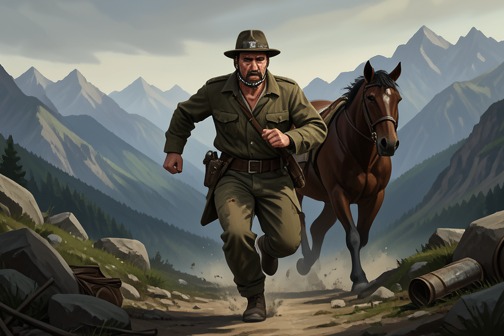
[Yadaka’s flight from the authorities](entity:event-recall-event-yadaka-s-flight-from-th-99a7e853c8c0) is both a physical escape and an attempt to return to his mother’s country after a life shaped by colonial custody and persecution. The episode follows him across the mountain range as he tries to reach [Guugu Yimithirr](entity:organization-recall-organization-guugu-yimithirr-cdac5b91809e) country, despite the danger of his injuries and the pursuit of the authorities. Its immediate encounter with [Frank Edwards](entity:character-recall-character-frank-edwards-fe813961be12) turns the journey into a confrontation, but [Yadaka](entity:character-recall-character-yadaka-ab02449e856b) survives the meeting and continues north. The flight also establishes the conditions under which he later seeks shelter from Molly Johnson: he is not simply a stranger passing through the bush, but a wanted man trying to make his way home.
## Escape and the journey home
Yadaka is introduced on the track to [Everton](entity:location-recall-location-3506ce81dd30) after days of running. He is about forty, athletic, and seriously injured; an iron collar around his neck and the convict clothing marked Government property indicate that he has been in custody. The collar is more than a sign of his immediate predicament: it makes visible the authority from which he is fleeing and the injuries and deprivation that have accompanied his escape.
His intended route gives the flight a destination beyond mere survival. He hopes to clear the southern range, join the Great Dividing Range, and head north toward Guugu Yimithirr country, his mother’s country. The journey will take months, but he is willing to undertake it to return to [Country](entity:concept-recall-concept-country-e417da8c27f3). His determination to go home persists even though he is exhausted, has not eaten for days, and carries a wound that has become dangerously infected.
## The encounter with Frank Edwards
Before Yadaka can steady himself on the track, Frank Edwards arrives on horseback. Frank sees the collar, Yadaka’s blackness, and his bloodstained clothes, then accuses him of murdering Frank’s wife and children and reaches for his pistol. Yadaka responds by throwing debris into Frank’s face and retreating into the snow gums. The encounter is brief, but it places Yadaka in immediate danger from a man who treats his appearance and custody status as evidence of guilt.
Frank follows cautiously, then becomes disoriented when a crow flies up behind him. He turns with his pistol raised but does not shoot the bird. He retreats to his horse, repeats his accusation, and rides toward Everton. Yadaka is left alive and temporarily beyond Frank’s reach. The episode does not resolve Frank’s charge; it records the accusation as part of the pursuit Yadaka must escape while continuing his journey.
## Colonial persecution and the cost of flight
Once Frank has gone, Yadaka reflects on a life without peace and on the danger Aboriginal people face in a society that hunts, massacres, imprisons, and disperses them. He has learned to read by examining diaries and journals left open by the people he has worked for and by officials who arrested him. Those records reveal the gap between colonial authority’s written accounts and the life of the man it has confined: Yadaka can read what his captors do not expect him to understand.
His brief despair grows from the immediate cost of escape and from the wider racial violence surrounding it. Pain, hunger, fear, and the possibility that his next breath might be his last lead him to close his eyes and address death. The crow’s call then draws his attention back. He recognizes the bird as his grandmother and answers that he is coming. The moment connects his flight to ancestral kinship, without removing the physical danger he faces.
## Flight’s continuation and narrative consequence
Yadaka gets up and runs again, putting distance between himself and Frank’s encounter because stopping could mean death. The flight is therefore not a completed escape but a continuing effort: home remains months away, and his infected wound and exhaustion remain unresolved. His movement north brings him into the narrative circumstances of his later meeting with Molly Johnson, where he exchanges kindness for shelter and tells her a truth that helps her imagine another path.
The episode also gives context to the danger that follows him into Molly’s life. In Everton, Yadaka is described as a wanted Aboriginal man, and officials consider checking on Molly while planning how a search party might move through the area. Later, [Miss Shirley](entity:character-recall-character-miss-shirley-29fbc349d68f) invokes the accusation that Molly is harbouring a wanted murderer when she urges the removal of Molly’s children; the judge authorizes their removal, and Molly ultimately burns the order. Thus the pursuit reaches beyond Yadaka himself: the presumption of his guilt becomes part of the pressure placed on Molly and her family.
## Significance
The flight binds a personal journey home to the novel’s account of colonial power. Yadaka is at once a fugitive from custody and a person seeking return to his mother’s country, while the iron collar and the authorities’ pursuit expose how the law structures his movement and danger. His encounter with Frank shows how quickly suspicion becomes a threat of armed violence; his reflection on written records reveals that he can also read and understand the systems that record, arrest, and condemn him.
The crow’s appearance offers a different relation to the journey: where the colonial world marks Yadaka as a prisoner and fugitive, he recognizes an ancestral connection. His decision to rise and keep moving does not erase the hardship or promise a safe return. It sustains the journey that carries him toward Molly, making his flight a turning point in the connected stories of his survival and her family’s exposure to racialized authority.
Event 13
The murder of the Edwards family
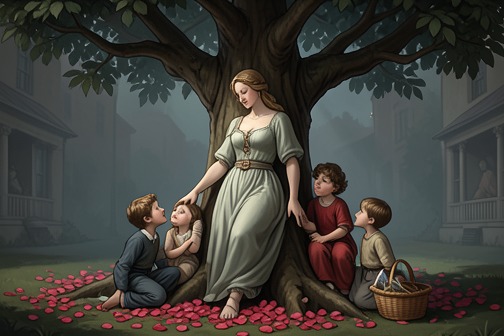
[The murder of the Edwards family](entity:event-recall-event-the-murder-of-the-edwar-e26452899220) is the violent discovery that turns a family’s absence into a public accusation. When [Frank Edwards](entity:character-recall-character-frank-edwards-fe813961be12) returns from [Melbourne](entity:location-recall-location-c8e23ab07219), he finds his wife and three children dead beneath a tree, arranged with rose petals around them. Nearby, he encounters the wounded fugitive [Yadaka](entity:character-recall-character-yadaka-ab02449e856b) and immediately blames him. The scene binds private grief to the novel’s wider climate of colonial suspicion, while leaving the accusation distinct from proof.
## Discovery at the [Edwards property](entity:location-recall-location-edwards-0a92db959255)
Frank returns to the Edwards property expecting his children to race down the track and greet him. Instead, the house is silent. He initially mistakes the still family beneath a tree for a picnic, calling to Ulla and the children; as he approaches and recognizes what has happened, the illusion collapses. His wife and three children are dead, their bodies arranged around the tree with rose petals scattered nearby. The little basket Leaellynn had used to collect the petals lies close at hand. The scene’s careful arrangement contrasts with the family’s absence of life, making the discovery at once intimate and bewildering.
Frank drops to his knees, then runs to his horse and rides toward town for help. His response establishes the immediate consequence of the killings: a bereaved father becomes the first accuser, and his grief drives the story into a confrontation with someone already marked as dangerous by the authorities.
## The accusation against Yadaka
On the track near the property, Yadaka is trying to continue north toward [Guugu Yimithirr](entity:organization-recall-organization-guugu-yimithirr-cdac5b91809e) country, his mother’s country. He has been running for days, has not had time to eat, and is carrying a serious wound. When Frank arrives, Yadaka is exhausted and in pain. Frank sees his dark skin, the iron collar around his neck, and his bloodstained clothing, then reaches for his pistol and accuses him of murdering the family. The encounter establishes the accusation as Frank’s immediate conclusion, not as a demonstrated account of who killed the Edwardses.
Yadaka throws debris into Frank’s face and retreats into the trees. Frank follows only tentatively, then becomes disoriented and returns to his horse. He rides toward [Everton](entity:location-recall-location-3506ce81dd30) still insisting that Yadaka killed his family and will be hanged. His certainty, formed in the shock of discovery and reinforced by Yadaka’s appearance and custody marks, gives the murder an unresolved dimension: the person blamed is also a pursued man seeking to reach home.
## Suspicion and the wider climate of danger
The encounter grows out of a landscape in which accusation can carry consequences before evidence is established. Yadaka’s iron collar and government-issued clothing mark him as a man who has been in custody; his own account is that his only crime is existing while Black. Molly Johnson recognizes the larger pattern behind his remark: Aboriginal people in the district are blamed, imprisoned, or driven away, while whites have unofficial permission to shoot them on sight. Frank’s readiness to interpret Yadaka’s appearance as proof therefore belongs to a wider colonial order in which racialized suspicion makes the fugitive immediately legible as a culprit.
That order also turns the killings into an urgent threat beyond Frank’s grief. Sergeant [Nate Clintoff](entity:character-recall-character-nate-clintoff-7adc2f6a84ce) notes that a check on Molly Johnson may take two days even if troopers leave their outpost immediately, and that official responsibility for her welfare would then be considered over. The delay matters because the search for the Edwards family’s killer intersects with Yadaka’s flight and with the danger faced by those sheltering him. The murder thus sets in motion not a simple pursuit supported by settled facts, but a conflict in which the state’s attention, its limits, and its assumptions shape who is exposed to danger.
## Frank’s grief and the turn toward accusation
The discovery leaves Frank Edwards with no immediate explanation, only the certainty that his family has been taken from him. He drops to his knees and sobs; his cries across the range shift into shouts of frustration and pain. Then he runs back to his horse and races to town for help. The movement from mourning to action carries the killings beyond the Edwards property: Frank’s loss becomes a public matter, and his response sends the search for help into motion.
The accusation takes shape almost at once. Nearby, Yadaka is trying to make his way north toward Guugu Yimithirr country, his mother’s country, after days of flight without food and while carrying a serious wound. When Frank confronts him, he sees a Black man, an iron collar, and bloodstained clothes, reaches for his pistol, and calls him the murderer. The novel presents this as Frank’s conclusion in the immediate aftermath of finding his family, not as proof of Yadaka’s responsibility for their deaths.
Yadaka throws debris into Frank’s face and escapes into the trees. Frank follows tentatively, then turns back and rides toward Everton, still declaring that Yadaka killed his family and will be hanged. The killing therefore produces not only grief but a pursuit founded, in the evidence presented here, on accusation. Yadaka’s flight and Frank’s certainty set the family’s deaths within a wider conflict over whose appearance and status are treated as evidence.
## Consequences and unresolved meaning
The murder’s consequences extend beyond the immediate pursuit. At the property, the killings leave Frank grieving without an explanation; on the track, his accusation turns Yadaka into a suspect before the account establishes any proof of responsibility. Yadaka’s flight continues toward his mother’s country, while the authorities’ concern for people exposed to danger is constrained by distance and delay: Sergeant Nate Clintoff is told that troopers cannot check on Molly Johnson for two days, and that their responsibility would then be considered over. The search for the killer thus unfolds alongside the vulnerability of those connected to Yadaka and the people who might shelter him.
Later, the case against Molly Johnson invokes the Edwards family’s deaths as part of a racialized argument about motive. In court, [Miss Shirley](entity:character-recall-character-miss-shirley-29fbc349d68f) labels Molly’s children as mixed-blood and urges their removal, while the Crown’s closing statement claims that Molly’s hostility toward the white men she killed was generational and had been encouraged by Yadaka. That account treats her heritage and her mother’s suffering as grounds for suspicion, rather than establishing the truth of the Edwards murders. The family’s deaths therefore remain consequential not only as the loss Frank discovers, but as an accusation repeatedly shaped by colonial assumptions about Aboriginal identity, criminality, and danger.
Event 14
Yadaka’s visit to Molly
[Yadaka’s visit to Molly](entity:event-recall-event-yadaka-s-visit-to-molly-ceedd468528a) Johnson is a brief refuge that changes what Molly and her son [Danny Johnson](entity:character-recall-character-danny-johnson-6e1010d05e9a) can understand about their lives. An Aboriginal man fleeing the authorities, [Yadaka](entity:character-recall-character-yadaka-ab02449e856b) finds shelter at Molly’s isolated homestead; in return, he offers practical help and stories. Their cautious meeting develops into mutual respect, and Yadaka reveals a truth about Molly’s Aboriginal heritage. The visit’s consequences reach beyond his short stay: [Danny](entity:character-recall-character-danny-318bc697472f) remembers it as a defining encounter, while the racialized threat surrounding Yadaka foreshadows the danger that will later gather around Molly and her children.
## Arrival and the terms of shelter
Yadaka comes to Molly as a fugitive from the authorities in a region where Aboriginal people face arrest, forced displacement, and the threat of being shot. Molly, already wary of the risks posed by strangers and of attracting the troopers, does not treat shelter as a simple act of hospitality. She warns that the mountains are troubled and fears that Yadaka might go to town for the reward, bringing the authorities to her doorstep. His need for time to rest and recover makes their exchange a negotiation: he asks for trust and offers useful work in return.
Yadaka proposes felling a tree, stacking the woodheap, and leveling the ground, giving Molly a practical reason to let him stay. The bargain takes place under pressure from the danger beyond the homestead as well as from Molly’s immediate responsibilities. Shelter offers Yadaka a brief interval away from pursuit, but his presence also risks drawing that pursuit toward her family.
## Racial violence and recognition
When Molly assumes that Yadaka must have done something wrong to be wearing an iron collar, he answers that his only crime is existing while black. His reply makes the injustice underlying his fugitive status explicit. Molly recognizes the treatment he describes: Aboriginal people in the district are blamed, arrested, imprisoned, or driven away, and white people have unofficial permission to shoot them on sight. The conversation shows how colonial violence shapes the choices of both visitor and host, even before either can know what the stay will bring.
The two initially approach one another with caution, but the encounter becomes more than a temporary exchange of labor for shelter. Around the fire, Yadaka and Danny share stories and lessons; over their short time together, the man and boy develop understanding and genuine respect. Yadaka also reveals the truth of Molly’s Aboriginal heritage, offering her a different way to understand herself and to imagine a path beyond the life imposed on her.
## The visit’s consequences
The visit is brief, and Yadaka’s intended direction is north, toward his mother’s [Country](entity:concept-recall-concept-country-e417da8c27f3). Its first full-moon night in the winter becomes momentous for more than one reason, marking the encounter as a turning point rather than a passing episode. The shelter Molly grants has immediate stakes: she must weigh compassion and the possibility of help against the prospect that a wanted man’s presence will bring troopers to her home.
That risk becomes more concrete when [Spencer Leslie](entity:character-recall-character-spencer-leslie-87d243fe305b) says Molly will be checked on, but that the troopers cannot reach her for two days, even if they leave their outpost immediately. The delay underscores the precariousness of the family’s isolation: official concern for Molly’s welfare is distant and conditional, while the presence of a fugitive could bring enforcement directly to her doorstep. The encounter thus joins personal trust to the broader racial and legal pressures of the frontier.
## Memory and later interpretation
Years later, [Danny’s notebook](entity:object-recall-object-danny-s-notebook-b35c673df08a) preserves the visit as part of the story of his mother. He recalls Molly as steadfast and loving, and Yadaka as noble, wise, and gentle; the account also makes clear that Yadaka was not Danny’s father. The remembered exchanges around the fire become a record of a bond built through stories, lessons, and mutual respect, not through kinship. Danny has kept these painful memories to himself, even from his grown siblings, and the act of writing gives the private past a form that can endure.
The visit also becomes entangled with the authorities’ later account of Molly. [Miss Shirley](entity:character-recall-character-miss-shirley-29fbc349d68f) labels the children with the racial classification “Octaroon” and urges their removal, and the judge authorizes that removal for their supposed safety. At Molly’s trial, the Crown presents her heritage and what Yadaka taught her as part of an argument that she was driven by inherited hatred and encouraged toward revenge. That prosecution account distorts the significance of the meeting: what Danny remembers as an exchange of stories and genuine respect is recast as evidence against his mother.
## Narrative significance
Yadaka’s visit brings together the story’s intersecting vulnerabilities: Molly is an isolated mother confronting gendered and legal dangers; Yadaka is a wanted Aboriginal man under threat from colonial authority; and Molly’s children become targets of racial classification and removal. The encounter briefly creates a relationship grounded in aid and recognition, but it cannot place either household beyond the reach of the law’s unequal power.
Its importance lies both in what Yadaka tells Molly and in what Danny later does with the memory. The revelation reshapes Molly’s sense of her heritage, while the shared stories make Yadaka a formative presence in Danny’s life. The visit’s meaning is contested after the fact: preserved privately by Danny as a story of respect and care, it is turned publicly into an accusation against Molly.
Event 15
1847 Ginginbarra attack
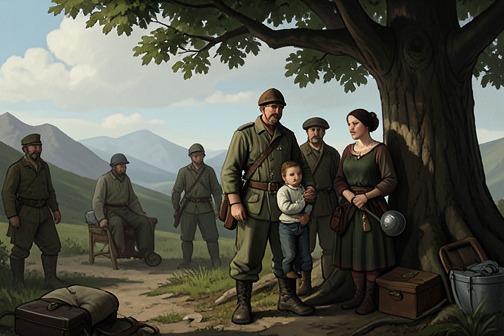
The [1847 Ginginbarra attack](entity:event-recall-event-1847-ginginbarra-663649621ccf) is a decisive episode in the history of frontier violence that shapes [Robert Parsen](entity:character-recall-character-robert-parsen-f0fc16d691be)’s life and echoes through the novel’s later conflicts. It begins with the killing of Parsen’s mother during an attack on the local Ginginbarra clan, and leads, two years later, to the thirteen-year-old joining a vigilante ambush at [Bingera](entity:location-recall-location-bingera-77e3603390d9). The episode links personal revenge to the wider colonial seizure of land and to the coercive institutions that later threaten Aboriginal families.
## Background and Escalating Conflict
In [1847](entity:time-recall-time-1847-1018ac72bf25), Robert Parsen’s family moved to [Maryborough](entity:location-recall-location-maryborough-00ee5ae58249), [Queensland](entity:location-recall-location-485892ef3322), with other colonial entrepreneurs seeking to establish a pastoral station. The move placed them amid the expansion of settler enterprise, but the immediate cause of Parsen’s personal involvement in the conflict was the brutal attack on the Ginginbarra clan: twenty-eight squatters were killed, and Parsen’s mother was among the casualties.
That loss becomes the stated background to Parsen’s later revenge. Two years after the attack, when he was thirteen, he joined Gregory Blaxland, then twenty-one, in leading a vigilante group of about fifty squatters and station hands. The narrative presents the reprisal as a direct response to the earlier deaths, while its scale and target make clear that retaliation falls on a much larger sleeping group rather than being limited to those responsible for the original attack.
## The Ambush at Bingera
At Bingera, Parsen and Blaxland’s party ambushed about a hundred sleeping people identified in the account as belonging to the Gin Gin tribe. The group’s size and the choice of a sleeping target establish the attack’s asymmetry: roughly fifty armed settlers and station hands struck a group twice as large while it was least prepared to respond. The episode is presented as an organized vigilante action, not as a confrontation between equally positioned forces.
The novel’s chronology makes Parsen both a bereaved child and a participant in collective violence. His mother’s death provides the personal context for his revenge, but does not erase the distinction between the earlier attack and the mass ambush that follows. The account thus locates the origin of Parsen’s hardness within a cycle in which grief is carried forward as violence against another Indigenous community.
## From Frontier Violence to Colonial Authority
The attack belongs to a broader settlement history in which pastoral expansion depends on access to land and the displacement of its Indigenous inhabitants. Elsewhere in the novel, [Ngarigo](entity:organization-recall-organization-ngarigo-b672143f0280) elders initially share knowledge of high-country tracks with the Edwards settlers, but settler meetings later discuss dispersing Aboriginal people so a town can be developed. This contrast places the Bingera ambush within a recurring pattern: Indigenous relationships with [Country](entity:concept-recall-concept-country-e417da8c27f3) are subordinated to the aims of settlement, pastoral wealth, and town-building.
The pattern also extends beyond armed attacks. When [Miss Shirley](entity:character-recall-character-miss-shirley-29fbc349d68f) labels Molly Johnson’s children octaroons and [Judge Eisenmangher](entity:character-recall-character-judge-eisenmangher-12251c75ab87) authorizes their removal, the threat is administered through classification and official paperwork rather than a vigilante party. Molly destroys the signed order and leaves with her children, resisting a system that claims to act for their safety while disregarding their family ties. The juxtaposition does not make the events identical; it shows how colonial power can operate through different means, from frontier violence to bureaucratic control over children.
## Consequences and Narrative Significance
The immediate personal consequence for Robert Parsen is the formation of a revenge history that precedes his later life as a drover. The novel records that he was among the leaders of the Bingera ambush, making his past part of the larger structure of colonial violence rather than presenting him only through his later friendships and work. His subsequent history is also marked by early loss and a harsh upbringing, but those circumstances explain his trajectory without resolving the moral weight of his participation.
The attack’s significance lies in the way the novel connects individual histories to a continuing struggle over land, kinship, and authority. Settler accounts of loss and revenge coexist with Indigenous dispossession and the loss of freedom to move with the seasons. In the later child-removal episode, the official language of protection repeats the imbalance of power in a new form: Aboriginal families face decisions imposed by outsiders who claim the right to define both their status and their future. Against that history, the novel’s attention to oral stories, elders, and cultural inheritance insists that violence does not extinguish Indigenous memory or belonging.
Event 16
1849年Bingera屠杀
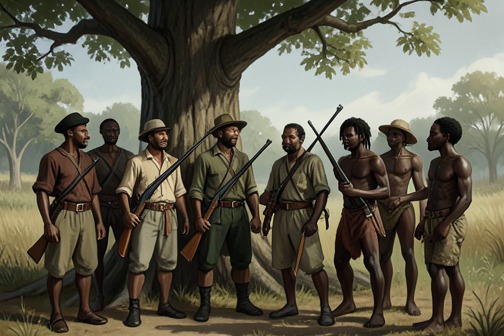
The 1849 [Bingera massacre](entity:action-recall-action-bingera-massacre-4aa0aecf8744) is a turning point in [Robert Parsen](entity:character-recall-character-robert-parsen-f0fc16d691be)’s life and a concentrated account of frontier reprisal: at thirteen, he joined Gregory Blaxland in leading a vigilante party against sleeping Gin Gin people. The attack does not settle the violence that preceded it. Instead, it converts personal grief into an enduring racial vendetta, while exposing the self-justifying logic by which colonial retaliation expands beyond its claimed cause.
## Background and motive
Two years before the massacre, Parsen’s family had moved to [Maryborough](entity:location-recall-location-maryborough-00ee5ae58249) with other colonial entrepreneurs seeking to establish a pastoral station. There Parsen witnessed an attack on the local Ginginbarra clan in which twenty-eight squatters were killed; his mother was among the casualties. Yet her death did not fit the simple account of revenge that Parsen would later maintain: she had been caught in crossfire and killed by a bullet from her own side. The discrepancy between the actual circumstances and his continuing blame of Aboriginal people is central to the event’s moral and narrative force.
Parsen’s family history had already linked colonial advancement to violence. His great-grandfather, an English convict transported to [Australia](entity:location-recall-location-29432536e761) on the First Fleet, had won his freedom and acquired land after killing three Aboriginal people during an attack on a captain. That inheritance forms a grim background to Parsen’s own choices, but the massacre is not presented as an inevitable consequence of ancestry. It is a specific act of reprisal, undertaken by a young man who has learned to treat violence as both a means of action and a reason to harden himself against grief.
## The attack at [Bingera](entity:location-recall-location-bingera-77e3603390d9)
In 1849, thirteen-year-old Parsen and twenty-one-year-old Gregory Blaxland headed a vigilante party of about fifty squatters and station hands. They went to Bingera and ambushed a group of roughly one hundred sleeping Gin Gin people. The party chose its opportunity deliberately: Parsen advised waiting until after a major gathering, when the people would be sleeping more soundly and waking later. Asked how he knew, he said he had slept out and seen it himself. His confident reply presents the attack not as a sudden clash but as an operation planned around knowledge of the intended victims’ circumstances.
Parsen had learned to handle a gun early and was a capable marksman despite his age. During the assault, he shot many people, including those trying to escape through the [Burnett River](entity:location-recall-location-burnett-river-a4aa4fb87925). The violence was indiscriminate. The imbalance between the assembled party and the sleeping group, and the attackers’ deliberate choice of timing, make the event a massacre rather than a fair confrontation. The narrative places Parsen’s youth beside the brutality of his actions without using his age to excuse them.
## Revenge and its aftermath
Parsen’s stated justification was that Aboriginal people had killed first and that the attack therefore followed from their violence. The story undercuts that rationale through the account of his mother’s death: she had been killed by a bullet from her own side, not by the people against whom he directed his vendetta. The revenge thus rests on a racialized attribution of collective guilt, not on the circumstances of the loss he invokes.
After the massacre, Parsen’s ruthlessness became fixed, and his hostility toward Aboriginal people was described as beyond repair. He continued to carry a vendetta over his mother’s death despite knowing that she had been caught in crossfire. He also cried for the last time during the episode, declaring that the violence would not have happened if Aboriginal people had not killed first. His response marks a personal change: grief is not resolved but shut down, and a claim of retaliation becomes the lasting principle through which he interprets violence.
The massacre belongs to a broader cycle rather than standing alone. The preceding attack on the Ginginbarra clan and the reprisal at Bingera are distinct events, but Parsen’s reasoning binds them into a sequence in which one act of violence is made to authorize another. The narrative’s attention to the mother’s accidental death interrupts that sequence’s apparent logic: the supposed cause of Parsen’s revenge does not support the blame he assigns.
## Later echoes: classification and removal
The novel returns to the consequences of colonial power in a different form when [Miss Shirley](entity:character-recall-character-miss-shirley-29fbc349d68f) invokes Molly Johnson’s Aboriginal ancestry and calls Molly’s children octaroons before [Judge Eisenmangher](entity:character-recall-character-judge-eisenmangher-12251c75ab87). The judge signs an authorization for their removal, framed as being for their safety. [Danny](entity:character-recall-character-danny-318bc697472f) hears the classification and fears separation from his mother; when he later tells Molly what Miss Shirley said, the word awakens Molly’s memory of an earlier threat to send her away as a child because of her mixed ancestry. She understands that the same racial classification now puts her own children at risk.
Molly responds by binding Miss Shirley and [Father McGuinness](entity:character-recall-character-father-mcguinness-5eebb18b4a3a), taking food and blankets for the children, and burning the signed order. The scene is not the same event as the Bingera massacre, but its proximity in the novel’s account of racial power sharpens the contrast between forms of coercion: the earlier vigilante attack enacts violence directly, while the later threat operates through official language, classification, and a judge’s signature. In both, Aboriginal lives and kinship are subjected to decisions made by colonial actors; in the later scene, Molly’s resistance prevents the authorized separation from taking effect.
## Narrative significance
The massacre establishes Parsen as more than a skilled drover with a violent disposition. It shows the formative event through which he converts personal loss into a durable racial grievance and learns to present retaliation as justice. The revelation that his mother was killed by a shot from her own side makes that conversion especially consequential: the story distinguishes the fact of his grief from the explanation he uses to sustain his hatred.
The episode also places private memory within a history of collective violence. Parsen remembers his mother, but his response falls upon a sleeping group and extends far beyond the circumstances of her death. The later child-removal episode echoes the same unequal authority in a bureaucratic register, where racial labels become grounds for separating children from their mother. Together, these episodes show how violence can persist both as armed reprisal and as an official claim to decide which families may remain together.
Event 17
Yadaka’s escape from custody and killing of two officers
[Yadaka’s escape from custody and killing of two officers](entity:event-recall-event-yadaka-e236c8912d2a) is framed as a desperate response to an arrest he believes unjust, exposing the danger of a colonial system in which he expects no fair hearing. The event links a mistaken accusation to his decision to resist capture, while a later telegram brings the deaths and his flight into the authorities’ account.
## Arrest and Accusation
[Spencer Leslie](entity:character-recall-character-spencer-leslie-87d243fe305b) tells [Yadaka](entity:character-recall-character-yadaka-ab02449e856b) that he is under arrest for the murder of Missus Edwards and her three children, as well as the murders of Trooper Phillips and [Native Police](entity:organization-recall-organization-native-police-fc0b9a521193) officer Dempsey Buckskin. The formal charge places Yadaka in the position of a suspect already associated with multiple deaths, even though the later narration states that he did not commit the Edwards murders.
## Escape and Its Immediate Cause
The narrative explains that Yadaka killed the other trooper and the Native Police officer while being arrested for a crime he had not committed. He had reached the limit of what he could endure in the treatment directed at him and his people. Believing that no trial would be held for him, he understood the situation as one in which he must either live or die, and chose to live by resisting the arrest.
## The Telegram and Official Knowledge
Three weeks after the deaths, Sergeant [Nate Clintoff](entity:character-recall-character-nate-clintoff-7adc2f6a84ce) reads a telegram reporting that a trooper and a Native Police officer have been found north of the Victorian border while transporting a Native prisoner. The telegram relays a Black Tracker’s report that the prisoner killed them and was wounded in the lower back. Nate is appalled and grips the message tightly: the distant report turns Yadaka’s escape into an urgent matter of official knowledge, while also recording the uncertainty and violence surrounding his condition.
## Consequences and Significance
The event grows directly out of the arrest and its underlying accusation, but its consequences deepen Yadaka’s danger: his attempt to survive makes him a fugitive sought by the authorities. The narration places his choice against the expectation that he would not receive a trial, so the escape is not presented as an isolated act of violence but as a response to a justice system he regards as denying him a chance to answer the charge. The closing question of whether survival was worth the cost leaves that choice unresolved, emphasizing the severe price attached to resisting an unjust arrest.
Event 18
Mary dies in childbirth
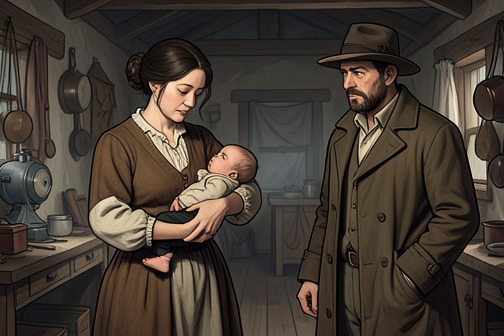
[Mary dies in childbirth](entity:event-recall-event-mary-6739d4c0a084) before the main action of the novel, but her death is not merely a piece of family background: it is the fact that connects Molly Johnson to an Aboriginal maternal line and makes her later identity legible. The circumstances of Mary’s death are recovered through [Yadaka](entity:character-recall-character-yadaka-ab02449e856b)’s account of what [Ginny May](entity:character-recall-character-ginny-may-a0225624dfa3) kept alive, turning a private loss into knowledge with consequences for Molly and her children.
## Identity and Circumstances
Mary is Molly Johnson’s mother. She dies giving birth to Molly, leaving Molly without a maternal relationship she can remember. As an adult, Molly tells Yadaka plainly that she did not know her mother and that Mary died during her birth. She describes a small family history shaped by absence: before her children, she had only her father, [Jock Stewart](entity:character-recall-character-jock-stewart-3b05d8af1786).
That absence has affected Molly’s life beyond grief for a person she never knew. Her father warned [Joe Johnson](entity:character-recall-character-joe-johnson-18bf90a2b2bb) that she had grown up without female influence and might need to learn what he considered women’s ways. Molly understands the consequence of that warning through her violent marriage: the knowledge Joe imposed on her was not maternal care, but abuse. The novel thus places Mary’s death at the start of a chain in which the loss of a mother leaves Molly vulnerable to others’ definitions of womanhood.
## The Birth and Its Witnesses
The novel does not stage Mary’s death as a scene. It reaches it through recollection and testimony, particularly the story Yadaka has received from his adoptive mother, Ginny May. He tells Molly that on the night she was born, Ginny May held her while her father cried over Mary’s body. The account gives the death a specific human setting: Jock is grieving, the newborn Molly is in Ginny May’s arms, and the woman who will later become Molly’s mother in the biological sense is already absent from her life.
Ginny May’s presence at the birth also creates the line by which the story travels. She is Yadaka’s adoptive mother and Mary’s sister, and she preserves the history of Mary’s love for a man of a different skin. Through her, the birth and death remain known beyond the immediate family. The novel presents this knowledge as something carried forward rather than formally recorded: Yadaka can repeat what Ginny May told him because she kept the story alive.
## The Revelation of Molly’s Ancestry
While Yadaka is staying with Molly, their exchange about family leads him to recognize the pattern in her history. Molly’s statement that her mother died giving birth supplies the final piece he needs. He connects it with what he knows about Ginny May and tells Molly that Ginny May held her as a newborn. He then identifies Mary as a woman of [Ngarigo](entity:organization-recall-organization-ngarigo-b672143f0280) ancestry, remembered locally as [Black Mary](entity:character-recall-character-black-mary-ba7d9fc543ca), and explains that her relationship with Jock was real but had to remain private because others would not accept it.
The revelation changes the meaning of Mary’s death in the story. Molly had known the fact of her mother’s death without knowing the mother’s identity or the history that surrounded her birth. Yadaka’s account makes clear that Mary was not simply a missing parent: she was an Aboriginal woman whose relationship with Jock crossed a racial boundary enforced by the surrounding society. Molly initially rejects the news and orders Yadaka away, but his account is grounded in the story Ginny May entrusted to him, not in a claim that Molly already recognizes.
## Consequences Across Generations
Mary’s death leaves Molly without the mother who might have transmitted her ancestry directly. That break in family knowledge helps explain why Molly does not know her own maternal identity until Yadaka visits her. The story reaches her through another generation and another household: Ginny May remembers, Yadaka carries the account, and Molly is finally confronted with it.
The revelation also bears on the danger facing Molly’s children. [Miss Shirley](entity:character-recall-character-miss-shirley-29fbc349d68f) later invokes the children’s mixed heritage to urge their removal, and the court authorizes that removal in the name of their safety. At Molly’s trial, the Crown uses her newly disclosed heritage and Mary’s history to frame Molly’s actions as generational hatred, while the only witness who could speak to Molly’s truth, [Danny](entity:character-recall-character-danny-318bc697472f), is absent. Mary’s death is therefore connected not only to Molly’s private sense of family but also to the racial classifications that threaten the next generation.
## Narrative Significance
Mary’s death is a recalled event whose significance grows as its story is retold. Early in the novel, Molly’s lack of a mother is part of her personal history; later, Yadaka’s knowledge reveals that the silence around Mary also concealed [Molly’s Aboriginal ancestry](entity:state-recall-state-molly-3a112447c02f). The frame of [Daniel Johnson](entity:character-recall-character-daniel-johnson-53f524256b7f) reading an old notebook years afterward emphasizes how much of the family’s experience depends on remembering and preserving what could not be safely or openly known at the time.
The episode also links bodily vulnerability to the novel’s wider conditions of isolation and unequal power. Mary dies in childbirth, and the account provides no scene of medical assistance or further explanation of the circumstances. What it does show is the human aftermath: Jock’s grief, Ginny May holding the infant, and a daughter growing up without her mother. By making those facts the basis of a later revelation, the novel presents family memory as both an inheritance and a means of restoring a history that racial prejudice had obscured.
Event 19
Jack Joseph Johnson dies in infancy
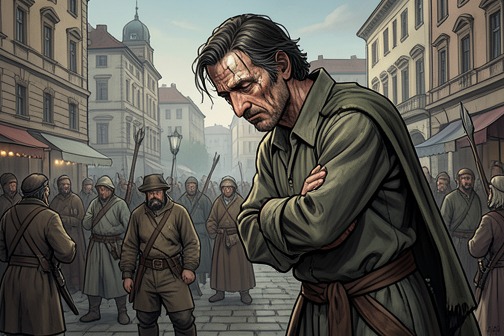
[Jack Joseph Johnson dies in infancy](entity:event-recall-event-jack-joseph-johnson-181ae7b98510), a loss the novel registers briefly but returns to through family memory and the physical record of the Johnson burial plot. His death is dated to 1869, and Molly’s later account of an earlier bereavement reveals how one child’s death belongs to a longer, largely solitary experience of motherhood and grief.
## Identity and Circumstances
Jack Joseph Johnson is identified in the family plot as the infant son of Molly Johnson. The evidence gives no account of the circumstances surrounding his death beyond the year 1869, so the event remains a stark fact rather than a narrated scene. Its brevity is significant: the novel preserves the child’s place in the family without supplying details it does not establish.
## The Death in Molly’s Recollection
After a difficult birth leaves Molly weak and grieving a stillborn daughter, [Yadaka](entity:character-recall-character-yadaka-ab02449e856b) brings a small coffin to the shanty. In the midst of that immediate loss, Molly recalls riding nineteen miles with a dead baby boy in her arms when she was sixteen. She says she saw no one, and that her cow died as well; her memory culminates in the recognition that she had been truly alone. The passage does not explicitly name that baby as Jack, but the family’s grave record identifies Jack Joseph Johnson as having died in 1869, placing his loss within the history of Molly’s early family life.
Molly also recalls that Joe had gone droving in [Queensland](entity:location-recall-location-485892ef3322) for eighteen months when she was sixteen and newly married. Set beside the memory of the dead infant, this detail locates her bereavement within a period of separation and limited support. The novel presents the recollection not as a fully explained account of Jack’s death, but as an opening into the loneliness that accompanied Molly’s young motherhood.
## The Family Burial Plot
The later visit to the family burial plot gives Jack a material memorial. Beneath an old snow gum, inside a rusty iron-fence enclosure, homemade wooden crosses bear the names of Jack ‘Jock’ Stewart, Molly’s father, and Jack Joseph Johnson, with the year 1869 beside the infant’s name. A river rock marked with the name Mary stands nearby. These handmade markers place Jack within a family history kept through modest, personal forms of remembrance rather than through an elaborated public record.
The scene’s surrounding actions underscore how loss is carried across generations. [Danny](entity:character-recall-character-danny-318bc697472f) sings while Yadaka hammers shut the small coffin for Molly’s stillborn daughter; Molly remains withdrawn, only slightly flinching at the sound. The present burial and Jack’s earlier grave are distinct events, but their juxtaposition makes the family plot a register of repeated bereavement. Jack’s name anchors that pattern in a specific year and in the lives of those who remain.
## Significance in the Narrative
Jack’s death contributes to the novel’s account of Molly’s accumulated losses without becoming a separately dramatized episode. Its trace appears in two forms: Molly’s remembered account of carrying a dead infant in isolation and the wooden cross that names Jack in the family plot. The distance between those forms—private memory and a sparse grave marker—reflects how little the narrative claims to know while still insisting that the child belonged to the family’s history.
Placed alongside Molly’s later stillbirth, the recollection connects maternal grief across time, but it does not collapse the losses into one event. Jack’s death is identified by name and year; the later baby is the newborn whose burial Yadaka helps arrange. Their separate histories reveal the recurrence of loss in Molly’s life and the fragile, practical acts through which the family marks it.
Event 20
Molly gives birth to Daisy, who is stillborn
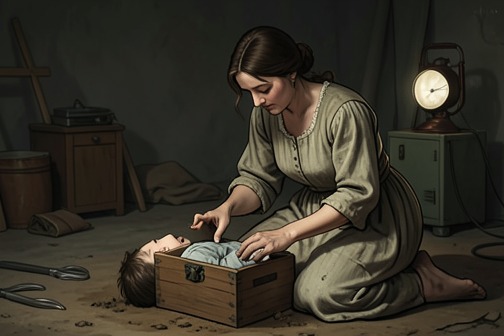
[Molly gives birth to Daisy, who is stillborn](entity:event-recall-event-molly-daisy-0a7cd63eb1d2), in an isolated and dangerous episode that binds loss, dependence, and an uneasy act of trust. Late in pregnancy and without medical care, Molly must confront a breech labour with the help of [Yadaka](entity:character-recall-character-yadaka-ab02449e856b), an injured stranger she has just knocked unconscious. The baby does not survive; Molly and Yadaka bury her, and [Danny](entity:character-recall-character-danny-318bc697472f) later gives her a marked grave as Daisy Molly Johnson, born and mourned in [1893](entity:time-recall-time-1893-90c32dac9dd0).
## Background and Isolation
Earlier, Molly’s pregnancy is part of the ordinary demands of caring for her children. At the river, about eight months along, she pauses from washing clothes because of back pain and breaks up an argument between Danny, [Joe Junior](entity:character-recall-character-joe-junior-a8d521c74d3d), and [Henry James](entity:character-recall-character-henry-james-6211b5b63ac1), who have been cooped up by days of rain. This scene places pregnancy within daily work and family care before it becomes an emergency.
When labour begins, the conditions are starkly different from any setting of supported medical care. Molly is alone with her children and the injured Yadaka, who has been staying nearby. She has reason to fear him: he is a stranger, and she knows he is being sought by the authorities. At the same time, her labour becomes urgent, leaving her to make decisions with no outside assistance.
## The Birth and Its Reversal
Molly’s waters break, and she realizes the baby is presenting feet first. Yadaka approaches and offers his hand, but she recoils from the prospect of accepting help from a Black man, fearing the social consequences of such contact for a white woman. In the confusion and pain of the moment, she swings her shotgun like a bat and knocks him unconscious. Her immediate effort to protect herself has the opposite consequence from what she needs: the only available helper is temporarily unable to assist her.
When Yadaka wakes, he understands that Molly is in labour and sees that the baby is still presenting feet first. He picks up and reloads the shotgun while Molly pleads for the safety of her children. The episode turns on a change in their positions: Molly had treated Yadaka as a possible threat, but her own crisis leaves her dependent on the man she struck. The evidence establishes that the birth is difficult and that Daisy is stillborn; it does not describe a successful rescue of the child.
## Burial and the Grave
After the loss, Yadaka offers to bury the baby girl, saying it is the least he can do. Molly insists that he owes her nothing, but he regards helping with the burial as the proper thing to do and expresses sympathy for her loss. Their shared act is not presented as erasing Molly’s grief or resolving their distrust. Instead, it gives the dead child a burial and places the two adults in a moment of practical responsibility toward her.
Danny later helps complete the burial. As Yadaka nails down the coffin lid, Danny watches, then claims the job of setting a small homemade wooden cross in the ground. The inscription reads “Daisy Molly Johnson, 1893”. Danny places the cross himself, and he and Yadaka bow their heads together. The name and year turn a private loss into a specific family remembrance, while Danny’s insistence that staking the cross is his job gives him a part in commemorating his sister.
## Consequences for Molly and Yadaka
The birth and burial alter Molly’s calculation about Yadaka. She is weak after the difficult labour and knows that Danny cannot do everything she needs. She also recognizes that the iron collar Yadaka wears could expose them both if anyone came to the property. In freeing him, she acknowledges the help he gave with the stillborn baby and that he had effectively saved her life. The loss therefore precedes a consequential change in their relationship: Molly releases the man she had treated as dangerous, while still setting a limit on his stay and insisting that he leave after two nights.
Their association continues beyond the immediate crisis. Danny later sees Yadaka as a figure of intense curiosity, and Yadaka joins in as Danny tells the story of Molly’s encounter with a wild bullock, mimicking the animal through dance. The birth does not itself explain all that follows between the men, but it belongs to the history of Yadaka’s presence in the household and of the trust and cultural exchange that develop around Danny.
## Family Memory and Narrative Significance
The loss remains part of the family’s remembered story, even as later generations retell other episodes of Molly’s life. Danny’s children perform the [Story of the Bullock](entity:concept-recall-concept-story-of-the-bullock-27602832699c), a narrative that he shared with the [Ngarigo](entity:organization-recall-organization-ngarigo-b672143f0280) and that the community incorporated into its practices of mimicry and dance. They honour Molly’s bravery and respect for her plight, and the story becomes a way for the clan to remember her and share in her memory. The later performance does not recount Daisy’s birth, but it shows how the family’s experiences of Molly continue to be carried forward through communal and embodied storytelling.
Daisy’s marked grave is the most direct memorial to this birth: it records her name within the family burial ground, where Danny and Yadaka stand together in respect. The event also makes the material limits around Molly’s pregnancy unmistakable. Her labour unfolds without medical support, and the people available to her are her children and a wanted, injured stranger. The stillbirth is a personal bereavement, but its consequences extend into the relationships formed around care, the choices Molly makes to survive, and the family’s later work of keeping her story alive.
Event 21
Molly frees Yadaka by breaking his iron collar
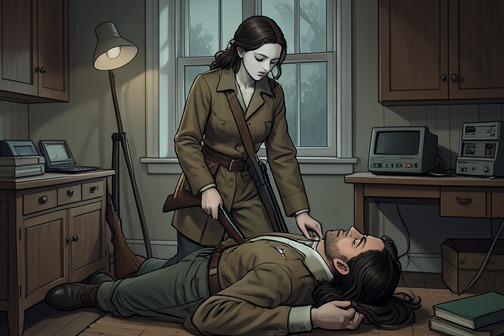
[Molly frees Yadaka by breaking his iron collar](entity:event-recall-event-molly-yadaka-15ae95945982), an act that changes their relationship from an uneasy encounter under threat into a provisional alliance. The release follows his help during a dangerous birth and his offer to bury her stillborn daughter; it costs Molly some control and exposes her to consequences, but leaves both characters bound by a shared secret.
## Circumstances and Immediate Crisis
The sequence begins in the aftermath of Molly’s difficult labour. When [Yadaka](entity:character-recall-character-yadaka-ab02449e856b) offers his hand, she recoils from the racial and social implications of accepting help from a Black man. In the confusion, she strikes him with her shotgun and knocks him unconscious. Her response establishes the distrust between them, but also the extremity of her circumstances: exhausted and facing a birth she cannot manage alone, she lashes out at the person trying to help.
Afterward, Yadaka helps bury Molly’s stillborn daughter. He regards the burial as the right thing to do, while Molly insists that she owes him nothing. Her response is not simple gratitude. She needs him to leave because a report to the authorities could bring troopers to her home, and she does not want that danger at her door. Yadaka, meanwhile, needs time for his wound to heal. Their exchange places practical need, grief, and distrust alongside the assistance he has given her.
## The Collar Is Broken
When Molly wakes, she finds Yadaka eating near the stove and approaches him with her shotgun. She orders him outside. The scene then shifts from her having the weapon and the power to command him to a decisive action involving the collar: Molly raises an axe and breaks its hinge while Yadaka kneels at the chopping block. The collar falls away, and he rises with it in his hand, freed from its immediate restraint.
Yadaka thanks her, but Molly is uncertain whether she has done the right thing. While the collar was on, she felt she had some control over him; without it, he is a capable man whom she cannot restrain in the same way. Yet she also recognizes that the collar itself could expose them both if anyone came to the property. Its removal therefore brings two consequences at once: Yadaka gains freedom from the restraint, and Molly removes an incriminating sign that could draw official attention.
## Terms of the Alliance
Molly’s decision is shaped by more than the danger of the collar. She is still recovering from the birth, knows that she needs help, and recognizes Yadaka’s role in assisting her and burying her daughter. She allows him to remain temporarily, first setting a limit of one night and then accepting his proposal to stay two nights, until the full moon makes it easier for him to travel. The arrangement is conditional, practical, and explicitly temporary.
She also makes clear that the release does not mean unconditional trust. Molly warns Yadaka that she will kill him if he crosses her, and orders him to bury the collar and dig the grave. She knows she has damaged government property to release a prisoner and tells him to stay out of sight. Yadaka accepts her authority in the moment, addressing her as his boss; Molly immediately distinguishes that temporary arrangement from her position in her household, saying that her husband is the boss and that she is only a drover’s wife.
## Significance
Breaking the collar reverses the immediate power relation established by Yadaka’s captivity: Molly acts with the weapon and tool, but uses them to end his restraint rather than to keep him under it. The reversal is not a clean reconciliation. Molly remains wary, and her permission for Yadaka to stay is governed by the need for assistance, secrecy, and a departure deadline. Trust emerges as a limited practice—helping, concealing evidence, and sharing risk—rather than as a declaration that suspicion has vanished.
The collar also makes the alliance materially dangerous. It is both the instrument of Yadaka’s visible subjection and evidence that could implicate Molly once broken and hidden. By ordering him to bury it, she turns his freedom into a secret they must protect together. The event thus joins care with self-preservation: Molly acknowledges what Yadaka has done for her and releases him, while insisting on boundaries that reflect the dangers of their unequal and politically charged circumstances.
Event 22
Joe Johnson’s death
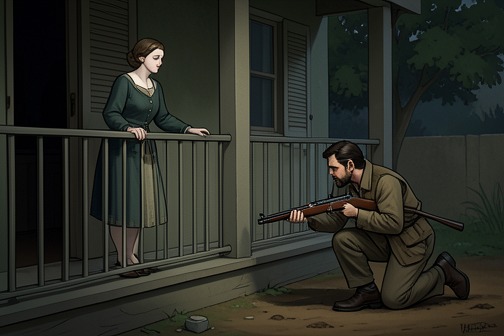
[Joe Johnson’s death](entity:event-recall-event-joe-johnson-5322180cd795) becomes an explicit fact only when Molly confesses to [Yadaka](entity:character-recall-character-yadaka-ab02449e856b) that she buried her husband beneath the woodheap beside the house. The revelation transforms a mound in the yard into a grave and reframes Molly’s determination to protect her children: she says she would fight for her life and for them, without making excuses. The burial is both a concealed consequence of that struggle and the reason she offers Yadaka [Joe’s boots](entity:object-recall-object-250854122637) as a means of passing with less notice.
## Disclosure at the Woodheap
Yadaka is preparing to leave Molly’s house when she comes onto the verandah and calls him back. After an awkward pause, Molly asks him to take the blame for the trooper and for Joe. Her request surprises him, but its wording makes him understand that she has brought her husband’s death into the matter. She explains that her children need their mother and says she would not kill merely for its own sake, but would fight for her children and her life.
Yadaka asks whether that is what she did with Joe. The question breaks through the effort Molly has made to keep the secret from others and from herself, so that life might seem normal for her children. She grips the rail to steady herself, then tells Yadaka that she buried Joe’s boots beside him beneath the woodheap: she could not bury a man without his boots. In this exchange, the death is disclosed not through an account of the act itself but through Molly’s admission and the practical object she preserved for the burial.
## The Hidden Grave
Yadaka follows Molly’s words to the mound beside the old woodheap and asks whether Joe is there. Molly confirms that the children were about to wake, so she made the grave shallow and stacked the last of the wood over it. She also explains that dogs came to dig at the grave and that Alligator fought them off. Her matter-of-fact account places the concealment within the immediate demands of caring for the children and keeping the death hidden at home.
The mound had been visible before Molly named it, but its meaning changes once Yadaka recognizes it as a grave. The wood piled above it hides Joe’s burial in plain sight, while the boots mark the place as a deliberate burial rather than an abandoned body. Molly does not give Yadaka a fuller account of Joe’s death in this scene; what she reveals is the grave’s location, the way she concealed it, and the circumstances surrounding its protection.
## Boots, Blame, and Survival
Molly tells Yadaka to take Joe’s boots. When he declines, she explains that wearing them might attract less attention if he is stopped, and urges him to use his white name. The offer makes the burial part of a plan for Yadaka’s passage through danger: an object belonging to the dead husband could help a fugitive appear less conspicuous. It also connects Joe’s concealed grave to Molly’s request that Yadaka take responsibility for the trooper and Joe, though the scene does not establish that he agrees to either request.
The episode holds grief and necessity together without making Molly’s confession a complete explanation of the killing. She has hidden the grave so her children can wake without seeing it, yet she does not deny what she has done when Yadaka asks. Her emphasis on fighting for her children and her life places the death within her stated effort to survive, while the boots and the woodheap give that private history a concrete, continuing presence. Joe’s death is thus revealed as a secret Molly has carried alone, and as a fact that changes what the mound, the boots, and her appeal to Yadaka mean.
Event 23
Yadaka reveals Molly’s Aboriginal heritage
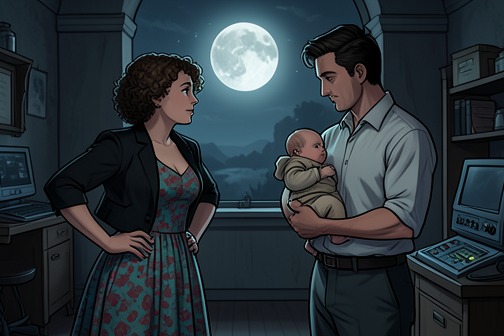
[Yadaka reveals Molly’s Aboriginal heritage](entity:event-recall-event-yadaka-molly-b6756743dcb6) at a moment when their growing trust makes family history newly speakable. By connecting [Ginny May](entity:character-recall-character-ginny-may-a0225624dfa3)’s long-kept account of Molly’s birth to Mary’s [Ngarigo](entity:organization-recall-organization-ngarigo-b672143f0280) ancestry, he changes Molly’s understanding of her mother and herself. The disclosure is not simply a recovered genealogy: in a society where Aboriginal people are displaced and may be shot, and where officials can classify mixed-heritage children as removable, it makes the danger surrounding Molly’s family impossible to separate from its history.
## The story behind the revelation
Molly has just explained that her mother died giving birth to her. As she tends to [Yadaka](entity:character-recall-character-yadaka-ab02449e856b), she says her family had been only her father and herself before her children, recalling his belief that family did not need to extend beyond those who stood together. Yadaka listens and recognizes a connection. Details he has encountered in Molly’s life, together with this account of her mother’s death, begin to form a coherent story for him.
He identifies Ginny May as his adoptive mother and tells Molly that she had held Molly as a newborn while Molly’s father grieved over Mary’s death. Molly initially treats a gin’s assistance at a birth as ordinary, not as evidence of a particular family tie. Yadaka then supplies the missing link: Ginny May had preserved the story of her sister’s love for a man of different skin. Mary, known locally by a racialized nickname, had red hair and fair skin, yet retained strong Ngarigo features. She had worked as a cook for drovers, and Molly’s father was among them. Yadaka states plainly that Mary was Aboriginal.
The disclosure emerges through conversation rather than an official record. Its authority rests on the family account Ginny May kept alive and entrusted to Yadaka. A history that Molly could not assemble from the fragments of her own upbringing becomes legible through a chain of care: Ginny May aided her birth, adopted Yadaka, and preserved knowledge of Mary that could eventually reach her daughter.
## Molly’s response and the limits of recognition
Molly reacts with disbelief and anger. She slaps Yadaka and orders him to leave, interpreting his account as an affront after she has shown him respect. Her response marks the emotional force of the revelation: Yadaka is not offering a neutral detail but altering the story Molly has understood about her mother and her own place in the world. He continues because he believes he must pass on what Ginny May entrusted to him, even though Molly is not ready to accept it.
The surrounding circumstances make the discovery consequential beyond the private question of ancestry. Earlier, while explaining his own position as a wanted Aboriginal man, Yadaka describes the injustice of being punished simply for existing as black. Molly recognizes the broader pattern: Aboriginal people are blamed, arrested, imprisoned, driven away, or exposed to a policy that permits their being shot on sight. His account of Mary’s history therefore enters a world in which racial identity has immediate practical risks, rather than remaining a matter of family naming alone.
The revelation also clarifies why Ginny May’s relationship to Molly matters. Yadaka later insists that she is Molly’s family and her children’s family, not merely someone who once assisted at a birth. He offers Molly directions to his winter cave, where there will be food, blankets, and shelter, and where, in spring, she can find her people. His invitation gives the newly disclosed connection a possible future in kinship and community, although Molly’s silence at that moment leaves her decision unresolved.
## From private history to public classification
The story of Mary’s ancestry is subsequently repeated in a very different setting: a hearing where officials discuss Molly and her children. [Miss Shirley](entity:character-recall-character-miss-shirley-29fbc349d68f) asserts that Mary’s father was [Charles Edwards](entity:character-recall-character-charles-edwards-2d9b50fc22df), then invokes Molly’s supposed sheltering of a wanted Aboriginal man to urge the children’s removal. She labels the children as mixed-blood and presents removal as urgent help. [Judge Eisenmangher](entity:character-recall-character-judge-eisenmangher-12251c75ab87) signs an authorisation for their removal, which frightens [Danny](entity:character-recall-character-danny-318bc697472f).
The contrast is sharp. In Yadaka’s telling, ancestry comes through a connection among women and generations: Ginny May’s knowledge of her sister, her care for Molly at birth, and her eventual transmission of the story. In the hearing, officials convert racial ancestry into a category that can justify separating children from their mother. The language of protection does not erase the coercive effect of the signed order. Molly’s family knowledge is treated as grounds for state intervention, while the children’s attachments and their mother’s care receive no comparable force in the decision.
At Molly’s trial, the Crown uses her mixed heritage and knowledge of her mother’s suffering to characterize her actions as generational hatred, claiming that Yadaka encouraged her to seek revenge. This account recasts a personal and familial history as evidence against her. Nate recognizes that the hearing is biased, but the only witness to Molly’s truth is Danny, who is absent. The disclosure thus enters public proceedings in distorted form: the history that explains Molly’s vulnerability is used to support the case against her.
## Kinship, danger, and cultural continuity
The event joins two forms of authority without making them equivalent. Colonial officials exercise power over property, movement, and children through meetings, racial classifications, and signed documents. The kinship knowledge carried by Ginny May and Yadaka moves through memory, care, and obligations to family and people. Their account restores Molly’s connection to her Aboriginal heritage, but it cannot by itself protect her from the institutions that threaten her household.
The novel’s later account of the children’s lives shows that cultural connection outlasts the attempt to classify and remove them. In the high country, Danny and his brothers learn a men’s-business ceremony from their Ngarigo family; their uncle passes it on in haste because he fears that modern ways are eroding practices essential to Ngarigo survival. The family’s return to the mountains and the continuation of ceremony place kinship in a living cultural community, not merely in an account of descent. Against the public use of ancestry as a mark of danger, the children’s inheritance becomes a source of knowledge and responsibility.
Yadaka’s revelation is therefore a turning point in Molly’s understanding, but not a simple resolution. It recovers a concealed maternal history, identifies Ginny May as family, and opens the possibility of belonging with Yadaka’s people. At the same time, the story’s later uses of that history expose how easily recognition becomes racial surveillance and bureaucratic threat. The account passes from one generation to another; whether it can offer refuge depends on relationships and cultural continuities that official authority does not control.
Event 24
Trooper Spencer Leslie’s death
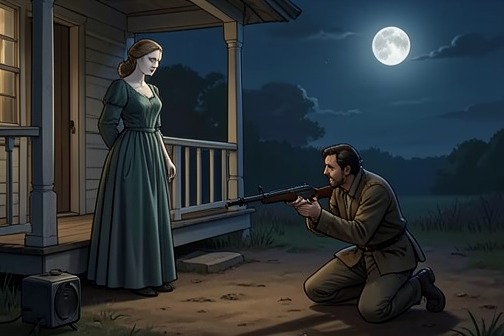
[Trooper Spencer Leslie’s death](entity:event-recall-event-trooper-spencer-leslie-06e776e1b6b0) is the sudden, decisive turn in the full-moon confrontation at Molly Johnson’s home: a scene that begins with the capture of [Yadaka](entity:character-recall-character-yadaka-ab02449e856b) ends with Molly shooting Spencer and asking Yadaka to bury him. The killing makes Molly’s home a place where the danger of colonial law enforcement collides with her determination to protect her children, while leaving her and Yadaka bound to conceal what happened.
## Causes and Confrontation
Spencer arrives after hearing shouting. His horse has been ridden hard, and he appears tired and flustered. Molly hides her alarm and tells him that her husband is in town, while Yadaka keeps his head lowered and tries to find a way out of the encounter. The full moon exposes his face, however, and Spencer recognises him from the wanted poster as the man accused of killing members of the Edwards family and several law-enforcement officers.
Spencer sees the arrest as an opportunity to gain credibility. He orders Yadaka not to move and points his pistol at him. Under the moonlight, Yadaka kneels as Spencer reads the charges, including the murders of Missus Edwards and her three children, Trooper Phillips, and Native Policeman Dempsey Buckskin. Molly is startled to learn that Yadaka has not told her about the deaths of the men. Spencer then tells Molly she must accompany him to the lock-up for questioning about her husband’s whereabouts. She resists, saying her children will soon be home and that she will not leave them.
## The Shooting
As Spencer continues questioning Molly, Yadaka sees her distress mounting. He knows that she will put her children first and decides to act before she does, despite the danger that Spencer may shoot him. When Spencer turns sharply toward Molly and aims his pistol at her, Yadaka prepares to intervene. Spencer shouts at her to be quiet; Yadaka launches himself toward him, hoping to knock him aside.
A shot rings out. Both men fall, and Molly initially cannot tell who fired. She checks herself, then sees that her [Cowles & Dunn shotgun](entity:object-recall-object-cowles-dunn-shotgun-674efad0de3a) is smoking and understands that she pulled the trigger. Yadaka rolls away and gets to his feet, stunned. Spencer is dead. Molly, numb with shock, tells Yadaka to bury him deep.
## Burial and Immediate Aftermath
Yadaka carries out Molly’s order and buries Spencer deep. When he returns with the shovel and leans it against the shanty, the struggle has been erased from the yard: the blood has been covered, the ground swept, and no trace of the trooper remains. Molly sits by the fire pit wrapped in her shawl, with her broom and shotgun beside her, stunned into silence. The clearing away of the scene turns the killing into a secret the two survivors must carry, while the quiet fire and the moonlit snow gums frame the abrupt contrast between the violence of the encounter and the stillness that follows.
## Burial and Immediate Aftermath
Yadaka carries out Molly’s order and buries Spencer deep. When he returns with the shovel and leans it against the shanty, the signs of the struggle have been cleared from the yard: the ground is swept, the blood covered, and no trace of the trooper remains. Molly sits by the fire pit wrapped in her shawl, with her broom and shotgun beside her, still in shock. The concealment makes the killing a secret shared by Molly and Yadaka, while the quiet fire and moonlit snow gums set the stillness after the confrontation against the violence that has just occurred.
## Burial and Immediate Aftermath
Yadaka carries out Molly’s order and buries Spencer deep. When he returns with the shovel and leans it against the shanty, the ground has been swept, the blood covered, and no trace of the trooper remains. Molly sits by the fire pit wrapped in her shawl, with her broom and shotgun beside her, still in shock. The clearing of the yard turns the shooting into a secret shared by Molly and Yadaka; the fire’s quiet crackle and the moonlit snow gums frame the stillness that follows the confrontation.
Event 25
Judge authorizes the removal of the Johnson children
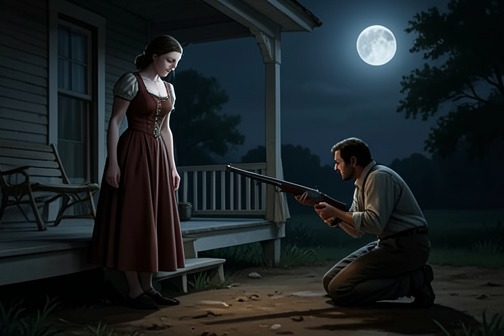
The authorization to remove Molly Johnson’s children is a decisive act of colonial authority disguised as protection. [Judge Eisenmangher](entity:character-recall-character-judge-eisenmangher-12251c75ab87) signs the order after [Miss Shirley](entity:character-recall-character-miss-shirley-29fbc349d68f) classifies the children as “Octaroon” and argues that they need urgent help; [Danny](entity:character-recall-character-danny-318bc697472f) overhears the decision and understands that the family is in danger of being broken apart. The paper’s official force changes the immediate stakes from suspicion to threatened separation, driving Molly to destroy it and leave with her children.
## Causes and Background
The order grows out of a chain of racialized judgments rather than evidence that Molly’s children are unsafe with her. Miss Shirley tells Judge Eisenmangher that Molly’s father had spoken while drunk about [Black Mary](entity:character-recall-character-black-mary-ba7d9fc543ca)’s father being [Charles Edwards](entity:character-recall-character-charles-edwards-2d9b50fc22df), and adds her suspicion that Molly is harboring [Yadaka](entity:character-recall-character-yadaka-ab02449e856b), whom she calls a wanted murderer. She presents the children’s mixed heritage as a reason for intervention, naming them “Octaroon” and insisting that they need urgent help. The language of rescue turns ancestry into an administrative category and makes separation appear benevolent.
This threat develops against a wider background of colonial hostility. Earlier, Nate reads a statement advocating the removal of Aboriginal people from a district in the name of settler progress, while [Spencer Leslie](entity:character-recall-character-spencer-leslie-87d243fe305b) recommends a raid and dismisses the likely victims as “Blacks.” Nate recognizes the danger to innocent people, but Spencer proposes delaying action around Molly’s property while troopers are sent for. The wider policy climate gives Miss Shirley’s appeal institutional force: the danger is not only private prejudice, but a system in which racial classification can authorize coercive action.
## The Hearing in the McGuinnesses’ House
The decision is made at night in the McGuinnesses’ home, where Molly’s three youngest children are sleeping after being given shelter. Danny wakes and worries about Molly and Sergeant Clintoff’s journey to the property. When he sees Miss Shirley with [Father McGuinness](entity:character-recall-character-father-mcguinness-5eebb18b4a3a) and a distinguished older man, he listens from behind the bedroom door and discovers that the man is Judge Eisenmangher, writing a document.
Father McGuinness challenges Miss Shirley’s claim about Molly’s ancestry as hearsay, invoking scripture against her willingness to speak without proof. Miss Shirley answers sarcastically, then returns to the claim that Molly may be sheltering Yadaka. She asks the judge what remains to be done and urges him to act for the children’s safety. The appeal fuses unproven family history, suspicion about Yadaka, and racial classification into a case for intervention.
Judge Eisenmangher finishes writing, signs his name, folds the paper, and hands it to Miss Shirley. His words make the consequence explicit: “For their safety, the children’s removal is authorised.” The order is produced through a brief domestic exchange, but the signature gives Miss Shirley’s assertions the power of law. The children’s own account of their family, and Molly’s care for them, are absent from the decision.
## Danny’s Discovery and the Meaning of Removal
Danny’s eyes widen when he realizes that the judge has authorized the children’s removal. He does not know where they would be taken or why, but he knows they need to go home to their mother. He thinks of Molly as a loving parent who does what she can for them, despite the hardships she faces. The order therefore reaches him not as an abstract administrative measure but as an immediate threat to the family he depends on.
After hearing enough, Danny quietly closes the door. He looks from his sleeping siblings to the window and recognizes that he must act. His response links the official decision to the later escape: the order does not merely create a future possibility of separation; once the children know about it, it changes what they must do that night. When Danny later tells Molly that Miss Shirley called the children “octaroons,” the word confirms the basis on which the judge’s intervention was sought. Molly connects it to her own childhood, when she heard adults discuss sending her away because of her mixed ancestry, and understands that the same racial logic now threatens her children.
## Destruction of the Order and Aftermath
Molly ultimately confronts the order at the McGuinnesses’ house. She binds Miss Shirley and Father McGuinness, takes the paper, and condemns Miss Shirley for presuming to know what is best for her children. She then throws the document into the fire. The flames consume its claims that the children are “octaroons,” that removal is necessary, and that permission has been granted, along with Judge Eisenmangher’s signature. Molly leaves with blankets and food, while her children wait in a wagon; their fear reflects both the upheaval of the escape and the threat that has made it necessary.
Destroying the paper does not undo the conditions that produced it, but it prevents this particular authorization from governing the family’s immediate fate. The scene places the judge’s pen and signature against Molly’s decisive refusal: a written order seeks to sever the children from their mother, while her action reasserts her responsibility to protect them. The episode makes the contradiction of paternalistic authority concrete. A decision framed as safeguarding children disregards the family’s bonds and treats their ancestry itself as grounds for removal.
## Narrative and Historical Significance
The order is a turning point because it transforms the risk of child removal from an implied fear into a signed legal instrument. Miss Shirley supplies the classification and argument; Judge Eisenmangher supplies official authorization; Danny witnesses the decision; and Molly’s response converts the threat into an immediate escape. The paper’s movement—from the judge’s hand to the fire—gives institutional power a concrete form and shows how quickly a claim of welfare can become an attack on kinship.
The author’s note identifies the novel as fictional, shaped by Australian history, family history, research, and oral stories, and reflects on the author’s experience of cultural knowledge being lost through government policy that prevented its transmission. That context supports reading the episode as a literary representation of child-removal governance, while keeping distinct the novel’s setting and the later policies that inform the author’s reflection. Within the plot, the order exposes the danger of defining children through racial categories and allowing outside authorities to override a mother’s care and a family’s own understanding of belonging.
Event 26
Molly Johnson’s killing of Joe Johnson
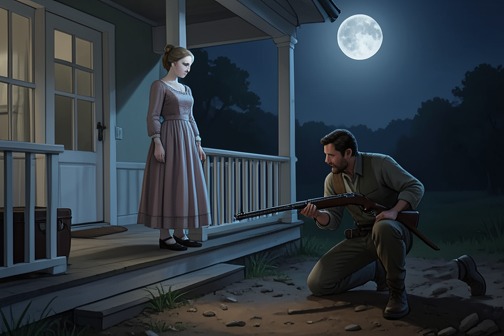
[Molly Johnson’s killing of Joe Johnson](entity:event-recall-event-molly-johnson-s-killing-7cae59f6ae56) is recalled by [Danny](entity:character-recall-character-danny-318bc697472f) as a moment of self-defense that binds mother and son to a secret. Joe’s threat to Molly, who was six months pregnant, leads Danny to urge her to shoot; afterward, Molly and Danny acknowledge what he witnessed and agree to keep it between them. The remembered death resurfaces amid a second danger: officials authorise the removal of Molly’s children, making the family’s safety and unity newly precarious.
## Background and Threat
Before the shot, Joe had been tormenting Molly and preventing her from leaving. She was pregnant, and he had used the threat of hurting her belly to keep her seated. Danny, sensing that something was wrong, got out of bed and watched through a crack in the wall.
The memory establishes the immediate circumstances of the killing through Danny’s perspective. Joe was drunk, and his conduct grew threatening as the confrontation continued. Molly had her shotgun with her; when Joe advanced on her, Danny saw that she was frightened and urged her to shoot. The episode is thus recalled not as a detached report, but as a child’s witness to a danger directed at his mother.
## The Shot and Its Immediate Aftermath
The remembered sequence turns on the abruptness of the shot. Danny sees Joe lunge toward Molly and hears his own whispered plea for her to shoot; then a single shot ends the attack. Recounting it afterward, Danny describes the shot as straight between Joe’s eyes, comparing it with the one that killed the bullock. His voice breaks as he names the outcome: Joe is dead. The comparison connects this private act of survival to an earlier image of decisive violence, while making clear that Danny has carried the scene as a witness, not merely learned of it later.
Back in the present, Danny opens his eyes to find Molly looking deeply upset that he remembers what happened so vividly. She apologises and opens her arms; he moves into her embrace, and they hold on to one another for a long time. Their stillness is marked by relief rather than crying. The killing has not severed their bond, but the moment exposes the cost of what Danny saw: Molly must comfort the child who had urged her to act, while confronting that he has shared the danger with her.
## The Secret and Its Pressure
After the immediate exchange of comfort, Molly names what survival will require: “Our secret, Danny.” The words are a declaration rather than a question, turning the remembered shooting into a shared obligation. Danny, described as an abiding son, agrees when she asks him to promise; his “Yes, Ma” confirms that he will keep what he witnessed between them. The scene does not present secrecy as an uncomplicated bond. It is also a burden placed on a child who has already seen his mother in danger and urged her to shoot.
That private promise is immediately overtaken by a new threat to the family. Molly realizes that Danny’s brothers and sister are not with him and asks where they are. He is too frightened to answer at first, then tells her that [Miss Shirley](entity:character-recall-character-miss-shirley-29fbc349d68f) called them “octaroons” before [Judge Eisenmangher](entity:character-recall-character-judge-eisenmangher-12251c75ab87). The term recalls the racial classification that had once been used to mark Molly herself for removal. Now Molly understands that the judge has authorised her children’s removal “for their safety,” acting on Miss Shirley’s appeal and the claim that they need help. The official language of protection thus carries a consequence Danny experiences as separation from his mother.
Molly recognizes the word as the link between her own childhood and the present danger. When she was eight, she heard Miss Shirley discuss sending a mixed-heritage child away; the remembered conversation described removal as a way to cleanse the child and conceal knowledge of her origins. Molly now sees that the same logic threatens her children. The discovery makes the shooting’s secret only one part of a larger struggle: preserving the family requires resisting an authority that turns racial naming into permission to take children from their mother.
Molly responds by confronting Miss Shirley and [Father McGuinness](entity:character-recall-character-father-mcguinness-5eebb18b4a3a), whom she leaves bound and gagged while she gathers blankets and food for the children. She puts the judge’s signed paper into the fire. Its phrases—“octaroons,” “removal necessary,” and “permission granted”—are consumed along with Judge Eisenmangher’s signature. Destroying the document does not undo the order or erase its threat, but it is a direct refusal to accept the paper as the final word on her children’s fate. The shooting and the secret surrounding it therefore sit within a wider chain of danger: Danny and Molly protect one another through silence, while Molly acts openly against the authority trying to divide their family.
## A Secret Under a Removal Order
The remembered killing returns in a present already shadowed by the threat of separation. Miss Shirley tells Judge Eisenmangher that [Black Mary](entity:character-recall-character-black-mary-ba7d9fc543ca)’s father was [Charles Edwards](entity:character-recall-character-charles-edwards-2d9b50fc22df), then argues that Molly’s children need urgent help because they are classified as “octaroons.” Father McGuinness challenges her claim as hearsay, but the judge signs the authorization for their removal, ostensibly for their safety. Danny hears the decision and is frightened: he cannot understand where the children could be taken or why anyone would remove them from a mother who loves and cares for them. The official order turns the danger that preceded the shooting into a broader threat to the family’s survival together.
Molly understands the force of the classification because it reaches back to her own childhood. When she was eight, she had heard Miss Shirley discuss sending a mixed-heritage child away and invoking a racial label to secure that removal. Danny’s report that Miss Shirley has now called his siblings “octaroons” makes Molly recognize the old threat in a new form. The revelation places the secret of Joe’s death beside a second secret of family history: Molly’s ancestry, and the way authorities use racial classification to treat her children as removable. Her response is not to accept the judge’s protective language at face value, but to act against the separation it authorizes.
Molly confronts Miss Shirley and Father McGuinness, restrains them, and takes blankets and food for the children. Then she throws the signed paper into the fire. Its language of “removal necessary” and “permission granted,” together with Judge Eisenmangher’s signature, burns; the destruction is a physical rejection of the document’s claim to determine the children’s fate. It cannot erase the order’s consequences or guarantee safety, but it makes Molly’s resistance unmistakable. The episode’s final contrast is between an institution that claims authority over the family and the care Molly and Danny enact for one another: their promise keeps Joe’s death concealed, while Molly’s intervention openly refuses to surrender her children.
Event 27
Molly Johnson’s killing of John McPharlen
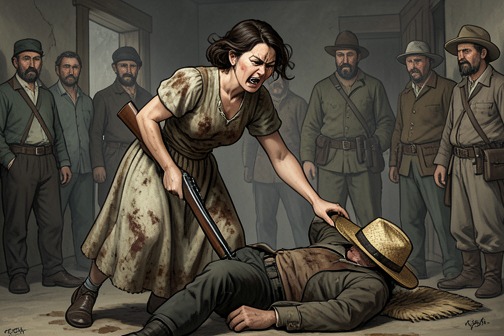
[Molly Johnson’s killing of John McPharlen](entity:event-recall-event-molly-johnson-s-killing-13e72b3c3ab3) is the violent turning point of the family’s attempted escape from [Everton](entity:location-recall-location-3506ce81dd30): at the [Stanlow Inn](entity:location-recall-location-stanlow-inn-d34ebef14031), Molly confronts the man who assaulted her, kills him, and is found by [Nate Clintoff](entity:character-recall-character-nate-clintoff-7adc2f6a84ce) before she can rejoin her children. The scene makes a private history of violence into a public legal crisis, while leaving Molly’s immediate concern not for herself but for the children she has sent ahead.
## Causes and Background
Earlier, Molly has reason to fear that [Yadaka](entity:character-recall-character-yadaka-ab02449e856b)’s presence will bring troopers to her doorstep. She warns him that the mountains are full of trouble and that a reward-seeker might draw the authorities to her; she needs him to leave, especially in her vulnerable condition. The fear is not abstract: troopers already intend to check on her, though [Spencer Leslie](entity:character-recall-character-spencer-leslie-87d243fe305b) tells Nate Clintoff that reaching the [Johnson property](entity:location-recall-location-johnson-7584c6ade144) will take at least two days. He frames the delay as a limit on the authorities’ responsibility for her welfare, even as Nate hopes her husband will be home by then.
Molly’s vulnerability is also shaped by the racial violence around her. When Yadaka explains that his crime is simply existing while black, Molly understands the treatment he describes: Aboriginal people have been blamed, arrested, imprisoned, or driven away, and white settlers have unofficial permission to shoot them on sight. The novel places the later killing within this wider landscape of unequal protection and coercion, without making that context erase the immediate events at the inn.
McPharlen is not a stranger to Molly. On the road out of town, she sees him near the Stanlow Inn; [Danny](entity:character-recall-character-danny-318bc697472f) recognizes him as the man who assaulted his mother and as one of the men involved in Yadaka’s hanging. That recognition ties Molly’s personal trauma to the family’s recent losses and gives the encounter a history that precedes the moment of violence.
## The Encounter at the Stanlow Inn
As the family approaches the last establishment before leaving town, Molly sees McPharlen. Danny notices her reaction and grips the spear beside him, but continues driving the horse onward. The separation between mother and children becomes crucial: when Molly later finds McPharlen alone around the side of the inn, the children are already on their way ahead.
McPharlen reacts with hostility when Molly appears before him. She stands her ground, confronting the man who hurt her, though the scene makes clear that fear and the memory of what he did remain present. He wipes at her tears and grabs her jaw. Molly then kills him. The narrative marks the act as the culmination of the confrontation, not as a planned escape strategy or a victory without cost.
Afterward, snow begins to fall. McPharlen dies, and Molly is jolted out of her stunned state by the flakes on her face. She realizes what she has done, trembles, and tries to leave. Her immediate response is remorse and shock rather than triumph; the act has ended the immediate confrontation but has not freed her from its consequences.
## Witnesses, Children, and the Law
Molly runs directly into Nate Clintoff. He is shocked by what he sees: Molly is visibly battered and in pain, while McPharlen is dying. Nate feels for her and recognizes that her injuries provide grounds to turn a blind eye, but he must also confront the death and the absence of a government-issued horse whose rider cannot be found. His position is therefore divided between the law he has sworn to uphold and the justice suggested by Molly’s condition and the circumstances before him.
Molly looks toward the direction in which her children have gone and pleads with Nate to help them. Her request fixes the stakes of the scene: even after killing McPharlen, her attention is directed toward her children’s safety. The plea also sharpens Nate’s conflict, because his response may determine whether the children’s flight remains possible or whether the family is separated by the authorities.
That threat is already being advanced through official channels. [Miss Shirley](entity:character-recall-character-miss-shirley-29fbc349d68f) labels the children as having mixed Aboriginal descent and tells [Judge Eisenmangher](entity:character-recall-character-judge-eisenmangher-12251c75ab87) they urgently need help. Despite [Father McGuinness](entity:character-recall-character-father-mcguinness-5eebb18b4a3a)’s objection that the allegation is hearsay, the judge signs an order authorizing their removal. Molly’s plea at the inn thus occurs against the immediate prospect of child removal, not in isolation from the racialized administration of law surrounding the family.
## Aftermath and Significance
Two and a half days later, Molly is in custody. Nate’s private account reveals that he remains troubled by his decision: he wonders whether he should have overlooked her act, acknowledges that she was deeply wronged, and cannot sleep over how events have unfolded. His oath and his sense of injustice pull in opposite directions, with consequences that also strain his relationship with [Louisa Clintoff](entity:character-recall-character-louisa-clintoff-3db7831651e8).
At Molly’s hearing, the prosecution presents her hostility toward white men as generational, linking it to her heritage, her mother’s suffering, and what Yadaka told her. An all-male jury hears the case, while Danny—the only witness identified as able to tell Molly’s truth—is absent. The narrative connects the death at the inn to a broader failure of legal recognition: Molly’s circumstances are recast as evidence against her, while the testimony that might explain them is unavailable.
Louisa works to advance legislation for battered wives, but it cannot take effect in time to help Molly. In custody, Molly tells Nate that her children will have all the help and love they need, expressing a hope that the events at the inn have put in jeopardy. The killing consequently marks both an irreversible death and a narrowing path for Molly herself: the immediate threat from McPharlen has ended, but legal custody, the children’s threatened removal, and Molly’s uncertain future remain.
Event 28
Molly Johnson’s escape from Everton
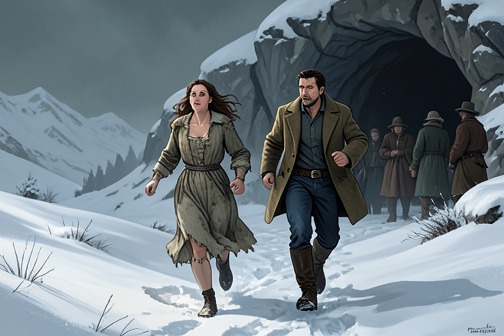
[Molly Johnson’s escape from Everton](entity:event-recall-event-molly-johnson-0d9d252e5f0f) is the turning point at which a threat of colonial child removal becomes a flight toward family and [Ngarigo](entity:organization-recall-organization-ngarigo-b672143f0280) belonging. When she learns that a judge has authorized the removal of her children under the label “octaroons,” she binds the people who helped secure the order, destroys it, and takes her family toward the mountain cave [Yadaka](entity:character-recall-character-yadaka-ab02449e856b) had described. The escape offers a possibility of protection and cultural connection, but its route through [Everton](entity:location-recall-location-3506ce81dd30) forces Molly to face [John McPharlen](entity:character-recall-character-john-mcpharlen-6423bfe4e0f5), and she separates from [Danny](entity:character-recall-character-danny-318bc697472f) so the younger children can continue toward safety.
## The removal order and its meaning
The immediate trigger is Danny’s report that [Miss Shirley](entity:character-recall-character-miss-shirley-29fbc349d68f) called the children “octaroons” before [Judge Eisenmangher](entity:character-recall-character-judge-eisenmangher-12251c75ab87). Molly recognizes the term from her own childhood: when she was eight, she overheard Miss Shirley discussing a plan to send her away because of her mixed heritage. The recollection makes the present threat legible. The judge has authorized the children’s removal “for their safety,” but Molly understands that the racial classification is what makes them vulnerable to separation from her.
The order follows Miss Shirley’s accusation that Molly is sheltering a wanted Aboriginal man. She invokes the children’s supposed need for “urgent help,” and the judge signs her request. For Molly, the episode is not an abstract dispute about welfare: it is the recurrence of a policy she had once feared for herself, now directed at her children. Her recognition that the past explains the present turns maternal alarm into decisive action.
## Binding the authorities and destroying the order
Molly goes to McGuinness’s residence, where Miss Shirley and [Father McGuinness](entity:character-recall-character-father-mcguinness-5eebb18b4a3a) are in their nightclothes. She ties them up in front of the fireplace; signs of resistance remain in the room, with furniture scattered and a vase broken. Although she acknowledges that they have been good to her and her children, she confronts Miss Shirley over presuming to know what is best for them. She takes blankets and food, but does not kill either captive: Miss Shirley’s fear gives way to relief when she realizes Molly is sparing their lives.
Molly then burns the paper bearing the words “octaroons,” the removal instruction, and Judge Eisenmangher’s signature. The document is the instrument that makes the threatened separation official; destroying it is a direct refusal of the authority it represents. The act does not resolve the danger or change the judge’s decision, but it gives Molly a brief chance to move her children beyond the reach of the order.
## Preparing the flight
In the backyard, Molly gathers the children into a wagon. They have been woken by the disturbance and are frightened by the scene and by Molly’s battered face. She distributes blankets and food, embraces the younger children, kisses them, and gently traces each face. Danny watches her tenderness; the children do not fully understand what is happening, but they remain attached to her and to one another.
Molly prepares concealment as carefully as shelter. She tucks [Delphi’s rag doll](entity:object-recall-object-delphi-s-rag-doll-cf44cc3105fe) beneath the blankets, tells the boys to keep warm and quiet, and covers the children so that they appear to be provisions. Danny is to feign influenza if anyone stops them, while the younger children must not make a sound. The plan depends on the children following instructions and on Molly presenting an ordinary wagon as it travels through town.
## The route to the cave and the promise of belonging
Yadaka’s directions give the escape a destination beyond immediate flight. Danny repeats the route: north-east to the Great Waterhole, then right, past a bald patch, and left toward three boulders resembling giant emu eggs. He had been told that the cave holds supplies and, in spring, people. Molly understands that the refuge offers not only a chance to survive together but a chance for her children to encounter an extended family and learn who they are.
To make that reunion possible, Molly tells Danny to introduce her as [Black Mary](entity:character-recall-character-black-mary-ba7d9fc543ca). When he asks who the people at the cave are, she answers that they are their people and family. The name links her hidden history to a community she has been separated from; the journey is therefore both escape from colonial authority and movement toward kinship. The novel’s closing promise of refuge is qualified by the likely harsh conditions, but the prospect of being among their own gives the family a future beyond the immediate danger.
## The encounter with McPharlen
The wagon must pass through Everton to leave town. Near the [Stanlow Inn](entity:location-recall-location-stanlow-inn-d34ebef14031), Molly recognizes John McPharlen, one of the men associated with the assault on her and with Yadaka’s hanging. Danny recognizes him too and grips the killing spear Yadaka gave him. The encounter interrupts the escape at the moment when the family is closest to getting out of town.
Molly gives Danny the reins and orders him to take the younger children straight to the cave, leaving the trooper’s horse at the edge of town. He wants to remain and promises that, when he is old enough, he will return to punish McPharlen. Molly silences his protest and leaves the wagon, sharing a look of love and understanding with her son before she disappears into the shadows. Danny drives on reluctantly, holding to her promise that she will catch up. The escape thus divides its central purpose: Danny carries the siblings toward collective refuge, while Molly turns back toward the unresolved violence that threatens her own survival.
## Significance and outcome
Molly’s flight exposes the contradiction between official language of protection and the coercion it enables. A judge’s authorization and Miss Shirley’s racial label threaten to remove children from their mother; Molly responds by destroying the document and relying on concealment, mobility, and kinship rather than accepting the state’s definition of their welfare. Her actions are shaped by her own childhood memory of a proposed removal and by the knowledge that her children’s mixed heritage can be used against them.
The escape remains incomplete at the point where Molly leaves Danny. The family has a direction, supplies, and a destination, but the road requires them to pass the man who represents the violence behind their flight. Danny’s journey toward the cave holds out the prospect of remaining together and reaching their people; Molly’s decision to confront the immediate danger leaves that reunion uncertain. The episode consequently makes protection both an act of maternal care and a struggle over who has the authority to define a family’s future.
Event 29
Molly Johnson’s trial and conviction
[Molly Johnson’s trial and conviction](entity:event-recall-event-molly-johnson-a40c53b2218e) turn the novel’s private history of violence into a public judgment—and show how racial classification and a rigid account of law can eclipse the circumstances of a mother’s actions. The all-male jury, the prosecution’s account of her motives, and [Nate Clintoff](entity:character-recall-character-nate-clintoff-7adc2f6a84ce)’s divided testimony frame a case in which abuse and recent bereavement are acknowledged but do not alter the outcome: Molly is sentenced to death for the deaths of [John McPharlen](entity:character-recall-character-john-mcpharlen-6423bfe4e0f5), Trooper [Spencer Leslie](entity:character-recall-character-spencer-leslie-87d243fe305b), and [Joe Johnson](entity:character-recall-character-joe-johnson-18bf90a2b2bb).
## Causes and Background
Molly enters the case after a life shaped by intersecting dangers. Late in pregnancy, she had been washing clothes at the river when she was confronted by the risks of an unattended breech birth. The birth ended with her baby girl stillborn, and the trauma left her unwell. When [Yadaka](entity:character-recall-character-yadaka-ab02449e856b) helped her, she initially feared the consequences of allowing a Black man to touch her during childbirth, a fear grounded in the racial rules that governed her isolated life. These circumstances do not erase the legal charges, but they clarify the vulnerability and pressure surrounding the events the court later judges.
Her circumstances also include longstanding abuse by Joe Johnson. At the trial, [Louisa Clintoff](entity:character-recall-character-louisa-clintoff-3db7831651e8) argues that Molly’s battered condition should be considered as evidence of provocation and that her violence against her husband must be understood in the context of cumulative abuse. Nate acknowledges that Joe’s death might have been self-defence, but the case also involves two other killings. His account of the evidence, especially the killing of Trooper Spencer Leslie, becomes decisive in explaining why the court imposes the death penalty.
The proceedings arise against a wider system of anti-Aboriginal persecution. Yadaka describes his crime as existing while Black, and Molly knows that Aboriginal people in the district are arrested, imprisoned, or driven away, while white people have unofficial permission to shoot them on sight. [Miss Shirley](entity:character-recall-character-miss-shirley-29fbc349d68f) turns Molly’s suspected ancestry into a further threat: she calls the children octaroons and urges [Judge Eisenmangher](entity:character-recall-character-judge-eisenmangher-12251c75ab87) to intervene for their supposed protection. The judge signs the order authorizing their removal. The trial is therefore not only about individual deaths; it unfolds in a setting where racial categories can be used to challenge a family’s right to remain together.
## The Court’s Case and Sentence
The Crown’s closing argument portrays Molly’s hostility toward the white men she killed as inherited and racially motivated. It attributes that supposed motive to what she learned from Yadaka about her ancestry and her mother’s suffering, and claims that Yadaka encouraged revenge. The account recasts knowledge of Molly’s heritage as an explanation for violence while placing the court’s attention on a wanted Aboriginal man’s influence, rather than giving equal weight to Molly’s own experience of abuse and loss.
The hearing is conducted before an all-male jury. Nate later recognizes that it was biased, but says there was little he could do. The only witness to Molly’s account of what happened is [Danny](entity:character-recall-character-danny-318bc697472f), who cannot be found. Without his testimony, the court hears no direct account from the child who could have described the family’s circumstances and what he had seen. The absence of that witness leaves Molly’s truth without the support that might have challenged the prosecution’s framing.
Nate’s position is divided between legal duty and moral doubt. He considers whether he should have turned a blind eye to Molly’s crime, which he understands as the desperate act of a woman deeply wronged. Yet he has sworn to uphold the law, and he believes the evidence against her is substantial. He also recalls witnessing the killing of John McPharlen and seeing Molly with the knife. At the same time, he recognizes that he saw her battered face and that the circumstances could be understood as provocation. His conflict is not resolved by the verdict; it remains an explicit burden of the case.
Louisa challenges the judgment on grounds the proceedings have not adequately addressed. She asks whether a doctor has examined Molly’s mind, pointing to her recent childbirth, the death of her baby, and her fear for her other children. She argues that the evidence against Molly must be read alongside the abuse she experienced, and that the lack of witnesses is itself unsurprising in cases of domestic violence. Nate answers that Molly confessed, a fact that weighs heavily against Louisa’s appeal. Their disagreement makes visible the gap between treating confession and physical evidence as sufficient proof, and asking what the violence and danger surrounding the accused mean for her responsibility.
The court ultimately sentences Molly to hang. At the public reading of the sentence, Judge Eisenmangher names the three killings: those of John McPharlen, Trooper Spencer Leslie, and Joe Johnson. The sentence makes the proceedings’ central contradiction stark: Molly’s acts are counted individually as crimes, while the history of abuse, racial hostility, and family peril that shapes her situation fails to change the punishment.
## Children, Classification, and Escape
The children’s removal order gives the legal crisis an immediate consequence beyond Molly’s own trial. When Danny returns alone and tells his mother that Miss Shirley called the children octaroons, Molly understands the word through her own childhood. At eight, she had heard Miss Shirley discuss sending a mixed-heritage child away, with a different racial label offered as the means to secure that removal. The old conversation suddenly clarifies the danger now facing Danny and his siblings: Molly recognizes that the label is not a neutral description but a route by which officials can separate them from her.
That recognition changes Molly’s course. She leaves with Danny under the full moon, carrying her shotgun and supplies; [Joe’s boots](entity:object-recall-object-250854122637) are tied to her bag, and Danny carries the killing spear Yadaka gave him. Molly drives her horse hard, focused on escape. The flight follows directly from the threat of removal: once she understands what the judge’s authorization may mean for her children, the need to protect them becomes more urgent than remaining in town.
The family’s danger sharpens the difference between official language and lived consequence. Miss Shirley presents the children as needing help and urges the judge to act for their safety, while Molly sees the same intervention as the destruction of her family. The court’s power to authorize removal is thus joined to the trial’s power to define Molly: both operate through decisions made by others, while the mother’s knowledge of her children and their attachment to her is pushed to the margins.
## Nate and Louisa: Law and Conscience
Nate’s participation in the case also strains his marriage. He has promised Louisa he will ensure the children’s safety, but he cannot reconcile that promise with his oath as a peacekeeper or with what he believes the evidence shows. After Molly’s arrest, he loses sleep over whether he made the right decision and recognizes that the case has intensified the tension between them. His divided position gives the trial a second line of consequence: the law’s outcome unsettles not only the accused family but also those who enforce or contest it.
Louisa’s response is more openly reformist. She is lobbying for legislation to help battered wives and continues to argue that Molly’s circumstances should matter, even though she knows reform will not arrive in time to save her. Nate acknowledges that Louisa’s work may help others in the future. That prospect does not repair the immediate injustice in Molly’s case, but it places the trial within a longer struggle over whether the law will recognize abuse as relevant to women’s survival and legal treatment.
## Narrative Significance
The trial brings together the novel’s connected conflicts over gender, race, and state power. Molly is judged as a defendant, but the court’s account is also shaped by the racialized story told about her ancestry and by the prosecution’s claim that her actions were encouraged by Yadaka. Meanwhile, the state’s language of child protection authorizes separation, and the domestic abuse that Louisa identifies struggles to gain legal standing. These are not separate pressures: they converge in the same proceedings and narrow the space in which Molly can be heard.
The court’s outcome is clear, but the narrative does not present it as an uncomplicated measure of justice. Nate’s admission that the hearing was biased, Louisa’s challenge to the treatment of abuse, and Danny’s absence expose what the judgment cannot establish about Molly’s full circumstances. The conviction therefore functions as both a legal resolution and a moral failure: the court names the deaths for which Molly is responsible, yet its procedure cannot accommodate the surrounding history that might make her actions intelligible without excusing them.
Event 30
Molly Johnson’s execution
[Molly Johnson’s execution](entity:event-recall-event-molly-johnson-1cb1092cb3a4) makes the conflict between legal authority and lived survival public and irreversible. Sentenced for the deaths of [John McPharlen](entity:character-recall-character-john-mcpharlen-6423bfe4e0f5), Trooper [Spencer Leslie](entity:character-recall-character-spencer-leslie-87d243fe305b), and her husband [Joe Johnson](entity:character-recall-character-joe-johnson-18bf90a2b2bb), Molly approaches the gallows barefoot, refusing the shoes offered to her. As [Louisa Clintoff](entity:character-recall-character-louisa-clintoff-3db7831651e8) and two other women protest the law’s failure to protect battered wives, Molly turns her thoughts toward her children and the mountains she calls home. Her death closes the legal case against her, but the scene insists that conviction does not settle the question of justice.
## The sentence and its grounds
At the execution, [Judge Eisenmangher](entity:character-recall-character-judge-eisenmangher-12251c75ab87) reads the formal sentence: Molly is to be hanged by the neck until dead. He names the three deaths for which she has been convicted: John McPharlen, Trooper Spencer Leslie, and Joe Johnson. The charge places those killings together under a single legal judgment, although the story gives them different circumstances. [Nate Clintoff](entity:character-recall-character-nate-clintoff-7adc2f6a84ce) recognizes that Joe’s death might be understood as self-defence, but regards the killing of Trooper Leslie, who had been performing his duty, as the decisive factor in the death penalty.
The trial has already been shaped by assumptions about Molly’s ancestry and by the absence of testimony that could establish her account. [Miss Shirley](entity:character-recall-character-miss-shirley-29fbc349d68f) identifies Molly as having mixed Aboriginal heritage and claims that Molly’s hostility toward white men was inherited and encouraged by [Yadaka](entity:character-recall-character-yadaka-ab02449e856b), whom she calls a wanted murderer. The case’s closing argument thus recasts violence and family history as evidence of racialized, generational hatred. Nate regards the hearing as biased, but says he could do nothing to change its outcome. [Danny](entity:character-recall-character-danny-318bc697472f), the only witness to Molly’s truth, is missing.
That outcome is foreshadowed by a wider pattern of vulnerability. Molly has described a world in which Aboriginal people are arrested, imprisoned, or driven away, and in which white people have unofficial permission to shoot them on sight. When Miss Shirley classifies Molly’s children as “Octaroon” and urges their removal, Judge Eisenmangher authorizes it in the language of their safety. At the gallows, therefore, the judgment against Molly stands beside an attempt to separate her children from her: legal power has reached both mother and family, while their own account has little standing within it.
## The gallows and the public protest
Molly’s final approach is deliberate. She told Louisa that she would not wear shoes; the choice is tied to her wish to honour her mother and to feel alive through her final steps. Nate steadies her when she falters near the rope. A trooper places the noose around her neck, while Nate steps aside, distressed and unable to look at her. The execution is carried out in public, before a crowd of stern male faces, and the formal reading of the sentence makes the state’s claim over her life explicit.
Louisa reaches the crowd with two other women, one of them Elpida Sava. They reveal messages written in charcoal on aprons: “Hear her! Battered wives are powerless! Legislate women’s rights now!” Holding hands, they step forward despite the disapproval of men in the crowd. Their protest connects Molly’s fate to Louisa’s effort to secure legislation for battered wives. Nate is moved by his wife’s courage, but remains in his appointed role as [Everton](entity:location-recall-location-3506ce81dd30)’s peacekeeper. The public scene gives the women a visible voice without granting them the power to halt the sentence.
Molly and Louisa exchange a subtle nod, a silent recognition between them. That gesture is the scene’s counterpoint to the written charges: the law names Molly’s crimes, while the women name the powerlessness that helped shape her circumstances. Louisa’s protest cannot save Molly, and Nate cannot turn his sympathy into intervention. The gap between what they understand and what they can change is made visible on the platform.
## Molly’s last thoughts and the children
As she waits, Molly recalls her father’s song, “And still I hope that the time will come when you and I will be as one.” She searches the crowd and imagines [Delphi](entity:character-recall-character-delphi-94e35d8e8dc9) holding up a daisy-chain necklace, then [Joe Junior](entity:character-recall-character-joe-junior-a8d521c74d3d) and [Henry James](entity:character-recall-character-henry-james-6211b5b63ac1) laughing and playing in the snow. These images turn the execution scene away from the official account of three murders and toward the family life Molly fears leaving behind.
Danny appears in her vision beside a snow gum. He signals to her with the gesture she taught him, blowing through his fist and opening his fingers; the breath and words are carried to her by a crow. Molly understands herself not simply as a drover’s wife but as a [Ngarigo](entity:organization-recall-organization-ngarigo-b672143f0280) woman, and imagines Danny turning to go with confidence that he and the others are safe. Her hope of being remembered rests not on vindication by the court but on her children’s knowledge of her love and on their continued journey.
The ending does not confirm that the children have reached safety. In the mountains, they are exhausted and dangerously cold: Joe Junior helps Henry James up, while Danny carries Delphi, whose condition is uncertain. The contrast between Molly’s hope and the children’s immediate peril makes the separation unfinished rather than resolved. Her imagined reunion offers emotional assurance, but the narrative leaves the family’s physical survival uncertain.
## Law, responsibility, and memory
Nate’s position reveals the execution’s moral division. He has lost sleep over his decision, wondering whether he should have overlooked Molly’s crime, yet he believes the evidence against her—especially in Trooper Leslie’s death—requires him to uphold the law. At the gallows he again wishes he had let her go to her children, but cannot reconcile that desire with his official duty. His final nod authorizes the trooper to proceed; it does not erase his distress or his recognition that the process has been biased.
The execution also marks the limits of the protection available to Molly as a mother and as a woman who has endured abuse. Louisa’s appeal for legislation is explicitly aimed at preventing other battered wives from facing the same powerlessness, but Nate believes reform will come too late to help Molly. Molly, for her part, has told him that her children will receive all the help and love they need. The scene sets that promise against the removal order and the children’s exposure in the mountains, showing how maternal care persists even when institutions threaten to sever the family.
In its final movement, the novel places the crow above the gallows as Molly gives her soul to its wings. Her last imagined words and gestures preserve a bond with Danny, while the mountains remain the image of home and belonging. The execution ends Molly’s life under the law’s authority, but the narrative refuses to let the sentence be the sole account of who she was: mother, survivor, and Ngarigo woman, remembered through her children and through the protest of those who witnessed her death.
Event 31
Danny and his siblings cross the snowy mountains to reach the cave
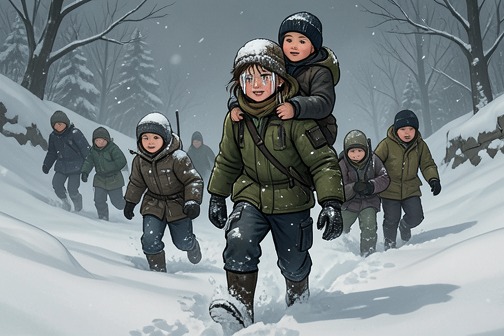
[Danny](entity:character-recall-character-danny-318bc697472f) and his siblings’ crossing of the snowy mountains to reach the cave is a perilous rescue journey in which Danny’s promise to his mother becomes a route to survival. Near collapse in the deep snow, the children find the three boulders that mark the cave, and pass behind them together toward food, shelter, and people in spring.
## The Children in the Snow
The journey is shown at the point where cold and exhaustion have become immediate threats. High in the snow-covered mountains, a branch cracks beneath the snow’s weight, startling the boys. [Henry James](entity:character-recall-character-henry-james-6211b5b63ac1), worn out, falls into the deep snow, while Danny carries [Delphi](entity:character-recall-character-delphi-94e35d8e8dc9) on his back. She is frostbitten, with tiny icicles forming on her closed lashes; the scene leaves it uncertain whether she is asleep or dead. Danny’s burden is therefore both physical and emotional: he must keep moving while carrying a little sister whose condition is frighteningly unclear.
The landscape dwarfs the children. Snow reaches their knees, and [Joe Junior](entity:character-recall-character-joe-junior-a8d521c74d3d) helps his little brother to his feet before they trudge onward. They are exhausted, painfully cold, and close to giving up. The crossing tests not only Danny’s ability to lead but the siblings’ capacity to keep one another moving: Joe Junior’s small act of help matters because the family’s survival depends on no child being left behind.
## Finding the Landmarks
Danny searches desperately for the place that will lead them to the cave. They have reached an area that looks as if someone has cleared it into a perfect circle. He scans from boulder to boulder, looking for three large rocks shaped like emu eggs. With the lives of his siblings resting on his ability to find the landmark, he is on the verge of tears; the search makes visible the weight of responsibility he has taken on.
For a moment he sees a woman in the distance, her fire-red hair catching his attention as she stands beside a boulder. He blinks, and she is gone. Unsure whether he has seen anything at all, Danny moves farther around the clearing. There, before him, stand the three large boulders, bold and strong. The apparent failure of the search gives way to recognition: Danny has found the markers and fulfilled what he said he would do for his mother. The passage does not explain the woman’s appearance, but links her briefly to the path Danny follows.
## The Cave and the Promise of Refuge
Danny’s brothers gather beside him, and he points out the way: the cave lies just beyond the three boulders that resemble giant emu eggs. The landmarks are not merely a destination; they convert an uncertain search into directions the other children can follow. Danny’s successful identification of them changes the scene’s movement from desperate looking to collective arrival.
Joe Junior and Henry James try to see the emu-egg resemblance for themselves. They wrinkle their noses, and Joe Junior whispers that the rocks might instead look like wombat droppings; his little brother agrees. Their cheeky exchange briefly interrupts the danger without erasing it. Danny smiles at them, and the siblings’ playful disagreement lets the exhausted children appear again as brothers, not only as bodies struggling through snow.
Danny adds what the cave can offer: “Food, shelter and, in the spring, people.” The promise distinguishes immediate necessities from the human company they will have to wait for. It also gives the destination a future beyond mere escape: first survival through the winter, then the return of people in spring.
## Arrival Together
Feeling confident, the brothers take each other’s hands and follow the path of the fair-skinned Aboriginal woman with fiery red hair. Together they disappear behind the boulders. The ending keeps the woman’s fleeting appearance unresolved, while making the children’s action clear: Danny has led them to the cave, and his brothers enter it with him rather than remain scattered in the snow.
The crossing turns a nearly hopeless search into a shared passage toward refuge. Its decisive change is from exposure to shelter and from the prospect of losing one another to the children moving together. Danny’s promise to his mother is carried out not through a triumphant return, but through the practical work of recognizing the landmarks, guiding his siblings, and getting them behind the rocks before the winter can overwhelm them.
Event 32
The Ngarigo adopt the Bullock Story
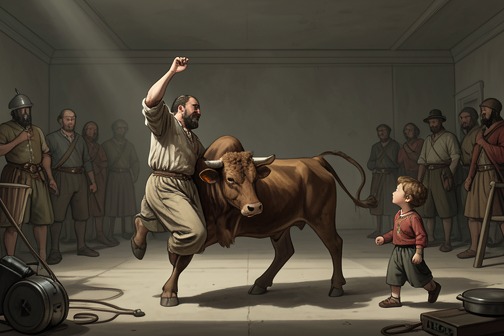
The [Ngarigo](entity:organization-recall-organization-ngarigo-b672143f0280) adoption of the [Bullock](entity:creature-recall-creature-bullock-26ecae335100) Story marks a change in the story’s life: what begins as [Danny](entity:character-recall-character-danny-318bc697472f)’s account of his mother protecting her children becomes a collectively performed narrative, carried through dance, song, and reenactment. The adoption honors Molly’s courage and plight, brings her into the family clan, and lets the Ngarigo share in the Johnson family’s memory without displacing its origins.
## From private memory to performance
The story’s path toward communal life is foreshadowed in an earlier encounter between Molly and her father and a gathering of Aboriginal men and boys. Molly recognizes that the gathering is important and not intended for outsiders; she and her father leave, while its practices remain in her memory as a scene of collective ceremony. Later, Danny recounts the bullock episode to [Yadaka](entity:character-recall-character-yadaka-ab02449e856b). As Danny describes the animal threatening his siblings and his mother taking up the gun, Yadaka rises and mimics the bullock in an Aboriginal dance. His movements draw Danny into the telling: the story is no longer conveyed only in words but also through bodily gesture and movement.
That exchange provides a model for transmission. Danny supplies the family’s remembered event, while Yadaka responds through a cultural form grounded in performance. The story can thus move from one person’s account into a shared enactment, with the teller and performer contributing different kinds of knowledge.
## Adoption into Ngarigo practice
Danny later tells the story to the Ngarigo, who incorporate it into the principles and practices of their ancient culture of mimicry and dance. They build it up with song and movement. The adoption is an act of cultural transmission, but also an act of recognition: the Ngarigo honor Molly for her bravery and acknowledge her plight by making her story part of a communal repertoire.
The event changes the story’s social reach and meaning. It remains rooted in what happened to the Johnson family, yet its performance allows the clan to share in that history. Danny and his siblings are proud that the Ngarigo have honored their mother and brought her into the family clan. The story therefore connects personal remembrance with collective belonging rather than treating the two as competing claims to ownership.
## A continuing family story
The adopted story returns in a later family performance. Danny’s children act it out in a simplified version, without the paint, singing, or traditional instruments of the fuller communal performance. Molly-Mary raises a pretend shotgun, and her brother urges her to shoot; she shouts the action as Danny, playing the bullock, falls, and the children applaud and gather around him. The scene shows the story continuing through play and family reenactment, not only through a formal communal presentation.
The later retelling preserves the central action while passing it to another generation. Its reduced form is distinct from the Ngarigo performance, but it continues to carry Molly’s place in the family’s memory. Across dance, song, and children’s play, the Bullock Story becomes a means of honoring her and sustaining a connection between the Johnson family and the [Ngarigo clan](entity:character-recall-character-ngarigo-28bdda43a5ff).