
The Arrival of Law in Everton
The Drover's WifeThis flow traces how the promised order of Everton becomes entangled with frontier racism, the investigation of murder, and legal decisions that punish the vulnerable rather than secure their safety.
increasing Bearing strength in each event
 decreasing
Bearing strength in each eventdecreasingA New Officer Arrives

The Promise of Order
A new post in the mountains
Nathanael Clintoff arrives in Australia with Louisa Clintoff and their son, Samuel Adrian Clintoff, to take up a position enforcing law in the developing town of Everton. He sees the post as a chance to recover purpose after war injury and years of desk work.
A difficult landscape
The journey to the high country is harder than anticipated. The Clintoffs lose provisions when their wagon is swept into a swollen river, and they reach Molly Johnson’s isolated home needing food and assistance.
Nathanael’s appointment promises formal authority in a place where distance, custom, and violence have shaped daily life. His early dependence on local help foreshadows how little control official law may actually have there.
Murder Shakes the District
The Law Meets a Frontier Crime
A prominent family killed
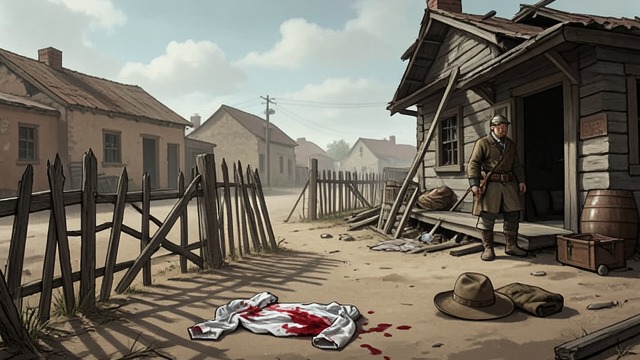
Frank Edwards returns to his property and finds Ulla Edwards, their children, and the Chinese household workers murdered. The crime draws immediate attention because the Edwards family’s wealth and influence are closely tied to Everton’s development.
A suspect in flight
Nathanael investigates the scene while a wounded Aboriginal man, Yadaka, flees through the district. Frank encounters him and assumes he killed the family; the description becomes a wanted portrait distributed around town.
The investigation begins under intense pressure to find a culprit and reassure settlers. From the start, racial assumptions shape which account seems believable, making the search for facts inseparable from the power imbalance of the region.
The Town’s Prejudices

Authority Under Pressure
Order as public performance
During sale day, Nathanael faces drunken brawlers and demonstrates that he can physically control disorder. The spectacle wins the crowd’s approval, but his assistant Spencer Leslie and local attitudes expose a deeper hostility toward Aboriginal people.
A biased hunt
Information about Yadaka is treated through the prevailing assumption that Aboriginal men are inherently dangerous. Nathanael is unsettled by calls for a raid that could kill innocent people, yet he remains inside a system that permits dispossession and violence against the people it claims to govern.
The new officer’s personal discomfort does not by itself change how authority operates. The murder investigation offers a test of whether law can distinguish evidence from racial prejudice, and the pressure to produce a decisive result increasingly narrows that possibility.
An Arrest Becomes a Crisis
The Law Reaches the Shanty
Recognition and accusation
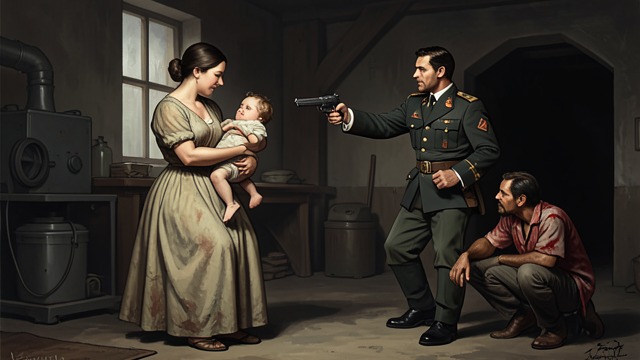
Spencer Leslie finds Yadaka at Molly’s property and recognizes him from the wanted portrait. He arrests Yadaka for the Edwards murders and orders Molly to accompany him for questioning about her absent husband.
A deadly confrontation
As Molly panics over what will happen to her children, Spencer’s pistol shifts between her and Yadaka. Yadaka tries to divert him; Molly shoots the trooper during the struggle, and Yadaka survives the encounter.
The scene brings together the novel’s legal and personal crises. Molly is both a mother trying to keep her children safe and a suspect subject to a system that has already marked Yadaka as guilty before hearing his account.
A Trial Without a Hearing

Justice on the Town’s Terms
A conviction shaped by prejudice
Molly is imprisoned after the killing of McPharlen and is tried before an all-male jury. Her mixed ancestry and supposed motive are used against her, while the people and circumstances that might explain her actions do not receive a fair hearing.
Conscience against duty
Louisa tries to advocate for Molly and argues that abuse, childbirth, and fear for her children must be considered. Nathanael understands the injustice but believes the evidence and his oath leave him unable to stop the sentence.
The law’s authority resolves the case through punishment, not understanding. Molly’s execution exposes the cost of a system that recognizes violence when it is committed by a woman but fails to protect her from years of violence by men.
1893, after the Clintoffs’ journey from London to Melbourne
1893, during the first days of the Edwards murders investigation
1893, during sale day and the days immediately after
1893, the full-moon night at Molly’s property
1893, during the winter trial and execution preparations
