Danny’s notebook
The Drover's WifeDanny’s notebook is the fragile written record through which Daniel Johnson preserves childhood memories that he has carried privately for sixteen years. Its sketches, poems, and recollections hold together a family’s flight, the lessons he received from Molly Johnson and Yadaka, and violence he witnessed but could not disclose. The notebook turns memory into a means of protection and transmission: what Danny first kept to himself becomes part of the story he tells his children.
Form and Origin
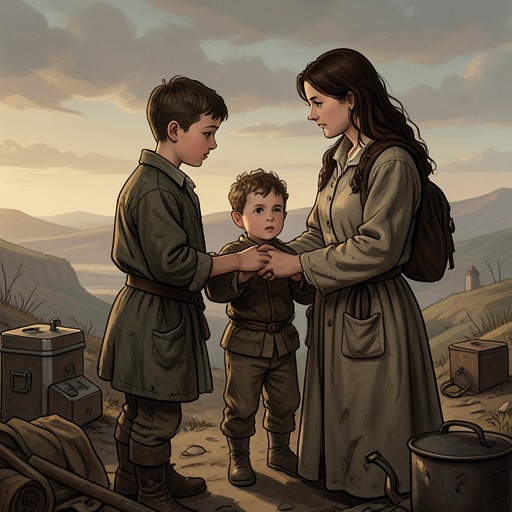
Late one evening, thirty-two-year-old Daniel Johnson sits alone on the verandah of a newly renovated homestead, reading from a tatty notebook by the low light of a lantern. The object is sixteen years old, and its pages gather sketches, poems, and memories. It began as a response to a crisis: the moment that drove Danny, Joe Junior, Henry James, and little Delphi to run into the mountains to be with the people who could teach them. Danny also records what he learned during the four short years he spent with them, aware that their knowledge was ancient and that time and society limited how much could be passed on.
The notebook makes that separation between the remembered past and the writing present visible. Danny reads as an adult, but the contents return him to a boy’s experiences and to teachings he understands as both precious and finite. His sketches seem animated as he turns the pages, giving the old record a vividness that unsettles the boundary between a fixed mark on paper and a living memory. Its age measures the distance from the flight into the mountains, while its continued presence shows that the lessons and losses have not receded with time.
Sketches, Poetry, and Memory
A page bearing a full moon stops Danny’s reading. He has drawn multiple rings around it to represent the unusually large halo of light: a powerful glow and energy that, in his recollection, brought unrest to the land. The image is not merely a record of what the moon looked like. It carries the remembered atmosphere of a night that would become momentous in more than one way, allowing a drawing to hold both a visible phenomenon and the tension associated with it.
The poem connected to the page began with advice from Louisa Clintoff, who encouraged Danny to write as a way of easing pain, hurt, and loss, without needing to show the result to anyone. She had taught him poetry and was by then a newspaper proprietor and a friend. The poem grew out of events Danny remembers too well, but has never shared, not even with his siblings. In the notebook, writing is first a private practice: it gives him a form for experience without requiring immediate disclosure.
That privacy is sharpened by Danny’s sense of responsibility. Even after he and his siblings have grown, he considers it his job to protect them from the harrowing moments he has kept to himself. The notebook therefore contains more than a child’s recollection. It preserves a deliberate withholding, a record whose silences are shaped by his effort to shield his family. The gap between what Danny has written and what he has told others becomes part of the object’s meaning.
The People Preserved in Its Pages
The notebook’s central human story is that of Danny’s mother, Molly Johnson, née Stewart, daughter of Jock Stewart, a Scotsman and jack-of-all-trades. Danny remembers her as strong, steadfast, reliable, and loving. Her story gives the notebook its emotional centre: it is the record of a mother’s fierce love as well as of the difficult events that made survival necessary.
It also preserves Danny’s relationship with Yadaka, the black man he describes as noble, wise, and gentle, and as a warrior of ancient proportions. Yadaka was not Danny’s father, a distinction that matters within the record of their connection. Their bond was built through cautious meetings, time together, and the sharing of stories. Around the fire pit, the man taught the boy and the boy learned from the man; over time, their exchanges grew into mutual understanding and genuine respect. Yadaka’s stay was short, however. The full moon guided him north, back toward his mother’s country, making their learning and companionship inseparable from departure.
The notebook thus keeps several kinds of kinship in view without collapsing them into one another: Molly’s maternal devotion, Yadaka’s brief but formative role, and Danny’s own place as a son and pupil. Its memories make a record of relationships formed under pressure and of knowledge shared in the limited time available. What survives on the page is not simply a sequence of events, but the human connections through which Danny’s understanding of family and belonging was shaped.
Witness, Silence, and What the Notebook Holds
The violence of Danny’s home life also enters the book through a memory he has not previously shared. When Nate Clintoff asks what the boy might have heard on a particular night, Danny’s memory returns in fragments: awake in bed, he hears thumping outside and flinches at each blow. The sounds are muffled, but he recognizes his mother’s groans and whimpers. Through a crack in the wall by the door, he creeps out to see what is happening.
He sees Joe Johnson towering over Molly, who is curled on the ground, trying to protect herself while Joe punches her. Molly does not cry out, apparently afraid of waking the younger children. Danny understands that she is taking the blows quietly because, on an earlier occasion when he tried to intervene, Joe threw him so hard that he struck his head and was sick for days. Molly had sworn she would not let that happen again; her silence is an attempt to keep Danny from being hurt a second time. The memory leaves him wishing the blows had fallen on him instead.
Afterward, Danny is visibly rattled, but tries to control his emotion by fiddling with his fingers and picking at the skin beside a nail. Asked what he heard, he reduces this defining memory to the words the usual. That contrast between the violence he remembers and the understatement he offers shows how deeply silence is bound to his protective instincts. The notebook’s significance lies partly in holding experiences that Danny can record before he can speak them plainly, while the fragmentary return of memory shows that recording does not make them easy to recount.
From Private Record to Inherited Story
As an adult, Danny describes the account he carries as the story he lived, has told, and will tell again, a story of survival he intends to pass down. The notebook is one stage in that movement from private experience toward family memory. What began as sketches, poems, and memories made for himself eventually belongs to a wider chain of telling, though the notebook’s existence does not mean every painful detail has already been shared with his siblings.
That transmission reaches the next generation in the family’s evenings together. Danny sits with his pregnant Aboriginal wife, Nell, and their six children, who range in age from two to twelve and have skin tones from brown to olive, including the red hair and freckles associated with their great-grandmother, Black Mary, or Waraganj, as they prefer to call her. The children listen to their father tell or read stories, while their mother shares Dreaming stories about the land and its origins. They also act out the Bullock Story, honouring Molly Johnson through the story of the bullock and Yadaka’s role in it.
The notebook and these retellings are related but not identical forms of remembrance. The notebook gathers a boy’s private, sometimes unresolved memories; the evening stories give his children a shared narrative they can repeat and perform. Danny smiles at the children’s play, then briefly grows sad at the memory of Yadaka, a sadness Nell alone recognizes. The notebook’s movement toward family storytelling therefore does not erase loss or turn memory into a finished account. It helps ensure that the story of survival, the people who made it possible, and the grief still carried by its teller will remain present for those who come after him.