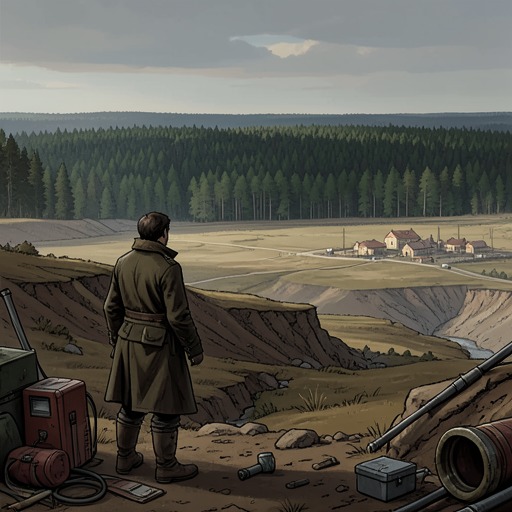
Ginginbarra people
The Drover's WifeThe Ginginbarra people are a clan whose history in the novel is marked by settler violence and the consequences of colonial expansion. Their attack at Bingera, where a settler posse ambushed a sleeping group in 1849, is presented through the history of Robert Parsen and helps explain how personal grievance became a justification for indiscriminate violence. The clan’s story also belongs to a wider account of Indigenous dispossession, coercive authority, and the struggle to sustain kinship and culture.
The Bingera attack and its context
In 1847, Robert Parsen’s family moved to Maryborough with other colonial entrepreneurs to establish a pastoral station. The move brought Parsen into a region where a violent attack on the Ginginbarra clan left twenty-eight squatters dead, including his mother. The account makes clear that his mother was caught in crossfire and killed by one of her own side, a fact that complicates the grievance Parsen later directs at Aboriginal people.
Two years later, thirteen-year-old Parsen joined twenty-one-year-old Gregory Blaxland in leading a vigilante group of about fifty squatters and station hands. At Bingera, they ambushed a group of roughly one hundred sleeping members of the Gin Gin tribe after a gathering. Parsen used his skill with a gun against people attempting to escape, including those entering the Burnett River. The attack was described as violent and indiscriminate, and it fixed a lasting ruthlessness in Parsen while hardening his hostility toward Aboriginal people.
The narrative does not make the ambush a simple act of retaliation. Parsen continued to blame Aboriginal people for his mother’s death despite the account that she had been killed by a bullet from her own side. His response shows how frontier violence can reproduce itself through a grievance that suppresses the circumstances of its origin. The massacre thus carries both the immediate consequence of the attack and the longer consequence of the colonial story Parsen tells himself about it.
Dispossession and colonial authority
The Bingera attack belongs to a broader setting in which white settlement expands through land-taking, fencing, and the forced displacement of Indigenous communities. The novel describes Ngarigo people and neighboring nations losing the ability to follow seasonal patterns and being driven into hiding to survive. A policy of shooting Aboriginal people on sight is presented as having unofficial white governmental permission, while official rhetoric frames dispersal as necessary for national progress. These conditions help situate the Ginginbarra people’s massacre within a wider colonial system rather than as an isolated feud.
The novel also shows colonial authority operating through classification and child-removal decisions. Miss Shirley labels Molly Johnson’s children “octaroons” and appeals to Judge Eisenmangher, who authorizes their removal in the name of their safety. When Molly later finds the order, she burns it. This episode is not an event in the Ginginbarra people’s history, but it echoes the same conflict over who has authority to define Indigenous identity, family, and belonging. The paperwork’s language of protection conceals a coercive power to separate children from their mother and kin.
Memory, kinship, and cultural continuity
The novel sets colonial displacement against Indigenous relationships to Country and community. Yadaka’s account describes his longing to return to his mother’s country and clan after years away; later, he gives Molly directions to a cave where food, shelter, and people await in spring. The promised destination is not only refuge but renewed connection with kin and homeland. This contrast makes clear that removal from land and family is a disruption of continuing obligations and belonging, not merely a change of residence.
That continuity remains vulnerable, but it is also actively carried forward. In the later family account, Danny and his brothers preserve knowledge from their Ngarigo family and pass on men’s-business ceremony to the next generation, even as they recognize that modern change threatens practices central to Ngarigo life. The Ginginbarra massacre and this later cultural transmission occupy different moments in the novel, yet together they expose the stakes of colonial violence: it threatens people, kinship, and the conditions through which culture can endure.
Narrative significance
The Ginginbarra people’s story is told in relation to settler movement, personal grievance, and the violence used to secure colonial control. Parsen’s role links a specific massacre to the way prejudice can persist when a settler refuses the facts that complicate his own account. The novel’s wider scenes of dispossession and child-removal authority extend that critique from armed violence to the bureaucratic power to classify and separate families.
Against these pressures, the novel places community memory and cultural transmission. Its account of the Ginginbarra people therefore contributes to a sustained contrast between colonial claims to manage land and people, and Indigenous ties to Country, kin, and inherited practice. The massacre is a rupture in that history, but the later insistence on cultural continuity prevents the narrative from treating rupture as the end of Indigenous life or belonging.