Molly Johnson’s imprisonment and death sentence
The Drover's WifeMolly Johnson’s imprisonment and death sentence expose how racial classification, gendered violence, and colonial legal authority converge against a mother already struggling to protect her family. Her conviction is not presented as a simple resolution of criminal evidence: the novel sets the legal verdict beside the circumstances of her actions, the absence of a witness able to tell her account, and the state’s earlier attempt to remove her children. As the town prepares its first execution, the law’s claim to order becomes inseparable from the question of whose experience it recognizes.
Custody and the prospect of execution
After Molly is held in the Everton jailhouse, preparations begin for her execution. The town’s first gallows is tested with a sack of flour, and troopers attend to the rope and structure while speaking casually. The ordinary quality of the preparations contrasts with their consequence: the scaffold is being made ready for the execution of a woman who has recently given birth and lost her baby. Molly, meanwhile, looks toward the mountains and hums softly. The scene places her attention beyond the town’s cleared boundary, even as the gallows fixes her within its authority.
Louisa Clintoff arrives carrying hot food, a dress, and the blood-red shoes she wore to a ball in Melbourne. Her concern is not for outward ceremony but for whether anything can still be done to delay the execution. She asks whether a doctor has examined Molly’s condition and argues that the recent birth, the loss of the child, and Molly’s fear for her surviving children should matter. Her appeal makes the jailhouse a point of collision between the scheduled punishment and the physical and familial circumstances the law has not adequately addressed.
Nate Clintoff answers from the evidence he believes he must uphold. He says he witnessed one killing and emphasizes the evidence against Molly, including her confession. Louisa challenges the sufficiency of that account: she points to Molly’s battered face, the possibility of provocation, and the cumulative abuse she endured in her marriage to Joe Johnson. When Nate says there are no witnesses, Louisa replies that such cases rarely have them. Their disagreement is personal as well as legal; Nate is committed to his oath, while Louisa’s effort to secure help for battered wives makes the limits of the existing law impossible for her to ignore.
Racial classification and the threat to family
The sentence follows a distinct earlier exercise of colonial power: an authorized attempt to remove Molly’s children. Miss Shirley identifies Black Mary as Charles Edwards’s daughter, then uses the classification “octaroon” to claim that Molly’s children need urgent help. Judge Eisenmangher signs the authorization for their removal. The language of safety and assistance thus becomes the means by which officials assert control over the children and sever them from their mother.
Danny Johnson learns that the children have been called “octaroons” and asks Molly what the word means. Its force becomes clear to her through a memory from when she was eight: Miss Shirley had discussed sending Molly away because of her mixed heritage, describing removal as a form of cleansing. Molly recognizes that the same racial logic now threatens her own children. Her response is to tie Miss Shirley and Father McGuinness, take supplies, and burn the signed paper. The document’s destruction cannot undo the authority behind it, but it prevents the order from serving as an unchallenged instruction and precipitates Molly’s departure with the children.
This earlier episode clarifies the stakes surrounding Molly’s confinement. The proceedings against her occur in a town where racial identity has already been turned into a basis for separating children from their mother. At Molly’s hearing, Miss Shirley’s declaration of Molly’s mixed heritage becomes part of the Crown’s account: the closing argument characterizes Molly’s actions as generational hatred arising from her heritage and her mother’s history, supposedly encouraged by Yadaka. The narrative places that argument alongside Molly’s own family ties and lived circumstances, showing how an official explanation can convert a woman’s history into evidence against her.
Conviction and competing accounts
Nate’s private reflections register his awareness that the hearing is biased, while also showing why he does not intervene. An all-male jury has convicted Molly; Danny, the only witness Nate believes could tell her truth, is missing. Nate considers whether he should have turned a blind eye, but sees his oath and the evidence he found as binding him. In particular, he regards the killing of Trooper Spencer Leslie as decisive in bringing about the death penalty, distinguishing it in his mind from the killing of Joe, which might have been self-defense.
The account at trial therefore narrows a complicated history into charges and a verdict. Molly is condemned for the murders of John McPharlen, Trooper Spencer Leslie, and Joe Johnson. The sentence does not erase the difference among those deaths or the circumstances surrounding them; rather, the court’s public formula places them together as grounds for execution. Louisa’s argument about cumulative abuse, Nate’s doubts, and the missing testimony of Danny remain outside the verdict’s settled wording.
Molly has said little to Nate during her days in custody, but she tells him that her children will have all the help and love they need. It is a hope, not a certainty: she is imprisoned and expects to die, while the children’s future has already been made precarious by the removal order and the adults who sought to enforce it. Her statement nevertheless keeps the focus on the relationship the legal process threatens to break. The punishment is directed at Molly, but its consequences reach the children for whom she continues to plan.
The scaffold and Molly’s final choice
Before the execution, Molly tells Louisa she will not wear the shoes. They would not feel like her, and she wants to honor her mother; she also wants to feel alive through her final steps. She approaches the scaffold barefoot, and Nate steadies her when she falters. The choice is small beside the sentence, but it is hers: the state controls the setting and the outcome, while Molly retains the ability to refuse the clothing prepared for her and to meet the last stage on her own terms.
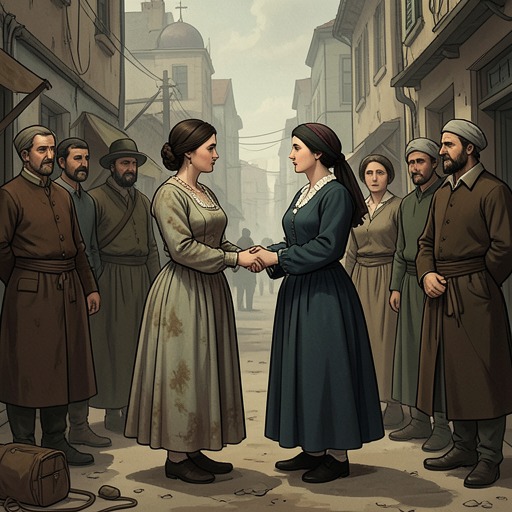
Judge Eisenmangher reads the sentence aloud, ordering that Molly be hanged until dead, and lists the three murders for which she has been condemned. Molly searches the crowd, where stern male faces predominate, until she sees Louisa pushing through it. Louisa is accompanied by two women, one of them Elpida Sava; each has brought an item of bright clothing. Their presence does not halt the execution, but it interrupts the spectacle’s isolation of Molly and makes female witness visible in a gathering otherwise defined by male authority.
The execution is the final consequence of a process in which evidence, racialized interpretation, and legal obligation pull in different directions without producing a reprieve. Nate’s belief that he has acted according to his oath coexists with his guilt and uncertainty; Louisa’s plea for intervention coexists with her failure to secure a stay. Molly’s sentence thus marks both the reach and the limits of the law in the novel: it can confine and condemn her, but the closing scenes preserve the competing account of a mother whose actions and family cannot be understood by the verdict alone.