Motherhood as protection and survival
The Drover's WifeMotherhood as protection and survival is the novel’s account of care made practical under pressure: Molly Johnson protects her children through everyday provision, instruction, affection, and decisive action, even as poverty, repeated pregnancy loss, illness, and racialized authority constrain her choices. Motherhood brings her a sense of purpose and peace, but it never removes the dangers she must manage; instead, it gives those dangers their most urgent stakes.
A hard-won maternal refuge
Molly’s understanding of motherhood begins in the insecurity of her own childhood. She recalls worrying about whether her father would survive his drinking, whether they would find shelter in rain, whether the sun would harm him, whether he would return from the shearing shed, and where the next meal would come from. She describes care as a constant calculation of basic needs. Against that childhood, seeing her daughter skip without worry becomes evidence that she has done her job and found a place in the world as a mother. Her children are not simply responsibilities: they are the source of the peace she has been able to find.
That peace is hard-won rather than effortless. Molly says her children can detect her worries even though she tries not to let those worries affect them. She has learned how to make things right, but the old habits of vigilance remain. The contrast between her anxious childhood and her daughter’s untroubled movement gives maternal protection a specific measure of success: not a life without hardship, but some relief from fear for the next generation.
Pregnancy makes the limits and costs of that refuge unmistakable. At seven and a half months, Molly counts this as her tenth pregnancy, with four consecutive miscarriages and a long interval before Danny survived. She calls Danny her angel and says she might have taken her own life had he died. The arithmetic is more than family history: it shows how closely her attachment to her children is bound to grief, survival, and the possibility of losing the child on whom her hope had come to rest. Now, at forty, she fears that her current pregnancy will be her last and worries about the preparations she cannot afford and the time she has left.
Care in ordinary acts and urgent danger
The novel repeatedly defines Molly’s protection through concrete acts rather than sentiment alone. During a family walk, the children run ahead, play observation games, and use pieces of bark to choose their route. The games also help with their schooling. At the river, when the boys argue, Molly ends the quarrel and sends them out of the water, balancing discipline with an awareness that they have been cooped up by rain. These ordinary decisions establish the attentive knowledge on which more dramatic acts of protection depend.
During the sudden flood, that knowledge turns into immediate action. Molly orders the children onto the bank, then realizes Danny is missing. When she sees him holding on to a boulder, she plunges into the fast-moving water despite her pregnancy. The current carries her under, and she is trapped by a branch; even then, her attention is fixed on her children and her unborn baby. The novel makes the conflict stark: reaching Danny exposes Molly and the pregnancy to danger, but remaining on shore is incompatible with the responsibility she feels. She survives the episode, while the fear of not seeing her children again returns afterward as private grief. She weeps alone, then composes herself to face the day and care for them.
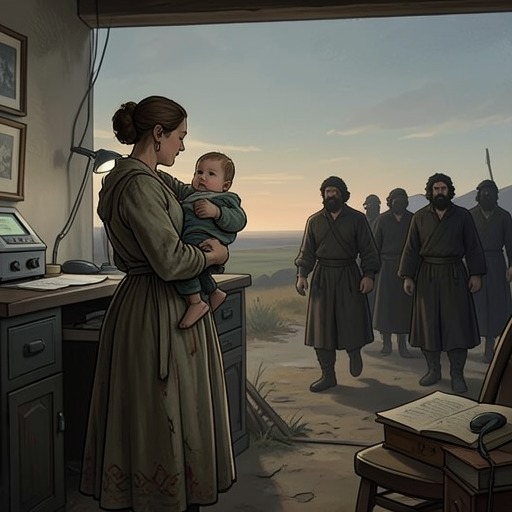
Molly’s maternal responsibilities also shape the choices she makes when help arrives in circumstances she distrusts. After a difficult breech birth, she is exhausted and faces the birth without dependable medical assistance. When the stranger offers to help, her fear of the racial and social consequences of a white woman accepting care from a Black man leads her to knock him unconscious with her shotgun. The decision is made under pressure, not as an abstract judgment on whether assistance is needed: Molly is trying to protect herself and her children in a world where racial boundaries and danger govern even intimate acts of care.
The baby girl is stillborn, and the stranger helps Molly bury her. Molly recognizes that freeing him may bring trouble, particularly because a reward could draw troopers to her home. But she is unwell, Danny cannot do everything she needs, and the stranger has helped with the burial and, in her judgment, saved her life. She breaks the iron collar with her axe and sets a limit: he can stay briefly, work, and then leave. Maternal protection here includes weighing competing risks when there is no safe or easy choice. Her actions do not erase her loss or the danger; they show care operating within both.
Family teaching, separation, and cultural memory
Molly’s care extends beyond immediate safety. When she sends the children away in the covered wagon, she prepares parcels of clothes and food, includes meat for trade, and gives Danny a written list and specific instructions about supplies. She asks him to look after his siblings, choose fresh vegetables, obtain a suitable animal, and remember that bullets are low. The practical detail matters: she entrusts Danny with responsibility because the family’s survival depends on provisions, judgment, and cooperation.
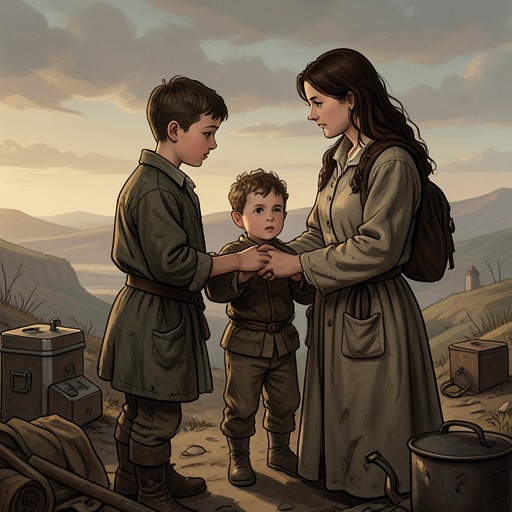
At the departure, Molly kisses and cuddles the younger children, tidies them, and gives Delphi extra time because this is her first time away from her mother. She tells them that she loves them and reminds them to mind their manners. Then she performs a family ritual: a clenched fist touched to their foreheads, a breath released through it, and the words “Always with you.” The same words belong to her own memory of her mother’s farewell to Waraganj, who leaves her promised marriage and accepts a dangerous path of her own. In repeating that ritual with her children, Molly turns inherited maternal reassurance into a means of enduring separation. Its meaning is not that distance is harmless, but that love and remembered kinship can accompany those who must leave.
The novel places this family care in direct conflict with authorities who describe coercive separation as help. At a hearing, Miss Shirley identifies Black Mary’s father as Charles Edwards and urges that Molly’s children be classified as “Octaroon,” calling their removal urgent. Judge Eisenmangher signs the authorization for their removal, and Danny is frightened and confused by the prospect of being taken from a mother he knows as loving and devoted. The bureaucratic language of safety thus collides with the children’s experience of family care: the very mother who has fed, taught, and protected them is treated as grounds for intervention because of her ancestry and theirs.
Protection under intersecting pressures
Molly’s position is shaped by gender, poverty, and racialization together. The novel shows that isolation limits access to help, pregnancy intensifies physical and practical vulnerability, and discriminatory attitudes make ordinary decisions dangerous. In one exchange, an Aboriginal man explains that his only crime is being black; Molly understands that Aboriginal people are blamed, arrested, imprisoned, driven away, or exposed to unofficial permission for violence. Her own need to protect her household cannot be separated from the conditions that make his presence, her assistance to him, and the prospect of official attention perilous.
The same inequality structures the threat to her children. Miss Shirley’s appeal to racial classification and the judge’s order give institutional force to the idea that the children need to be removed, despite Danny’s understanding of his mother’s care. Later, the legal proceedings against Molly are shaped by the declaration of her mixed heritage and by a prosecution account that treats her actions as the expression of inherited racial hatred. Nate Clintoff recognizes that the hearing is biased and that Danny, the only witness to Molly’s truth, is absent. The law does not simply fail to protect a vulnerable mother; it interprets her ancestry and actions in ways that help make her vulnerable.
Maternal resolve and its limits
When Molly rides away with Danny under the full moon, she carries a shotgun and the supplies needed for the journey; Danny carries the killing spear Yadaka gave him. The scene presents escape as another form of maternal protection: Molly acts to keep her son with her and to resist the forces that threaten the family’s integrity. The speed and purpose of her departure stand in contrast to the authorities’ formal claim to act for the children’s safety.
Molly’s fate reveals the limits of what maternal resolve can secure. In custody, she tells Nate that her children will have all the help and love they need, expressing a hope rather than control over what follows. The novel’s presentation of motherhood therefore refuses both idealization and defeat. Molly cannot prevent every loss or command a just response from the state, but her care shapes the children’s daily lives, equips them to act, gives them a language of belonging, and drives her attempts to keep them together. Protection is shown as persistent labor, undertaken within conditions that no mother can overcome by love alone.