Thomas McNealy
The Drover's WifeThomas McNealy is a wandering swagman whose brief appearances reveal a practiced opportunist: at Molly Johnson’s shanty he tries to turn an unconscious, injured Yadaka into a source of reward, while in Everton he uses the wanted posters and public hostility toward Yadaka to distract a crowd as he steals a gold pocket watch. He is not a dependable guide to danger but a danger of his own, moving through other people’s crises by exploiting what they fear and what they are ready to believe.
Identity and Appearance
McNealy introduces himself to Molly as a swagman, tipping his hat and bowing with theatrical formality. He appears to be around sixty-five, but remains fit and strong. His old, dirty three-piece suit suggests an effort to project respectability, while his soleless boots expose the precariousness of that performance: their laces loop beneath his feet and tie over the tops, making the shoes look more substantial than they are.
The mismatch between costume and condition is a recurring clue to how McNealy presents himself. He adopts the manners of a gentleman when it serves him, but neither the bow nor the title he gives Molly makes him trustworthy. His footwear, like his later storytelling, signals that appearance is something he improvises to gain an advantage.
Opportunism at the Shanty
McNealy arrives at Molly Johnson’s shanty while she is guarding the unconscious Yadaka. Rather than offer help, he immediately asks whether the man is dead, then presents himself as Thomas McNealy with a hat-tip and an elaborate bow. Molly recognizes the familiar pattern of local swagmen who appear at sunset with appeals for food and shelter, pressuring women whose husbands are away. Her knowledge makes her wary: she keeps her shotgun aimed at him and demands that he state his business.
McNealy claims Molly may have earned a reward because Yadaka is a wanted murderer, placing the blame squarely on the injured man. He says troopers will soon be searching the district, turning the authorities’ pursuit into leverage over Molly. When she counters that her husband, Joe, will soon return and mentions his sheep, McNealy replies that the flock is already on its way. Whether truthful or not, the remark unsettles her. As a contraction forces her to double over, McNealy takes the opportunity to seize her shotgun. His performance of polite deference has given way to direct opportunism, while Molly’s pregnancy makes the encounter more dangerous.
The Sale-Day Theft and Escape
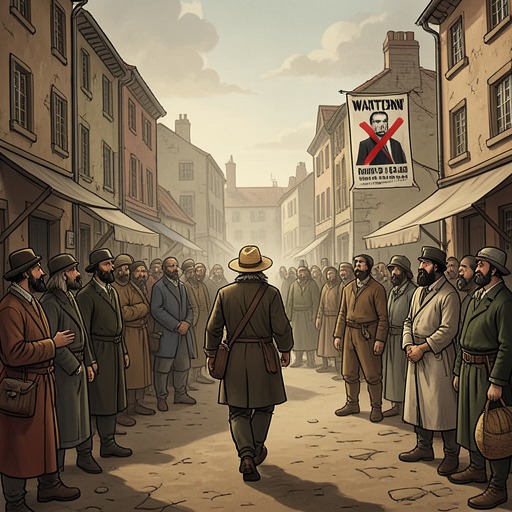
Later, during the crowded sale-day festivities in Everton, McNealy reappears at the edges of the main street, where wanted posters of Yadaka have been displayed on shopfronts and posts. A group of well-dressed townsmen study the portrait and voice contempt for the man it depicts. McNealy approaches from the shadows, then steps into the light and claims to have seen Yadaka. His story grows as he performs it: Yadaka becomes an enormous, threatening figure, and McNealy watches the crowd for signs that his account has taken hold. The wanted poster and the townsmen’s prejudice become tools in his own small deception.
As he moves around the group, McNealy secretly searches a gentleman’s pockets. The man soon discovers that his gold pocket watch is missing and points out the direction of the thief. Sergeant Clintoff, already near the Stanlow, hurries after McNealy, whose dirty, mismatched suit and soleless shoes make him recognizable. Clintoff pursues him despite an injured leg, but McNealy disappears behind a building into the crowd gathered at the boxing tent. The episode ends with the thief still evading capture: he has turned the public spectacle of Yadaka’s wanted status into cover for theft, then used the larger sale-day crowd to escape pursuit.
Characterization and Narrative Function
McNealy’s appearances form a compact sequence of performances rather than a sustained personal history. At Molly Johnson’s shanty, he presents an official danger to draw attention toward Yadaka and away from himself; at the sale-day gathering in Everton, he turns the same wanted man into a sensational story that helps him steal. In both scenes, he reads his audience, supplies a version of events suited to its fears, and acts while others are occupied by the account. The repetition makes his central skill less a single lie than the opportunistic use of other people’s expectations.
At the shanty, Molly already knows that some local swagmen exploit requests for food and shelter, especially when a woman’s husband is absent. Her suspicion prevents McNealy’s courteous introduction from earning trust. Later, the well-dressed townsmen’s hostility toward Yadaka gives McNealy a different opening: he amplifies their assumptions with an exaggerated description, then searches a gentleman’s pocket as attention follows his performance. The incidents are not equivalent in scale, but their shared mechanism links private intimidation to public prejudice. McNealy profits from an atmosphere in which Yadaka is readily treated as a threat.
The sale-day episode also sets McNealy’s deception against the visible machinery of official accusation. Trooper Leslie’s wanted posters give the crowd a portrait to inspect, while McNealy claims direct knowledge of the person depicted and embellishes it for effect. His story does not expose Yadaka’s guilt or innocence; it exposes McNealy’s readiness to exploit the poster and the crowd’s response for personal gain. When Sergeant Clintoff pursues him after the theft is discovered, McNealy vanishes into the people gathered outside the boxing tent. The book leaves his immediate fate unresolved, ending his recorded trail with evasion rather than capture.
His patched-together appearance reinforces this role without turning it into a full account of his life. The worn suit and soleless boots suggest an attempted display of standing that cannot conceal material poverty; his formal bow and self-styled courtesy similarly offer manners without reliability. McNealy is therefore a marginal figure who moves through the crises of others, but the narrative does not make him a heroic rogue or a dependable observer. His brief episodes instead expose how easily fear, respectability, and racial hostility can be recruited into small acts of coercion and theft.