Yadaka
The Drover's WifeYadaka is a Guugu Yimithirr man adopted into the Ngarigo community, a fugitive from colonial authorities, and a keeper of stories whose brief presence changes how Molly Johnson and Danny understand their family and their place in the world. He brings hard-won knowledge of dispossession and loss into the Johnson home, but also offers instruction, companionship, and a route toward community. His death does not end that work: Danny carries Yadaka’s memory into a later life in which story and ceremony help sustain Ngarigo cultural continuity.
Identity and Background
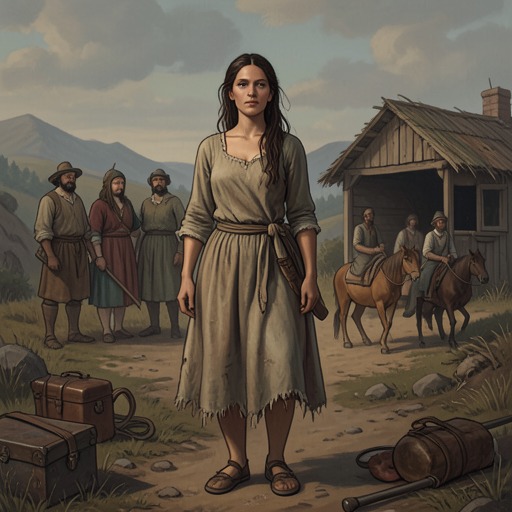
Yadaka is introduced as an Aboriginal man on the run, identified by the iron collar around his neck and the clothing issued to felons. He has been travelling for days while seriously unwell, hoping to cross the southern range and continue north toward Guugu Yimithirr country, his mother’s country, now called Queensland by white settlers. The journey is expected to take months, yet he is willing to undertake it to return to Country and his people. His present flight is only the latest part of a life marked by trauma and separation.
His history includes a period of care at a home for young Aboriginal men in Echuca, Victoria. He arrived there at about fifteen and was cared for by Father Daniel Matthews, who called himself guardian to the boys in his charge. Yadaka was trusted with work around the Matthews household, learned to read and write, and took pleasure in music shared at church and in the family home. That care did not erase his longing for his mother’s country in Far North Queensland or his desire to return to his clan. His literacy also gives him access to records that their authors did not expect him to read: he has learned about the authorities’ intentions from diaries and journals left open by people who underestimated him.
The name he gives when meeting the Clintoffs describes a layered belonging: he is “Yadaka. Of the Guugu Yimithirr adopted Ngarigo.” His identity holds together his connection to his mother’s country and his adoption into Ngarigo community, rather than reducing him to one affiliation. The book’s account of colonial settlement supplies the political context for that divided geography. The Ngarigo and neighbouring peoples are losing land to settlers, fences, and forced displacement; seasonal movement has become harder, and survival increasingly depends on staying out of sight. Yadaka’s need to travel home is therefore personal and cultural, while the danger attached to that journey is imposed by colonial authority.
Flight, Encounter, and Knowledge
Yadaka reaches Molly’s isolated home as an injured fugitive seeking shelter. Their meeting begins in suspicion: Molly stands over him with her Cowles & Dunn shotgun, and he is afraid to move. She fears that his presence may bring troopers to her doorstep, especially when she is already vulnerable, and initially sees his escape as a danger to herself and her children. He answers that fear by identifying the injustice behind his situation, saying, “My only crime, missus, is existin’ whilst black.” The exchange does not make the risks disappear, but it makes the unequal terms of their predicament explicit.
The relationship develops through cautious meetings and conversations around the fire. Yadaka offers kindness and knowledge; Molly offers shelter. Their time together is short, but the narrative describes a genuine mutual respect growing between him and Danny. In the retrospective account preserved in Danny’s old notebook, Yadaka is remembered as noble, wise, and gentle, a man of extraordinary stature who was nevertheless not Danny’s father. That distinction matters: Yadaka’s place in Danny’s life is formed through teaching, trust, and shared stories, not biological parenthood.
Yadaka also entrusts Molly with knowledge of a devastating loss. He tells her that he returned to find his wife, children, and elders dead. By reading tracks, he concluded that his family had been forced into a river and fired upon from both banks in a planned ambush. His account gives personal meaning to the wider violence directed at Aboriginal communities: dispossession is not an abstraction but the destruction of the people to whom he hoped to return. The disclosure deepens the relationship between him and Molly, while showing the grief and history carried by the fugitive she has sheltered.
During this encounter, Yadaka also connects Molly to Ginny May, the woman who had helped her: Ginny May is his adopted mother. The discovery links Molly’s immediate crisis to Yadaka’s earlier life and adopted family. His presence is consequently not only a chance meeting between strangers. It brings into the Johnson household a network of relationships and knowledge that reaches beyond the isolated homestead.
Teaching, Kinship, and the Proposed Journey
Yadaka’s bond with Danny is expressed through practical instruction as well as storytelling. He tells Molly that he can take Danny on his first kill with his spear, describing it as men’s business and a promise he has made to the boy. He also offers to take Molly and her daughter on a walk to see wildflowers near the widening Snowy River. These plans place him in the role of guide: he imagines Danny’s initiation into responsibility and offers Molly a chance to encounter the country beyond the demands of immediate survival.
He gives Molly precise directions to the cave where he intends to shelter for winter, northeast of her home and two and a half days’ walk away. The route is marked by the Great Waterhole, a bald patch, and three boulders shaped like emu eggs. The cave promises food, blankets, and shelter; in spring, he says, people will be there. He presents the destination not simply as a hiding place but as a possible return to community, telling Molly that her people are there too. His invitation joins material safety to belonging, while leaving the choice to follow him with her.
That promise is complicated by the authorities’ response to the possibility that Molly is sheltering him. Miss Shirley uses the accusation to describe Molly’s children as “Octaroon” and to urge their removal in the name of safety. Judge Eisenmangher signs the authorization. The episode shows how Yadaka’s fugitive status can expose Molly’s mixed-heritage family to state intervention even when the children’s welfare is invoked as its justification. The same colonial order that pursues Yadaka also classifies and threatens the Johnson children, making his presence a point where different forms of racialized vulnerability converge.
Death and Consequences
Yadaka’s intended route north and his proposed return to Country are cut short by violence at Molly’s home. Robert Parsen arrives armed and threatens him. During the struggle that follows, Yadaka is still recovering from an earlier assault; when Parsen’s shotgun jams, Yadaka seizes the opportunity to fight back, but Parsen ultimately incapacitates him and orders that he be tied up. The outcome is shown later that night. At midnight, Danny stands in the yard and sees Yadaka hanging from a snow gum, with Joe Johnson’s boots just above the ground. The image joins Yadaka’s death to the household’s earlier history and makes Danny a direct witness to the loss of the man who had become his teacher and trusted companion.
Yadaka’s death also shapes the public story told about Molly. At her trial, the Crown presents her knowledge of her heritage and her mother’s suffering as the source of a supposed generational hatred, and characterizes Yadaka as a wanted murderer who encouraged her to seek revenge. This account recasts his influence as incitement. It contrasts with the intimate memories of cautious conversation, shared stories, mutual respect, and instruction that Danny preserves. The trial therefore becomes a struggle over how Yadaka’s role will be understood: as the authorities’ racialized threat, or as a man whose teaching and presence helped Molly and Danny imagine another way forward.
Memory and Cultural Continuity
Yadaka survives in Danny’s recollection as a great man, father, and warrior who acted out the Bullock story. Danny loves retelling the episode, though the memory can bring a fleeting sadness that his wife recognizes. The story preserves more than an entertaining account of Yadaka’s character: it carries a relationship forward after his death and gives later generations a way to remember the people and losses bound up in it.
The novel connects this personal memory to collective practice. In a later generation, Danny’s son Mirribi is to complete the final stage of his men’s-business ceremony, a tradition that Danny and his brothers learned in the high country with their Ngarigo family. Their Uncle Bulbarai had passed the ceremony on in haste because he knew that modern ways were threatening practices the Ngarigo regarded as essential to survival. The children had returned from the mountains after the initiations of Joe Junior and Henry James. Against this pressure of cultural loss, Yadaka’s teaching belongs to a chain of transmission that joins Danny’s experience to Ngarigo kinship and ceremony.
The Ngarigo honor the Bullock story for Molly’s bravery and the respect for her plight it expresses, bringing her into the clan’s shared memory. Danny and his siblings take pride in seeing men, women, and children dress and paint to perform it. Yadaka is remembered within this communal act not as an isolated fugitive but as a storyteller whose relationship with Danny contributed to a story the Ngarigo could adopt and share. His plotline ends with colonial violence blocking his return home; his narrative role endures through the stories and practices that continue to hold people together.