Crossley Educational Trust grant paperwork
The DryThe Crossley Educational Trust grant paperwork turns an abstract suspicion into a traceable financial crime. It records that Kiewarra Primary School received a $50,000 award after an earlier application had been rejected, and its arrival exposes how Scott Whitlam diverted the money to meet debts. When Karen Hadler brings a Trust form to Whitlam’s office, the document becomes more than administrative evidence: his panicked dismissal of it tells her that something is wrong, while the reader learns how the theft was carried out and why he felt trapped into continuing it.
The award and its paper trail
The paperwork connects two applications and two sharply different outcomes. The school’s claim to the Crossley Educational Trust had been rejected the previous year; this year, the school was successfully awarded $50,000. Aaron Falk establishes the award by calling the head of the trust, then explains its significance to Greg Raco. The amount is concrete enough to define the stakes, while the discrepancy between rejection and subsequent success makes the grant itself a consequential piece of information rather than an incidental school record.
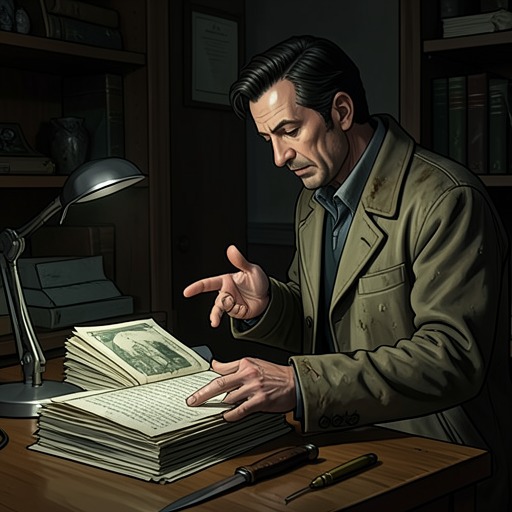
The particular page Karen presents is a form survey sent automatically to successful recipients to collect feedback about the submissions process. Its letterhead bears the Crossley Educational Trust logo, and the form is not, by itself, a direct record of the altered bank details or the money’s destination. Whitlam recognizes that it is not a conclusive smoking gun and suspects there may be further paperwork Karen has kept back. Its force comes from what it establishes: the trust has awarded funds to the school, and Karen has found a document that gives her reason to question what happened to them.
The paperwork also has a history before it reaches Karen’s hands. The funding notification, addressed directly to Whitlam, arrived two days after men from Melbourne came to his house to demand repayment of his debts. It arrived with the claim form while Karen was off work, and Whitlam left it unopened on his desk. That timing helps explain how he encountered the opportunity, but it also places the grant inside a chain of pressures and choices: the money was public support for the school, while Whitlam saw it as temporary relief from creditors.
Diversion and intended use
Whitlam decided to divert the money almost immediately. He reasoned that the Trust gave away millions and that $50,000 would be a small amount by comparison. He imagined assigning it to a vague category such as training courses or support programs, descriptions he thought might satisfy the funder’s requirements long enough to conceal what he had done. His plan was not to treat the grant as a permanent source of money; he intended to borrow it, pay his Melbourne creditors, and repay it later, somehow. The amount would not clear his debt, but he believed it could buy him breathing space.
The mechanism depended on changing the bank details while retaining the school’s account name on the form. Whitlam substituted his private account number, which Sandra did not know about, and relied on his belief that banks used the numbers rather than checking whether the account name matched. The paperwork therefore records the practical seam between the apparent recipient and the real destination: the school’s name remained visible, but the account details redirected the funds. Whitlam privately judged the arrangement to be barely workable, not a secure solution, and Karen’s discovery threatened the time he had hoped to gain.
His circumstances explain the urgency without erasing his agency. The men who came to his home had brought a nail gun and threatened his wife and daughter if he failed to produce money. Whitlam heard Sandra and Danielle talking in the kitchen as the men described what they would do to them; they also made him touch the nail gun. He feared that prison would leave him unable to repay his creditors and expose his family to the consequences. Under that pressure, the grant looked to him like an available reprieve, but he chose to conceal the diversion rather than disclose or resolve it openly.
Karen’s discovery and Whitlam’s response
Karen enters Whitlam’s office on a Wednesday afternoon, closes the door against the sounds of the school, and sits close to his desk. Worried and cautious, she tells him she has found a problem she cannot ignore, then hands over the paper bearing the Trust’s letterhead. Her manner suggests that she wants reassurance and a reasonable explanation, not simply an opportunity to accuse him. The form’s importance lies partly in this encounter: a routine feedback survey has placed the grant’s existence before someone prepared to ask what became of it.
Whitlam understands that Karen is giving him a chance to explain or confess. He later recognizes that he had misread the moment: he might have treated the award as surprising and promised to look into it, but instead he panics and dismisses the document without properly reading it. He tells her it will be nothing, a mistake to ignore. Those words do not settle her concern. As she leaves, Karen’s back stiffens and her gaze drops; Whitlam reads her changed manner as a sign that she has become more certain of his guilt. Her goodbye is dry, and the distance between them has widened.
The encounter produces an immediate physical reaction in Whitlam. After Karen leaves, he silently vomits into the wastepaper bin. He also punches the wall beside him, discreetly, until his knuckles are raw and bleeding. These actions show the pressure the paperwork activates: it has brought the hidden diversion into the room, alongside the threat to his family and his fear of prison. The form does not itself convict him, but his response makes the ordinary-looking document a point of exposure that he cannot control.
Narrative and evidentiary significance
The paperwork operates at two scales. As a record, it anchors the investigation in the difference between the school’s rejected prior application and its successful $50,000 award, and in the mismatch between the account name and the private account number. As a scene prop, the Trust letterhead is the detail Whitlam recognizes when Karen places the form before him. Its administrative plainness contrasts with the coercion and panic surrounding the theft: an automatically sent survey becomes the visible edge of a much larger concealed transaction.
The document also links the investigation’s discovery to Whitlam’s earlier decision. Falk and Raco can establish the award independently by contacting the head of the trust, while Karen’s form supplies the immediate occasion for Whitlam’s failure to conceal his alarm. The paperwork therefore serves both as a lead and as a test of character: it makes the financial fact verifiable, but it is Whitlam’s response that reveals the fragility of his cover. He had hoped to buy time; the form instead marks the moment when that time begins to run out.