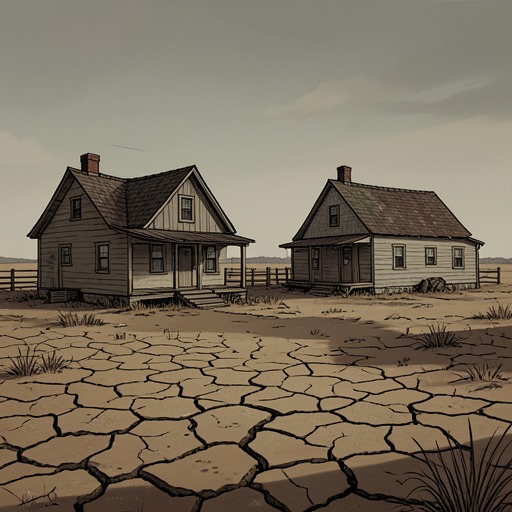
Deacon Farm
The DryDeacon Farm is an isolated hill property whose barns and farmhouse preserve the painful history of Ellie Deacon’s family. Seen from surrounding farms and approached by a gravel drive beneath a faded sign for Deacon Estates, it appears at once as a working rural property and as a place where the past has never settled: Ellie’s childhood home, Mal Deacon’s farm, and the setting of details that later make an apparently orderly bedroom feel like evidence of something suppressed.
Setting and Approach
When Aaron Falk walks around the property as an adult, the scale of the country makes its isolation newly apparent. The sky stretches above yellow fields, and a wire fence marks the edge of a tangled area of bushland. Although Falk’s childhood home was only a short bike ride away, it cannot be seen from the farm; the only other house in view is a sprawling gray building on a distant hill, Ellie’s house. The landscape that once seemed full of life to Falk now emphasizes the distance between households and the difficulty of seeing what happens behind another family’s walls.
The property sits high above the surrounding countryside. From there, Falk can see Hadler Farm down in a shallow valley: its rotary washing line looks like a cobweb on a stick, and its garden benches like dolls’ furniture. The view recalls visits Falk made to see Ellie twenty years earlier, but the memory no longer makes the landscape welcome. He now cannot bear to look at it. The same height that once offered a familiar view instead exposes how near the farms are to one another geographically, and how far apart their lives can remain.
Barns and Family History
The farm’s three barns belong to its working landscape, but one becomes the site of a formative childhood memory. At eleven, Falk watches Mal Deacon shear sheep with clippers and a brutal hand, leaving the animals bleeding and staggered. When the smallest ewe cries out, Falk begins to react, but Ellie pulls him away by the sleeve and silently shakes her head. The gesture ends the children’s attempt to intervene; Ellie’s familiarity with the scene, and her decision that they must leave, gives the barn’s violence a human context beyond the injured flock.
As the children turn away, they see Ellie’s mother watching from the barn doorway. She stands pressed against the frame in an ill-fitting brown jumper, holding a glass of amber liquid, her face resembling Ellie’s. Falk observes her close her eyes and breathe in sharply before fixing her husband with a look of unmistakable regret. A month after the shearing, with the difficult weather making farm work harder, Grant Dow moves into the farmhouse to help. Two days later, Ellie’s mother leaves in an old car with two suitcases and a clinking bag of bottles, promising her crying daughter that she will return soon. The farm’s domestic history is therefore marked not only by Mal’s violence but by a departure Ellie may have continued to hope was temporary.
Farmhouse and Hidden History
The farmhouse brings the farm’s public, practical routines into contact with its private tensions. Mal lives there with his nephew Grant, who does laboring and odd jobs rather than caring for his uncle full-time. When Mal comes home and finds no dinner prepared, he is irritated; Grant is lying on an old brown couch with a beer can on his stomach while cricket plays on the radio. Grant says that Ellie is responsible for the meal, and Mal takes a beer before going to the rear of the house. These ordinary details establish a household in which Ellie’s expected domestic work persists even when she is absent.
Her bedroom contrasts sharply with the disorder elsewhere in the home. It is clinically neat, silent, and almost separate from the rest of the farmhouse. Mal hesitates at the doorway rather than stepping inside. In the room, however, a small circular dent marks the white bedpost, and a roughly scrubbed circle on the pink carpet is a shade or two darker than the surrounding pile. The marks are slight enough to escape casual notice, but together they disturb the room’s apparent perfection. Mal feels that something is wrong and senses a memory pressing forward; he drinks until it recedes, allowing anger to take its place. The farmhouse thus contains a concealed history not through a dramatic change in its appearance, but through minute damage that its order cannot quite erase.
Land, Neighbors, and Narrative Significance
Deacon Farm also matters as property. Its boundary meets Hadler Farm, and Falk recognizes that the two parcels could be more valuable to the right buyer together. A local account says Mal intends to leave the farm to Grant, whose expected inheritance could become a windfall if investors interested in rural land were to buy it. The prolonged drought is not necessarily permanent, and the farm’s future value depends partly on what happens to the neighboring Hadler property. With Luke Hadler alive and managing his land, a sale seems less likely; after his death, Falk files away the changed possibility. The surrounding land therefore links the Hadler deaths to questions of inheritance and sale without itself resolving who is responsible.
Later, Falk approaches the property by a faded sign pointing to Deacon Estates and passes ragged sheep that raise their heads as he drives along the gravel. Mal is outside a dilapidated barn, struggling to lock his car; his hands shake and he drops his keys into the dust. His dog growls at Falk, but Mal’s expression is no longer simply aggressive: he appears exhausted and confused. The scene places the farm’s visible decay alongside the uncertainty surrounding its owner. Across its changing appearances—from a childhood landscape, to a remembered view, to a property with a damaged barn and ragged flock—Deacon Farm makes isolation and concealed history part of the same setting. Its rooms, boundaries, and sightlines connect the family’s private past to the neighboring farms, while leaving crucial truths hidden in plain view.