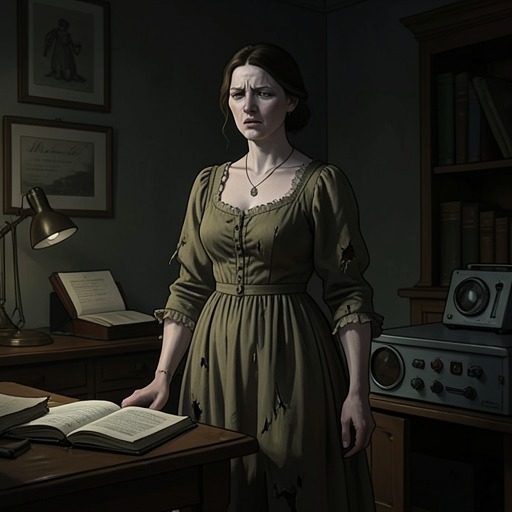
Ellie's diary
The DryEllie's diary is the private record through which Ellie Deacon's hidden life and intended escape become legible. Found decades after she hid it, it recounts the abuse she suffered at home, the fear that kept her from asking for help, and the practical steps she took to leave. Its significance lies not only in what it preserves, but in the contrast between the care with which Ellie prepared to survive and the fact that she never came back to retrieve it.
Discovery and Physical Form
The diary was at the very bottom of a backpack hidden in the gap in Rock tree. Aaron Falk recognized the bag immediately: the place was known only to him and Ellie, who had died in the river. The pack had been concealed there for years, and the diary itself had been wrapped in a raincoat when Ellie hid it, a small act of protection that had preserved it through the long interval before its discovery.
When Aaron opened the backpack, its contents showed that it had been assembled for a departure rather than left as a casual cache. It held several changes of clothes, a hat, underwear, a small bag of makeup, a plastic wallet containing identification in the name Sharna McDonald, and money Ellie had saved in small amounts. The diary lay beneath these items, making it both part of the escape kit and its most revealing record. Its cover was hard-backed, but it had become tattered and curled at the edges; the writing inside remained readable.
What the Diary Records
The recovered account traces the abuse Ellie experienced as she grew older and increasingly resembled her dead mother. Her father, Mal Deacon, first struck her when she was fourteen, calling her by her mother's name. The diary describes further physical abuse and sexual abuse, not as an isolated rupture but as a pattern that returned. Ellie's attempts to reduce her father's drinking did not make her safer, and her cousin Grant Dow dismissed the visible signs of harm rather than intervening.
The effects reached beyond the farmhouse. Ellie's schoolwork deteriorated, while teachers responded to her lack of attention with criticism instead of asking what was happening. Girls she had thought were friends whispered about her and pulled away. The diary thus records not only violence within the family but also the failures of the people around her to recognize or respond to her distress. Her isolation was cumulative: home offered danger, while school and friendship offered no dependable refuge.
Ellie's response changed over time. She began drinking, as both her parents did, but stopped after another frightening episode at home convinced her that she needed to leave with a clear head. The record makes that decision a turning point rather than a sudden escape: she intended to go soon, but not impulsively or into an unknown situation without preparation. A later assault intensified the urgency. The next day, she noticed the damage to her bedpost and cleaned blood from the carpet; the diary presents the aftermath as part of the moment when staying ceased to seem tenable.
The Escape Plan
The possibility of leaving became concrete when Aaron discovered the hidden gap in Rock tree. Its secrecy and size made it suitable for concealing a bag, and Ellie understood it as a place where she could prepare without her father finding her things. She was also aware of what leaving would cost emotionally. After she and Aaron kissed, his touch to her sore head made her recoil; he saw her reaction, but she did not tell him why she was hurt. The diary identifies fear, rather than a lack of trust or affection, as the force that repeatedly stopped her from speaking.
That fear was tied to the power Mal exercised beyond the household. Ellie had seen him threaten people and carry out retaliation, and she believed there was no one in Kiewarra she could rely on to stand up to him. In a community where people had to choose which conflicts to risk, she regarded his reach as a reason to conceal her preparations. She saved money, packed quietly, hid the backpack by the river, and booked a room at an anonymous motel three towns away. When asked for a name for the reservation, she gave Aaron's surname, the name she associated with safety.
A separate scrap of notepaper, placed in the pocket of her jeans, carried Aaron's name and the date she had chosen to leave. Ellie treated the note as a private reminder to keep to her decision and not retreat from it. Her diary ends with her recognition that discovery by her father could be fatal. That final warning gives the plan its stakes: the bag, reservation, and chosen date were not vague hopes of escape but parts of a concealed attempt to get out before she was found out.
Narrative Significance
The diary shifts the account of Ellie from what others suspected or failed to notice to what she herself endured and planned. Its recovered pages provide a view of her circumstances that her teachers, friends, and cousin did not seek out, and that she could not bring herself to share with Aaron while she was alive. The contrast is especially sharp because Aaron had helped reveal the hiding place without knowing what Ellie had placed there or why she needed it.
The object also binds a material trace of preparation to the absence that followed. The money had been saved, the clothing packed, the false identity secured, and the room booked; the diary was protected and hidden alongside the means of departure. Yet the backpack remained untouched until Aaron found it years later. Its durable, damaged pages preserve the last stage of a plan Ellie could not complete, while the fact that she had chosen Aaron's name for the motel reservation registers both her attachment to him and the safety she hoped his name could represent.