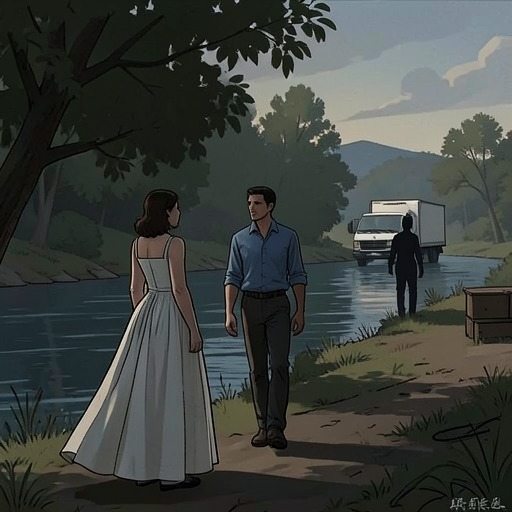
Gerry reveals a white truck followed Luke
The DryGerry Hadler’s disclosure gives Aaron Falk a witness to Luke Hadler’s movements on the day Ellie Deacon died—and a possible link between that concealed journey and the white truck Gerry saw following him. The memory does not identify the driver or explain what Luke had been doing at the river. Instead, its force lies in what Gerry observed, what he withheld for twenty years, and the possibility that Luke was guarding someone else’s secret.
The Disclosure
The conversation turns when Gerry admits that he should have told Falk something earlier. He says he knew Falk and Luke had lied about their alibis for the day Ellie died, and suspects that somebody else knew it too. This makes his account more than a late recollection of an unusual vehicle: Gerry places the false alibi within a wider circle of possible knowledge, though he cannot say who else understood that the story was untrue.
Gerry’s testimony directly challenges the account that he and Luke were together rabbit hunting in the fields. He remembers Luke coming from the south, from the direction of the river, and stresses that Luke was not near the fields the two young men had named. Luke was riding alone and did not have his shotgun. Gerry allows that other farms and bike trails also lay to the south, so direction alone cannot establish where Luke had been. But the missing shotgun and the distance from the claimed fields make his sighting difficult to reconcile with the alibi.
What Gerry Saw
Gerry’s memory begins with an ordinary drive. After a solid rainfall, he was pleased with the state of the farm. He had gone into town for supplies and picked up sparkling wine on impulse, intending to surprise Barb Hadler, whom he hoped was preparing Friday-night lamb casserole. A song with a jazz beat played on the radio as he approached a crossroads. These domestic details frame the observation as something encountered in the middle of a routine trip, rather than as a sighting Gerry was seeking or prepared to interpret.
Luke crossed the road on a bicycle, pedaling hard and looking down. Gerry noticed that his son’s hair looked slicked back, unlike its usual floppy style. Luke did not look for traffic as he rode through the crossroads; Gerry tutted at the danger and thought he would have to speak to him about it. At the time, his attention was on his son’s careless riding, not on a possible connection to Ellie’s death.
Only later did Gerry reconsider Luke’s appearance. Luke had been wearing a shiny gray button-down shirt that he usually saved for best, and looked to Gerry as if he were dressed for a date. Gerry had once explained the slicked-back hair to himself as an attempt at a new style. In the conversation with Falk, he corrects that earlier interpretation: he had always known the hair was wet. The detail makes the appearance more suggestive, but it does not establish where Luke had been or whom he might have seen.
After Luke passed, Gerry stopped at the crossroads, checked both directions, and continued. Looking in his rearview mirror as he pulled away, he saw a white truck flash through from the left, following the direction Luke had taken. The image lasted less than a second. Gerry had not been watching for a vehicle and could not identify its driver; he could not even say whether the driver saw Luke. The sequence establishes pursuit as a possibility, not a confirmed encounter between the two men.
Twenty Years of Silence
Gerry says he spent twenty years afraid that the driver would emerge and tell the police they had seen Luke that day. His fear gives the sighting a long afterlife: although he lacked a name, a clear view, and proof of what the driver witnessed, he understood that the truck might connect Luke to the river and expose the false alibi. The prospect of that disclosure remained with him even after Ellie’s body was recovered from the river three days later, an event he describes as the worst day of his life at the time.
Gerry remembers Ellie’s photograph appearing in newspapers and in shop windows, where makeshift posters also gathered contributions toward her funeral expenses. This public image of the dead girl sits beside his private memory of Luke riding away from the river. Gerry does not say that he knew Luke had seen Ellie there, or that the truck’s driver had anything to do with her death. What he reveals is the uneasy conjunction of a concealed alibi, a route from the river, and a vehicle moving after his son.
His final uncertainty shifts the direction of the suspicion. The driver may never have seen Luke; or, Gerry suggests, if the driver eventually came forward, perhaps the knock would not be at the police station. The remark leaves open the possibility that Gerry himself feared being approached, without specifying what such a visitor might want or know. His glance toward Luke’s farmhouse gives the unresolved memory a present-tense weight, but supplies no answer.
Falk’s Inference and the Unresolved Clue
Falk does not treat the white truck as proof. He recognizes that such vehicles were common in Kiewarra then and remain common in the present, and asks why someone who saw Luke would have kept silent for so long. The question turns Gerry’s recollection into an investigative problem: the driver’s identity is unknown, the sighting was fleeting, and the reason for any silence is unestablished. Gerry’s belief that the driver might have seen Luke is not the same as evidence that they did.
Still, the possibility that Luke saw the driver offers Falk a different way to understand the concealment. Rather than assuming the truck driver held the secret over Luke, Falk wonders whether Luke had recognized the driver and was protecting that person. He considers whether Luke had kept another person’s secret and had eventually had enough. These are explicitly tentative deductions, not conclusions Gerry confirms. Their importance is that the white truck may be connected to Luke’s silence in more than one direction.
The disclosure therefore expands, rather than closes, the mystery surrounding the old alibi. Gerry’s carefully remembered clothing, wet hair, route, absent shotgun, and fleeting reflection in the mirror provide concrete particulars, but none identifies Luke’s destination or the truck’s driver. After thinking through the possibility, Falk calls Greg Raco at the station. The account’s decisive effect is to turn a twenty-year-old private fear into a lead: the lie may have concealed not only Luke’s movements, but a secret that Luke himself knew.