Greg Raco
The DryGreg Raco is the new police sergeant in Kiewarra when the Hadler family murders thrust him into a case already burdened by grief and an apparent explanation. He becomes important not because he claims certainty, but because he tests the evidence against that explanation: the cartridges do not match the ammunition associated with Luke Hadler, and the photographs of Billy’s room suggest a search rather than a familiar pattern of hiding. Raco’s firsthand encounter with the children makes that scrutiny personal, while his admission that Luke may still have been responsible keeps doubt from becoming an unsupported alternative verdict.
Identity and Arrival
Raco has only recently taken up his post. When he is introduced as the new sergeant, another speaker observes that he has been in Kiewarra for only about five minutes before the crisis begins. The remark establishes both his inexperience with this particular town and the abruptness with which he must assume responsibility for a major investigation. He has no long-established local knowledge to fall back on; he arrives in the middle of an emergency and must work from what the scene and its evidence can tell him.
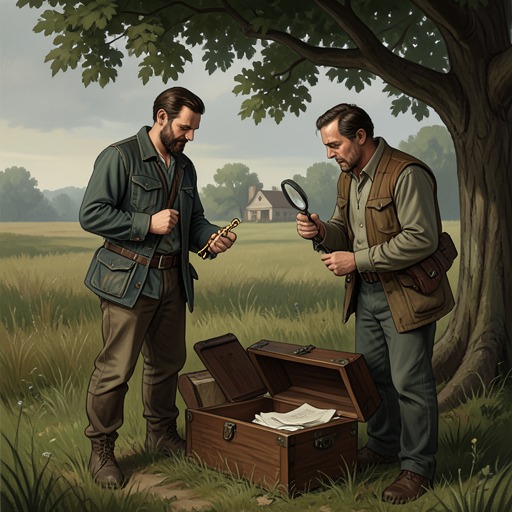
His early work takes him through the Hadler property, including one of its barns, where Aaron Falk finds him examining old boxes. The setting underscores the practical, material character of the inquiry: Raco is searching through what is present at the farm, not relying only on the community’s account of what happened. Falk’s arrival interrupts the search, and the two men’s subsequent exchange develops into a discussion of evidence that Raco has been considering closely.
Evidence at the Hadler Property
The first concrete problem Raco raises is ammunition. The three shots that killed the Hadlers were fired with Remington ammunition, while the only cartridges he has found on the property are Winchester. He also reports that Luke had used the Remington brand for years. The discrepancy does not by itself identify who fired the weapon or explain how the ammunition came to differ. Its significance is narrower and more consequential: the physical evidence at the property does not neatly support the assumption that the established pattern of Luke’s ammunition use continued on the day of the murders.
Raco’s attention to Billy’s room supplies a second challenge to an uncomplicated account of the crime. After examining photographs, he reads the arrangement as evidence that someone searched systematically for the child. He draws a contrast with his own family’s experience: his brothers know where their children hide, so a parent familiar with a child’s habits could find them quickly. In Raco’s reading, the photographs instead suggest someone working through possible hiding places without that knowledge. He then asks Falk to show him where Charlotte was found, connecting his interpretation of Billy’s room to the wider scene without claiming that the photographs settle who was responsible.
Experience, Doubt, and Responsibility
Raco’s persistence is rooted in what he saw during the investigation. He tells Falk that he found the children and cannot forget the sight of Billy after his death. That experience explains why he wants to ensure that the right person is held responsible; it does not make him certain that the prevailing conclusion is wrong. He explicitly concedes that Luke probably committed the murders, while maintaining that even a small possibility of another perpetrator escaping justice deserves attention.
This combination of emotional involvement and qualified judgment defines his position. Raco has a strong personal reason to pursue the case carefully, but he distinguishes that reason from proof. His questions about the ammunition and the photographs are specific tests of the accepted account, not a declaration that Luke was innocent. By acknowledging the likelihood he sees while refusing to treat likelihood as certainty, he keeps the investigation open to evidence that might otherwise be overshadowed by the apparent completeness of Luke’s life and the deaths within his family.
Narrative Role
Raco functions as a counterweight to the case’s first, seemingly self-contained explanation. He asks why a man who appeared to have a wife, two children, a farm, and standing in the community would destroy his family, but he recognizes that his inability to understand such an act is not evidence that it could not have happened. His role is therefore not to offer a simple psychological answer. Instead, he places the human difficulty of accepting the crime beside concrete inconsistencies that require examination.
His involvement also gives the investigation a point of view distinct from Falk’s personal history with Luke and Kiewarra. Raco is new to the town, yet his work quickly brings him into contact with the farm, the evidence, and the consequences of the killings. His insistence that the children deserve a correct accounting of what happened turns procedural doubt into an ethical obligation. The novel’s uncertainty gathers around that distinction: the evidence has raised questions, but Raco does not pretend that questions alone resolve them.