Hadler Farm
The DryHadler Farm is the family home where Karen Hadler and Billy Hadler were shot and where the aftermath of the killings is read through the household’s rooms, objects, and surroundings. The property first appears to Aaron Falk as a place saturated with childhood memory; it becomes, in turn, an isolated crime scene, a source of recorded evidence, and a home whose intimate details complicate the assumption that Luke Hadler had been living apart from his family.
Setting and Approach
Yellow police tape still hangs from the farmhouse door when Falk arrives. The morning sun has not yet reached its peak, but the heat is already on his skin. The house has changed little since Luke took it over from his parents, and the familiar bell and hallway make Falk feel as if he has traveled back in time. He expects, almost against reason, that his teenage friend might open the door. Instead, the closed curtains and stillness make the house seem unresponsive.
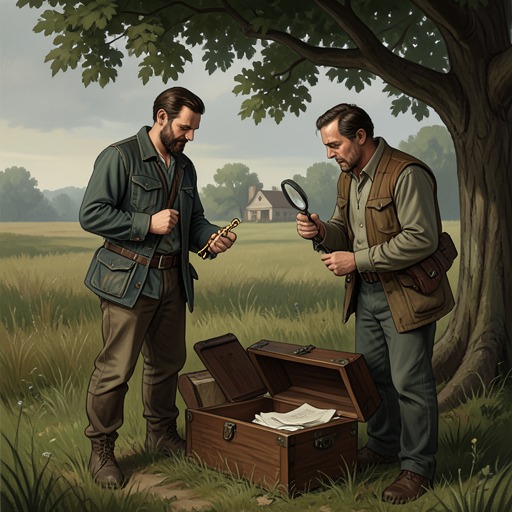
Falk has agreed to remain in town only until the weekend, before returning to work on Monday. He goes to the farm to look at its financial records for Barb Hadler, a practical obligation that also draws him back into the place and the history it holds. The property had once felt full of life to him. Now he recognizes its isolation: although his childhood home was only a short bicycle ride away, it cannot be seen from here. The fields and bushland open out beneath a large sky, with only one other house visible, a gray building on a distant hill: Ellie Deacon’s home. That sight reconnects the farm’s present investigation to Falk’s unresolved memories of Ellie and the four teenagers who once formed a close group.
The House as Crime Scene
Greg Raco unlocks the farmhouse and tells Falk that the investigation has become strange. One small blue bedroom makes that change visible. A child’s bed has been pushed at an angle against the wall and stripped to its mattress; toys are packed into boxes beneath football and Disney posters. The carpet has been removed, leaving untreated boards underfoot. Sawdust covers the floor, and one corner has been heavily sanded, though a stain remains. Raco lingers at the doorway and admits that the room is difficult for him to enter. The marks of attempted cleaning and renovation do not erase what happened there; they leave the effort to erase it visible.
The farmhouse is not only a place where evidence is collected but also the setting in which the family’s ordinary life can be reconstructed. When Falk later returns, the yellow tape has been taken down, the curtains and blinds are open, and the windows have been propped ajar. Barb is in the master bedroom, crying over a colored piece of paper amid the contents of an emptied drawer. The room itself is neat despite the dust. Baby photographs, the couple’s clothes, and the objects beside their separate sides of the bed establish a shared domestic space rather than an obviously abandoned marriage.
On Karen’s bedside table are a toy robot, night cream, reading glasses, and books. On Luke’s side, a phone charger sits beside a dirty coffee cup hand-painted with Daddy in a child’s lettering. The pillows retain their impressions. These details lead Falk to conclude that Luke had not been sleeping on the couch in the days before the killings: the bed had been used on both sides. The room’s modest furnishings and family objects do not resolve the marriage’s private difficulties, but they resist a simple picture of a household already divided into separate lives.
Perimeter, Surveillance, and the Murders
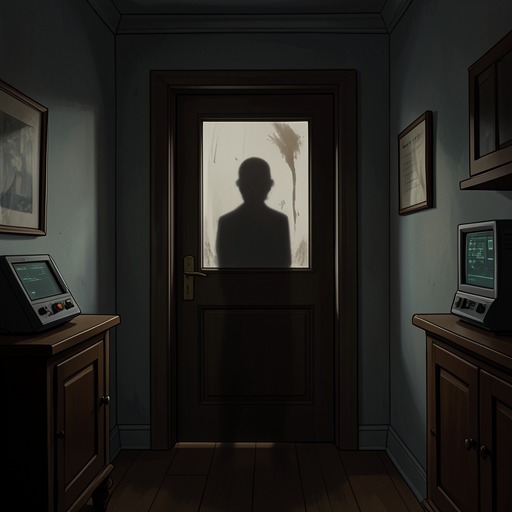
The farm’s openness also makes it possible to watch who comes and goes. A basic security camera, installed by Luke after equipment burglaries in the area, points from above the largest barn toward the yard. Its image includes one side of the house and a narrow slice of the driveway. The system records a day at a time, uploads the footage to the family computer, and ordinarily erases recordings after a week unless someone saves them. A device intended to deter theft thus preserves a partial account of the day the family was shot.
The footage shows the family leaving separately that morning. Luke drives away in his truck shortly after five, apparently heading to his fields; later, Karen, Billy, and Charlotte leave for school. Karen works part-time in an administrative role there, while Charlotte attends the on-site day care. The recording’s limited angle matters: it shows the yard and part of the driveway, not everything that happens across the property. Its value lies in what it can establish about movement and timing, while the blind spaces around the house remain beyond its view.
The farm’s relation to the murder is also revealed from the killer’s actions. After shooting Luke elsewhere, Scott Whitlam drives Luke’s body back to the Hadler property beneath a tarpaulin. At the front door he hesitates, unfamiliar with the house and grounds and unable to search confidently for Karen. He chooses to bring her to him by ringing the bell. Karen opens the door, recognizes him, and is shot before she can finish saying his name. Charlotte’s voice follows the shot. The familiar entrance, ordinarily a point of contact between household and visitor, becomes the threshold at which Whitlam’s attempt to control the encounter fails to spare the child from witnessing its immediate aftermath.
Landscape and Aftermath
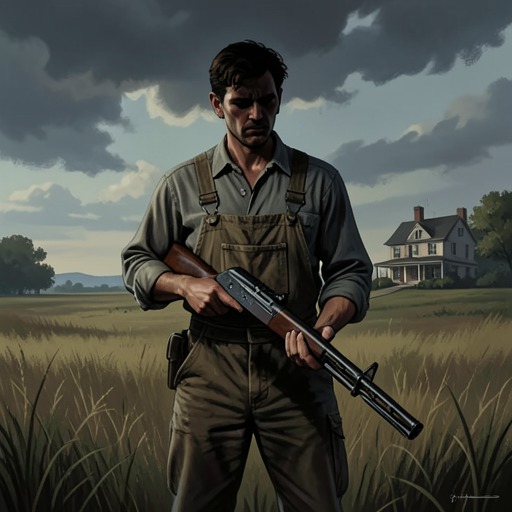
Hadler Farm sits in a shallow valley below Mal Deacon’s hilltop property. When Falk later drives to Deacon’s farm, he can see the Hadlers’ home from above: the washing line appears like a cobweb and the garden benches like doll furniture. He once loved this view on visits to Ellie; now he cannot bear to look at it. The change is not in the landscape’s arrangement but in what the view has come to mean. From a distance, the farmhouse is reduced to a small domestic scene, while for Falk it is inseparable from the deaths and the memories attached to the neighboring property.
The family’s surviving elders have not decided what to do with the farm. Gerry Hadler says they may have to sell it and place the proceeds in a trust for Charlotte; the house might even have to be bulldozed, leaving only the land to sell. Barb’s small sound of disapproval registers that the decision is not merely financial. The farmhouse is at once an asset, a home, and the setting of a loss that makes continued occupation difficult to imagine. Its possible destruction would remove the building, but not the history Falk has already recovered there.
The property’s narrative significance rests on the tension between visible evidence and hidden space. Its isolation explains the surrounding fields and long distances; its camera offers a narrow record of departures; its rooms preserve domestic habits alongside traces of violence. The farm does not provide a complete account of what happened, but it repeatedly changes the investigation’s understanding of the family: a house that first seems frozen in Falk’s childhood becomes a place where ordinary intimacy, incomplete surveillance, and murder occupy the same ground.