Kiewarra
The DryKiewarra is more than the setting for the investigation into the Hadler family deaths: the town’s drought, remembered places, and watchful community make it a force in the story. Its landscape exposes residents to sustained material pressure, while its social closeness turns private histories into public suspicions. For Aaron Falk, returning means moving through a place he once knew intimately but can no longer experience as uncomplicated home.
Setting and Drought
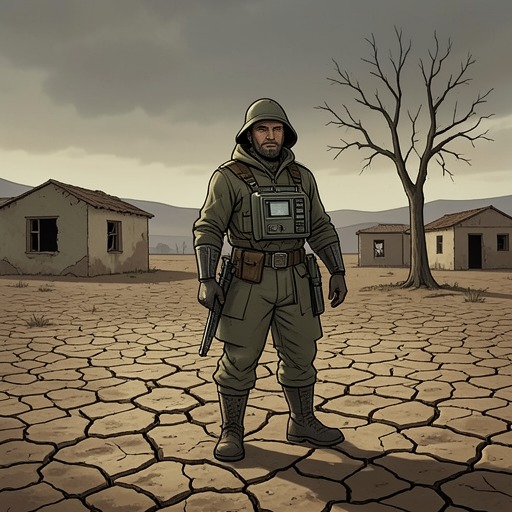
The drought defines Kiewarra in concrete terms. One summer, there is no rain and therefore no feed; farmers level rifles at thin livestock as flies gather around the animals. The town shimmers beneath repeated days of burning blue sky. The detail ties the environmental crisis to difficult decisions on farms: the heat is not simply scenery but part of the conditions under which residents make choices about their livelihoods and animals.
The same scarcity shapes how people explain the town’s mood. Gretchen tells Falk that residents are already frightened about money and the drought, and that the Hadler deaths have intensified their unease. She describes people as watching one another and wondering who might be next to lose control. Later, Scott Whitlam also connects the lack of water with the town’s agitation. These accounts make the drought a shared pressure rather than an isolated hardship, while showing how the killings give that pressure a new, fearful focus.
The landscape’s force recurs beyond the farms. During a search, rescue crews assemble along a bushland track in high-visibility orange as wind moves through the gums and drives dust and grit into their faces. Kiewarra lies behind them, low beneath the heat haze. The scene places organized human effort against an environment that remains dry, exposed, and difficult to ignore. The town’s weather and terrain persist as active conditions of the search, not a background that disappears when the investigation begins.
Familiar Places and Buried History
For Falk, Kiewarra is marked by personal familiarity. He reaches Luke Hadler’s farmhouse without needing directions and remembers spending almost as much time there while growing up as at his own home. On his return, strips of yellow police tape still hang around the doorway, and the morning heat is already palpable as he surveys the house. The contrast is exact: a place once bound to childhood familiarity is now a crime scene. The old geography has not changed enough to make it strange, but its meaning has.
Other locations hold earlier memories just as sharply. A property high on a hill overlooks the Hadlers’ home in the valley. Falk remembers loving the view when he visited Ellie Deacon there twenty years earlier; now he cannot bear to look at it. The distant house, washing line, and garden benches establish a visible relation between the two properties, while Falk’s changed response shows how a familiar view can become inseparable from painful history. Kiewarra’s scenery stores memory without resolving it.
The town’s past also survives in questions attached to its roads and landmarks. After hearing Gerry Hadler’s account, Falk considers the possibility that someone saw Luke coming from the direction of the river years earlier. White trucks were common in Kiewarra then and remain common in the present, so the detail offers no simple identification. Falk wonders why such a witness would have remained silent and who might benefit from keeping the matter concealed. The town’s familiarity thus has two sides: people know the local landscape, but knowing it does not mean that they have shared everything they saw.
Social Climate and Belonging
Kiewarra’s small-town closeness is expressed as mutual observation. In the aftermath of the Hadler family deaths, Gretchen describes residents as uncertain what to do or say, and as monitoring one another for signs that another person might snap. This is not simply collective grief: her account emphasizes apprehension and the effort to judge other people’s state of mind. The town’s social intimacy can offer recognition, but under pressure it also makes suspicion part of ordinary life.
Belonging within that community is not automatic. Falk has spent nearly ten years away, yet he remarks that many residents still regard him as newly arrived. He frames the town’s division as one between people born and raised there and those who remain outsiders. His return therefore places him in a revealing position: he knows the people and places, but his connection to Kiewarra does not protect him from being treated as an outsider. The distinction complicates any simple division between local knowledge and distance.
The town’s judgments can also change with circumstance. At the hospital, McMurdo tells Falk that many people have quickly altered their attitude toward the flyers and have begun to disapprove of them. He invokes the passage of twenty years as a reason people now treat the earlier matter as past. The shift suggests that Kiewarra’s public response is neither fixed nor fully detached from its history: residents can reconsider what they tolerate, even as the old events remain central to how the town understands Falk.
Narrative Role
Kiewarra connects the present investigation to separate layers of time. The Hadler farmhouse brings Falk face to face with his childhood familiarity; the hilltop property recalls his visits to Ellie; the river enters his thoughts through Gerry’s account of a possible witness. These places do not independently explain the past, but their repeated presence gives the investigation a geography of memory. Questions about what happened are also questions about who was present, what they might have seen, and why they did not speak.
The town’s physical and social conditions work together. Drought makes economic insecurity visible, and residents’ fear after the deaths turns attention toward one another. Falk’s uncertain standing shows that a long personal connection does not guarantee acceptance, while McMurdo’s report of changing attitudes shows that public judgment can move as time passes. Kiewarra’s significance lies in this combination: it is both a specific rural place under environmental strain and a community where shared history, silence, and belonging shape the way evidence is received.