Kiewarra school
The DryKiewarra school is a place where the effects of the drought and the limits of local support are visible in everyday life, but it also becomes an important source of evidence in the Hadler investigation. Its worn playground and financially constrained classrooms stand in contrast to the new public playground nearby; later, its entrance camera supplies a record that Aaron Falk and Greg Raco examine frame by frame, searching for meaning in the final movements of Karen Hadler and others on the day of the murders.
Setting and Material Conditions
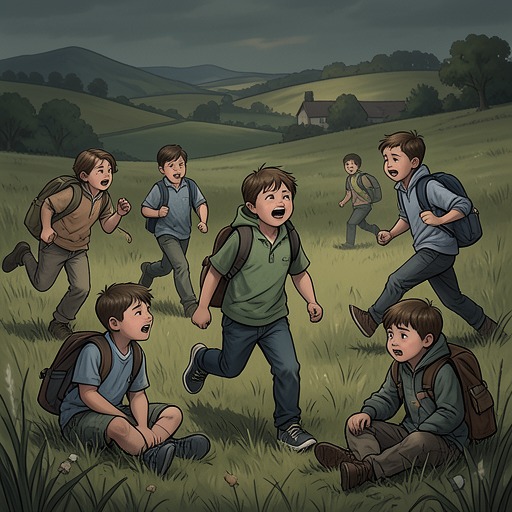
Aaron Falk remembers Kiewarra school as more run-down than he had recalled. The image that comes to mind is a playground with peeling paint and a lone basketball hoop. The school’s condition is not presented as a separate misfortune: Gretchen Schoner connects its lack of resources to the drought, explaining that government money goes toward farming subsidies and leaves little community funding for children. Parents cannot be asked to contribute more, either. The school’s difficulties are therefore part of a wider scarcity that touches both farming households and the services available to their children.
A nearby playground offers a pointed comparison. It has new equipment, is busy with children, and was funded through a rural charity initiative. Gretchen calls it the nicest place in town, even as she regrets the removal of the old bench. The school has no equivalent windfall. Gretchen says it had made the shortlist for a grant from the Crossley Educational Trust, a private group supporting rural schools, but did not receive funding; she expects the school will have to try again the following year. The contrast is not simply between two playgrounds: one visible improvement has been secured, while the school’s continuing needs remain unresolved.
Scott Whitlam, the school principal, is described by Gretchen as someone who cares and is doing what he can despite an empty budget. His position gives the school a human point of steadiness, but not the means to overcome the shortage. The school’s setting thus registers the drought through cumulative limits—worn facilities, scarce money, and dependence on uncertain outside support—rather than through a single dramatic incident.
The School as an Investigative Site
The school later matters for a different reason: its entrance camera has preserved footage that might otherwise have been erased. Whitlam warns that recordings are normally deleted after a month. In his office, he searches the computer files and brings up the view from a camera mounted above the large main doors, aimed down toward the steps to record approaching visitors. He apologizes for the poor image quality. The school is not merely the backdrop to an inquiry; its ordinary security system becomes a limited archive of the day’s movements.
Falk and Greg Raco watch the recording at the school while the Monday-afternoon bustle can be heard outside Whitlam’s office. They first wait through the thinning stream of pupils. Then Karen appears, crossing the parking lot with Charlotte in a stroller, coming from the direction of the day care. Billy follows three steps behind. The camera cannot provide a clear view of Karen’s expression, and the image makes her small movements difficult to interpret. That distance matters: the recording establishes where she went and when, but cannot disclose what she was thinking.
Karen Hadler’s Last Recorded Visit
The investigators replay a brief gesture several times. Karen has her head down and makes two small flicks of her hand. Greg Raco cannot tell whether she might be indicating something or simply scratching her nose. The footage invites interpretation but does not settle it; repeated viewing sharpens the uncertainty rather than turning an indistinct movement into proof.
They continue watching. Karen lifts her head, appears to take a deep breath, opens the driver’s door, gets in, and reverses out of the parking space. The timestamp establishes that she and Billy have less than eighty minutes to live. This timing gives an ordinary departure its terrible significance, while the camera’s limited angle leaves the circumstances behind the visible actions unresolved. The school records the last known sequence of movements there, not the murders themselves.
A Routine Day Preserved on Tape
The recording also sets Karen’s visit among the ordinary departures of a school day. About ten minutes after she leaves, the receptionist emerges; then the parking lot remains quiet for roughly forty minutes. Teachers eventually head to their cars one by one, and Whitlam identifies them as they appear. The caretaker returns, puts his bag back in the trunk, and drives away shortly after 4:30 p.m. These routine details establish the gradual emptying of the grounds and make the later image of the lot nearly deserted legible as part of a sequence rather than an isolated snapshot.
After the others have gone, Whitlam’s car is the only one left. The investigators fast-forward until shortly after 7 p.m., when Whitlam himself appears on-screen, walking slowly with his head down and his broad shoulders slumped. In the office, he exhales, his jaw clenched, as he watches. The footage does not explain his state or establish what it means; it preserves a visible change in posture and the principal’s reaction to seeing it. Across the school’s two roles—as an underfunded public institution and as a source of surveillance—the place holds both the slow pressure of the drought and a fragmentary record whose smallest details acquire weight only after catastrophe.