Kiewarra’s hostility toward Aaron Falk
The DryKiewarra’s hostility toward Aaron Falk turns an unresolved death into a continuing social judgment: although many residents privately believe Ellie Deacon died by suicide, her note named Falk, and the town found it easier to blame the absent man than to face its own failure to support her. The hostility is not confined to rumor. It surfaces in a playground demand that he leave, in flyers that identify him and his father, in a message carved into his car, and in a shopkeeper’s refusal to serve him. Together, these episodes show how suspicion becomes a means of policing who belongs in the town—and how its public displays coexist with the silence that allowed the accusation to endure.
The accusation and the town’s silence
Gretchen Schoner describes an early period when some residents tried to challenge Luke Hadler over Ellie’s death. Luke did not back down, and, as time passed, people accepted his position. Gretchen’s account places Falk’s exclusion within that history: the town had an explanation for his disgrace in the note Ellie left, even though no one could explain why she had written his name. Falk himself cannot solve that question. He has repeatedly revisited his final conversations with Ellie, searching for a message or meaning, but the uncertainty remains. She knew him as Aaron, not by his surname, and the reason she named him has never become clear to him.
Gretchen says that many people know Ellie killed herself and recognize that a sixteen-year-old who needed support did not receive it. That knowledge could have made the town confront its collective guilt. Instead, because guilt is uncomfortable and Falk’s name appeared on the note, the accusation offered a simpler focus for blame. The note did not establish what Falk had done; its power lay in giving suspicion a name. His inability to explain it left an opening that the community could fill with its own judgment.
Luke’s position in Kiewarra helped that judgment take hold. He had become involved in the community and, in Gretchen’s description, a local leader—someone the town felt it could not afford to lose. Residents could put the matter out of their minds while Luke stayed and Falk was gone. Gretchen’s contrast is blunt: Falk left, Luke remained, and Falk received the blame. The social division therefore rests not only on the contents of Ellie’s note but also on the different places the two men occupied in the town after her death.
Gretchen also connects this pattern to Kiewarra’s tolerance of Grant Dow and Mal Deacon. She presents that tolerance as part of a hard, interdependent local life in which residents see themselves as having to manage together. The same impulse to preserve the community can discourage open confrontation: people can carry on alongside those they resent, while directing blame toward someone who has already been driven away. The hostility toward Falk is thus bound to a broader reluctance to revisit what the town would rather set aside.
Exclusion in public spaces
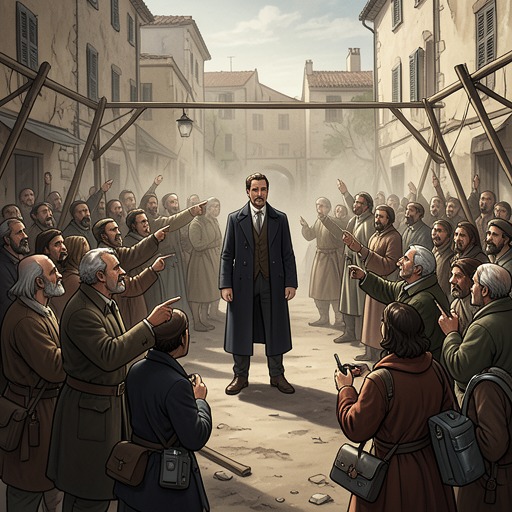
The playground confrontation makes that judgment explicit. Mandy Vaser speaks on behalf of herself and other mothers, saying they are uncomfortable with Falk being close to their children and demanding that he leave. Other mothers watch from nearby, so the request is not a private conversation but a public test of whether Falk is welcome. Gretchen answers on his behalf, and both she and Falk refuse the demand. Falk thinks he should return to the station to find Greg Raco, but he will not let Mandy dictate his departure.
Mandy then raises the possibility that the mothers’ husbands could make the message less politely. The implied escalation turns social disapproval into a threat of intimidation. When Gretchen reminds her that Falk is a police officer, Mandy counters by invoking what she says he did to Ellie. Parents around the playground are watching; the old accusation is made into a public charge once again, rather than a question to be examined. Mandy also threatens to contact social services over Gretchen’s association with Falk, invoking Gretchen’s responsibility for her son, Lachie Schoner. The pressure therefore reaches beyond Falk: it attempts to make Gretchen’s friendship with him seem a danger to her child.
The incident shows how the town’s judgment can be enforced through ordinary social relationships. The mothers’ concern about proximity to children, the possible involvement of fathers, and the threat concerning social services give exclusion several forms at once. Gretchen does not yield, and she warns Falk to be careful before leaving with Lachie. Her response distinguishes support for him from any claim that the hostility is harmless: she stands with Falk, but recognizes that the warnings should be taken seriously.
Public displays and material pressure
At the police station, Falk and Greg Raco come upon another form of intimidation when they reach Falk’s car. Someone has carved the same threatening message repeatedly across its doors and hood. The damage makes hostility material: the accusation is no longer only spoken or circulated but has been imposed on a vehicle Falk uses. Its placement across multiple surfaces and its repetition convey a deliberate effort to make the threat unmistakable. The evidence identifies the message but does not establish who carved it.
Flyers extend the accusation to a wider audience. McMurdo holds a handful at the pub; Falk has one of the same type. The crude copies appear to have been reproduced in large numbers at Kiewarra’s small library. They place the words marking Ellie’s death and age above photographs of Erik Falk, Aaron’s father, and Aaron himself. The image of Aaron is a hurried photograph apparently taken as he left the pub, catching him in a sideways glance. Beneath the photographs, the flyer says that the two men were questioned about Ellie’s drowning and calls for more information, ending in an appeal to protect the town. By pairing father and son, it turns a history of questioning into a visual accusation, while presenting suspicion as community safety.
The flyers also demonstrate that hostility can be circulated without being substantiated. They report that the two men were questioned; they do not establish guilt. Yet their design places the photographs, the death, and a call to protect Kiewarra together, inviting readers to treat association as evidence. McMurdo’s possession of several copies shows that the materials have reached the pub, though the scene does not show him endorsing their claims. Gretchen, after giving Falk a hug, calls those responsible fools and warns him to watch himself. Scott Whitlam then drives Falk toward the pub, an act of practical support set against the town’s more public hostility.
Refusal of ordinary welcome
The exclusion follows Falk into a shop. The shopkeeper has heard from Mandy Vaser that Falk has been bothering children in the park and says he will not serve him, either that day or ever. His attempted expression of disgust is undercut by his evident pleasure in the encounter. The rumor from the playground has travelled far enough to shape a transaction, turning an accusation into a reason to deny Falk ordinary service.
Falk considers arguing, then decides that doing so would waste his energy. He leaves the items on the counter and goes without them. His restrained response does not resolve the hostility; it shows its practical consequence. He can enter a shop, but a local resident can deny him service on the strength of a rumor. Across the playground, the station, the pub, and the shop, Kiewarra’s rejection moves from spoken blame to social pressure, threat, public display, property damage, and everyday refusal. The episodes expose the difference between a community’s claim to protect itself and the way that claim can sustain an unproved accusation against a returning outsider.