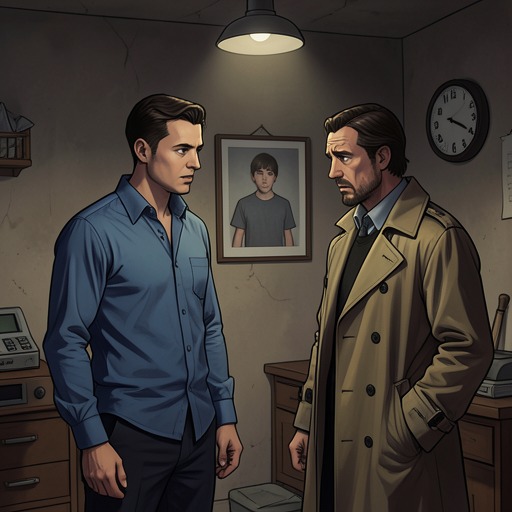
Luke and Aaron fabricate a rabbit-hunting alibi
The DryLuke and Aaron fabricate a rabbit-hunting alibi when sixteen-year-old Aaron Falk fears that people in Kiewarra will connect him to Ellie Deacon’s death. The lie begins as a whispered proposal at Falk’s bedroom window and becomes a rehearsed account that Falk repeats to police. Its immediate effect is to help him get released, but it does not settle the town’s suspicions: rumors change shape and continue to cast blame on him and his father.
The Rumors and Luke’s Visit
By the end of the day, rumors about Falk had grown from small talk into a crisis he faced alone in his bedroom. He was sixteen and scared, with his thoughts clamoring as he tried to understand what people believed. Luke appeared at the window in the evening gloom, his face described as ghostly white. Rather than visiting openly, he tapped on the frame and whispered that Falk was in trouble: he had heard his parents talking, and people were already asking what Falk had really done after school on Friday.
Falk said that he had been fishing upriver, miles away. His legs felt unsteady as he crouched by the window, and Luke’s next questions narrowed the danger to whether anyone else had asked him about that afternoon and whether anyone had seen him. Falk insisted that he had been alone. The exchange turns on that vulnerability: a private explanation that cannot be independently confirmed is precisely what Luke replaces with a story they can both repeat.
Building and Rehearsing the Alibi
Luke proposed that, if anyone asked, the two boys had been shooting rabbits together in the back fields. When Falk clarified that this meant nowhere near the river, Luke specified the fields off Cooran Road. The account placed them together all evening, supposedly mucking around and shooting one or two rabbits. Luke settled on two as the number they should give. These particulars make the invented story sound like a shared recollection, while also fixing what it excludes: they were not at the river.
Luke did not leave the claim as a suggestion. He made Falk practice saying it, first prompting him to state what he had been doing and then asking him to repeat it. Falk’s rehearsed wording was, “Luke and I were shooting rabbits together.” He was made to say it again with Luke Hadler’s name and the Cooran Road fields included. The scene therefore shows the alibi being constructed in stages: a location, a duration, an activity, a companion, and even a rabbit count become coordinated details. Luke’s final insistence that they had been together turns the account into a compact formula for both boys to use.
Repetition Under Questioning
The novel later shows the earlier lie resurfacing during police questioning, where Falk sits on a wooden chair and clings to the plan. The sequence of his answers moves through the rabbit story, his friendship with Ellie, whether he saw her at school, whether they fought, and whether he saw her later or attacked her. His account stumbles briefly over the description of Ellie as a friend—she is first present tense, then past tense—before he denies seeing or attacking her after school. The shift registers the pressure of speaking about a dead friend while maintaining the rehearsed version of his own movements.
Falk repeats that he was with Luke Hadler and that they were shooting rabbits, adding that they got two. The narration’s repetition makes the story sound less like fresh testimony than a phrase he has learned to hold onto. The investigators eventually let him go. That release is a concrete short-term consequence of the alibi, but the passage does not present it as proof that the town accepts Falk’s innocence or that suspicion has ended.
The Lie’s Uneven Afterlife
After Falk’s release, the whispers acquire a different shape. Murder gives way, for some, to a theory of suicide: one version portrays Ellie as a vulnerable girl led up the path by Falk; another alleges that his slightly odd father pursued and used her. In either telling, blame remains attached to the Falks. The rumors are said to be fed by Ellie’s father, Mal Deacon, and to grow into stories that never die.
The rabbit-hunting account thus accomplishes less than its rehearsed certainty promises. It helps Falk through one round of questioning, yet the community’s talk is not a single accusation that can be answered once and put to rest. It shifts from murder to suicide and redistributes culpability without relinquishing it. The movement from Luke’s exacting coaching to Falk’s repeated police answers also gives the lie a double force: it is both a practical defense and a burden that binds Falk’s account of himself to a story Luke invented. The scene establishes the shared alibi as an act of concealment whose immediate success cannot prevent the rumors from becoming a lasting form of judgment.