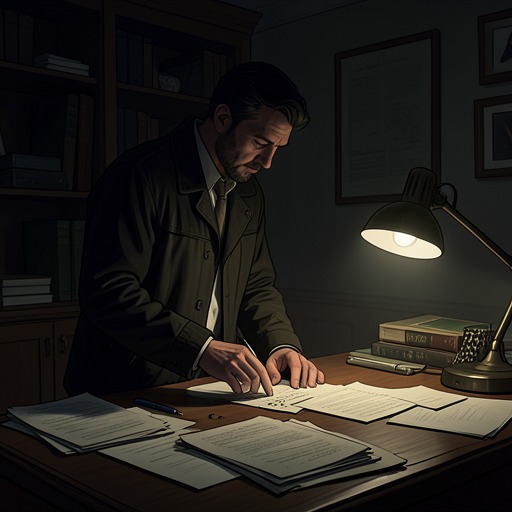
Mrs. Sullivan
The DryMrs. Sullivan, Jamie Sullivan’s elderly grandmother, is introduced in a house where her grandson’s attentive care sits beside her own prickly independence. During Aaron Falk and Greg Raco’s visit about Luke Hadler, she shows that age and physical frailty have not erased her awareness of what is happening around her. Most consequentially, she reacts when Jamie says that neither of them left the house on the evening in question. The moment does not establish what she knows, but it gives the inquiry a small, visible uncertainty that Falk remembers afterward.
Identity and Introduction
Mrs. Sullivan is an old woman living with her grandson, Jamie Sullivan. The narrative first presents her in the kitchen, where her blue-veined hands tremble beneath a full kettle. Jamie quickly takes it from her and offers to make her tea, a practical gesture that establishes his role in caring for her without suggesting that she is incapable of speaking or making her preferences known.
Her home makes that care feel constant and demanding. The hallway is cluttered with dusty ornaments and knickknacks, and a television blares from deeper inside. Jamie explains that the things belong to his grandmother: she likes them, and, as he considers how to put it, they keep her present. His phrasing implies concern for her state without specifying a condition or explaining what she experiences. The objects are thus more than background decoration: they are part of Jamie’s account of how the crowded household is organized around his grandmother’s needs and attachments.
The Visit and Her Account
In the living room, the contrast with the bright kitchen is immediate. The room feels claustrophobic; half-empty cups jostle for space with china figurines, and Mrs. Sullivan sits shakily in a threadbare armchair near the window. When Greg Raco reaches to move dog-eared newspapers from a chair, she snaps at him not to touch them. Her irritation is particular and direct: the newspapers have a place in the room, and the police officers do not have permission to rearrange it.
She has already inferred why the officers are there. Before they explain their business, she identifies Luke Hadler as the subject of the visit and reasons that he must have killed his family. She also raises the possibility that Jamie may have done something wrong, revealing how quickly she connects the investigation to her grandson. Her speech carries a trace of an Irish lilt, and her laugh is likened to a rusty gate; these details give her presence a roughness that contrasts with the officers’ careful questioning and Jamie’s efforts to smooth the visit.
Her knowledge of Luke, however, is limited. She says she did not know him, beyond his friendship with Jamie and his occasional visits to help on the farm. That account locates Luke in her household’s orbit but does not make her a close witness to his life. When Falk asks whether she knew him well, her answer distinguishes familiarity by association from personal acquaintance.
Jamie’s Care and Her Independence
Jamie manages the practical business of the visit. He carries in a tea tray, clears a space on the sideboard despite his grandmother’s protests, serves the officers, and invites them to sit on a battered couch. He apologizes for the mess, beginning to explain that things become difficult before glancing toward her and turning his attention to the teapot instead. His hesitation suggests that he is choosing what to say in front of her; the scene does not reveal the rest of the explanation.
Mrs. Sullivan is therefore neither simply an unattended dependent nor a silent presence in Jamie’s home. She objects when Raco touches her newspapers, protests when Jamie clears space, and takes part in the conversation about Luke. At the same time, her trembling hands and unsteady movement make Jamie’s small acts of assistance visible. The scene holds those facts together: he attends to her, but she retains preferences and an ability to interrupt the officers’ assumptions about her.
The Statement and Its Uncertainty
The visit acquires a more ambiguous edge when Falk asks Jamie whether he was alone with his grandmother, whether he left at all, and whether anyone else came by. Jamie answers that it was just the two of them. As he speaks, Falk catches a tiny movement from the corner of his vision: Mrs. Sullivan raises her pale gaze in surprise and looks at her grandson for barely half a moment before looking down again.
The gesture is easy to miss. Falk later feels sure of what he saw, but the narration keeps the observation narrow: a brief look, followed by no further upward glance. For the short remainder of the visit, Mrs. Sullivan appears to be sound asleep. That appearance neither confirms that she heard the question nor explains her reaction. Her response matters because it occurs directly after Jamie’s unequivocal account, but the evidence leaves open whether she is surprised by his words, by the question, or by something else.
The scene makes Mrs. Sullivan a quiet point of pressure in the inquiry without turning her into a disclosed witness. Falk’s attention, and his later recollection of the moment, convert an almost imperceptible movement into something worth retaining. Her age, the crowded rooms, the television, the fragile tea service, and the newspapers that Raco is warned not to touch all establish a household governed by familiar routines. Against that domestic texture, her single glance remains uncertain: an observation Falk cannot dismiss, but not an explanation he can claim.