Small-town rumors and collective blame
The DrySmall-town rumors and collective blame in Kiewarra form a social force that outlasts the evidence that first set them in motion. After Ellie Deacon’s death, suspicion of Aaron Falk and his father hardened into a public story, bringing exclusion and threats that drove the Falk family away. When Aaron returns years later, the old accusation resurfaces alongside new fears about the Hadler family killings, showing how the town’s willingness to repeat a charge can make it feel settled even when important facts remain uncertain.
From suspicion to a shared story
The rumor begins in the unresolved circumstances of Ellie Deacon’s death and the discovery of a note bearing the name Falk. The name did not distinguish Aaron from his father, and the younger Falk was still a child when police questioned him. Yet ambiguity did not remain a limit on what people said. In Aaron’s recollection, suspicion expanded into competing stories: that Ellie had been led along a path by him, or had been pursued and used by his father. Neither account is established as fact in the material; both circulated as explanations, and Mal Deacon helped feed the rumors.
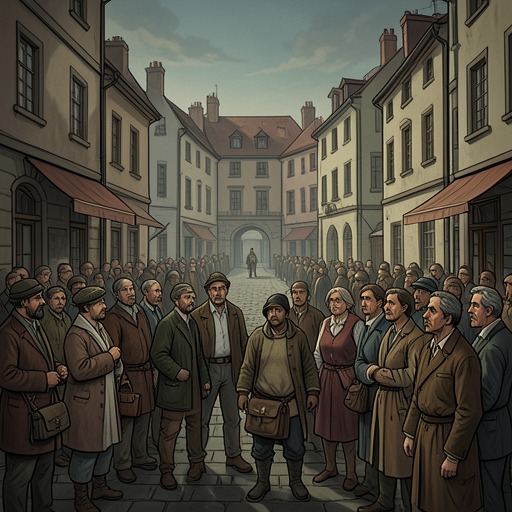
The accusations drew force from repetition. People discussed Ellie over coffee, traded gossip with neighbors, and read newspaper accounts beneath her black-and-white photograph. Years later, Aaron interprets a woman’s guarded manner as evidence that she remembers the case and the talk around it. He imagines that people who had known the Falk family before Ellie’s death would not have admitted to knowing them afterward. The scene makes rumor visible not as a single claim but as an everyday practice: recognition, hesitation, whispered exchange, and the decision to look away.
That circulation changed the meaning of the original uncertainty. Some whispers shifted from murder to suicide, but this did not restore the Falks’ standing; instead, they were blamed for having effectively caused Ellie’s death. The rumor acquired a life independent of any one version. Aaron remembers that it grew more substantial through retelling and never disappeared. The shift in allegation did not loosen the community’s judgment. It gave blame room to survive even when the story’s details changed.
Exclusion and the Falk family’s departure
The accusation became consequential in acts of social punishment. A brick was thrown through the Falks’ front window. Two days later, Aaron’s father was refused service at the corner shop and left without his groceries. The following afternoon, three men in a truck followed Aaron as he rode home from school. The episodes affected both father and son: the father was publicly shunned, while the boy had to make his way home under threat.
The family’s departure followed further intimidation. A dead calf was left at their doorstep. The next morning, Aaron and his father packed what they could into their truck. Aaron said a hurried goodbye to Gretchen Schoner and a longer one to Luke Hadler, without discussing the reason for leaving. As they drove beyond Kiewarra, Mal Deacon’s white truck followed them for one hundred kilometers past the town limits. The Falks never returned. The sequence shows how rumor becomes more than talk: it contributes to an atmosphere in which the family’s continued presence feels untenable.
The accusation returns with Aaron
Aaron’s return does not bring the old story to a close. At a public gathering, an older woman recognizes him, then draws another woman’s attention to him; their exchanged looks make clear that his identity has become a subject of whispered recognition. Aaron checks his watch and thinks of leaving again. The brief encounter compresses the history of the case into a familiar social gesture: he is not approached for an account, but recognized through what the community already believes it knows.
The same pattern surfaces in the Fleece bar. Mal Deacon objects not merely to Aaron being there but to his having returned to Kiewarra at all, and says that people remember what Aaron supposedly did to Ellie. When Mal brings up the note found in Ellie’s jeans, Aaron cannot answer him in the moment. The note is a concrete piece of evidence, but its meaning is not resolved by its existence; in the confrontation, it functions as a public trump card. Grant Dow’s intervention and the room’s attention intensify the accusation, while the bar falls silent as Mal demands an explanation. The scene distinguishes a fact people can point to from a conclusion they have already chosen to draw from it.
A town divided by the Hadler inquiry
When Aaron and Greg Raco investigate the Hadler family killings, the old stigma shapes how the new inquiry is received. Gretchen warns Aaron that news of their questioning has spread around town. In her account, opinion is divided: some people welcome the investigation, while others believe Aaron, of all people, should keep out of it. Beneath both responses lies a shared unease about what it would mean if someone other than Luke Hadler killed the family. The rumor surrounding Aaron therefore meets the town’s fear of a new explanation before the evidence can settle the matter.
That suspicion is made public in Anti-Falk flyers. Reproduced in large numbers, they place a photograph of Ellie beside photographs of Aaron’s father and Aaron, identify the two men as having been questioned about Ellie’s drowning, and urge readers to provide more information and protect the town. The flyers convert an old police inquiry into a present-tense warning. By pairing the men’s images and inviting further information, they present suspicion as a community duty, while leaving the distinction between being questioned and being guilty blurred.
The exclusion also reaches ordinary encounters. At the playground, Mandy Vaser tells Aaron and Gretchen that she and the other mothers are uncomfortable with him being near their children and asks him to leave. She warns that the fathers may make the request less politely, then invokes what everyone supposedly knows about Ellie. Later, a shopkeeper refuses to serve Aaron, citing Mandy’s account that he had been bothering children in the park. The claim moves from playground gossip to a reason for denying service; its repetition lends it authority without adding evidence.
Collective blame as a recurring pattern
Kiewarra’s rumors do not take one stable form. The story about Ellie shifts between accusations involving Aaron and his father, and between murder and suicide, yet the enduring conclusion remains that the Falks bear responsibility. Years later, a name on a note, a remembered police inquiry, and a renewed investigation are gathered into a renewed case against Aaron. The pattern is not that every resident holds the same view: Gretchen reports both support for the Hadler inquiry and opposition to Aaron’s involvement. Rather, competing reactions coexist with a shared readiness to treat the old suspicion as socially consequential.
The concept links private memory to public action. A whisper can become a neighborhood account; an account can justify avoidance, refusal, or a demand that someone leave; a printed flyer can give that judgment the appearance of an organized warning. Against this accumulated certainty, the unresolved meaning of the note and the changing versions of Ellie’s death remain important. The community’s repeated accusation does not resolve those uncertainties. It shows instead how collective blame can persist through them, shaping Aaron’s return before his present actions are heard on their own terms.