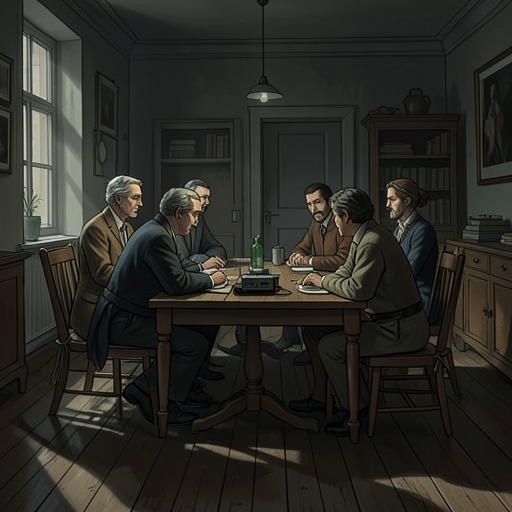
Ambiguous Guilt and Innocence
The Earthquake BirdAmbiguous Guilt and Innocence is the tension between what can be proved about Lily Bridges’s death and what Lucy Fly believes she owes the dead. A body first mistaken for Lily’s, Lucy’s detailed but invented confession, and photographs that undermine the case against her pull guilt in different directions. Her release does not settle the question: the evidence clears her of the murder while leaving her implicated in the chain of events that brought Lily to her door.
Evidence and mistaken certainty
When Lucy is questioned, the publicly accepted account begins with a young woman’s torso recovered from Tokyo Bay, accompanied by two matching limbs. The remains had no hands or fingerprints, so police could not formally identify them; nevertheless, many people—including Lucy—treated the body as Lily’s. That confidence rested less on identification than on circumstantial testimony: a neighbor said Lily had visited Lucy’s apartment, that Lucy spoke angrily to her in the doorway, and that Lucy later left carrying a bundle. Lucy calls the neighbor’s account a lie, but her account of what was said and what happened remains incomplete.
Kameyama points out how unusual Lucy’s certainty was. Friends and relatives of a missing person often resist accepting that unidentified remains belong to someone they love, even when the identification seems obvious. Lucy, by contrast, had accepted that the body was Lily’s before it was established. The discrepancy exposes how an inference can harden into apparent fact: the remains were not Lily’s, and the newspapers had been carried away by their assumption. The unidentified body nonetheless made Lucy’s connection to the disappearance look damning.
The actual discovery reverses that impression. Lily’s body is found in an unused shed behind a gas station a couple of minutes from Lucy’s home, and she had been strangled. The distinction between the first, unidentified remains and Lily’s body changes the case’s geography and logic: the early public story appeared to connect Lucy’s neighbor’s testimony to a corpse found in the bay, while the later discovery establishes a different location and cause of death. Certainty about the identity of the first body had concealed rather than solved the central question.
Interrogation and the invented account
The difference between evidence and story also shapes Lucy’s questioning. She is exhausted, delays answering, and says that the night in question is a blur she must recover a little at a time. Kameyama waits while Oguchi fidgets with his trouser seam; Lucy meets Oguchi’s glance and remains silent. Her pauses do not establish what happened. They show instead that the account the police seek is not immediately available to her as a clear memory.
Eventually Lucy gives the investigators a fluent narrative of murder. It assigns her jealousy of Lily and obsessive love for Teiji as motives, makes a pair of stockings the weapon, and describes Lucy surprising Lily while Lily still trusts her. In this version, Lily smiles, struggles briefly, and is dragged away dead. The story supplies a motive, means, opportunity, and emotional climax—precisely the completeness that can make a confession seem persuasive. Yet Lucy later states that she did not kill Lily and had fabricated the account. Its coherence is not proof; it is a constructed explanation offered under interrogation by a tired suspect.
Lucy’s readiness to accept the role of murderer has more than one stated cause. She says that people have slipped through her hands before, that she no longer trusts herself, and that she fears she could kill again. She also recognizes an indirect responsibility: had she taken Lily’s call, Lily might not have come to her street that night; Lucy had introduced Lily to Teiji and persuaded her not to return to Britain when she wanted to. Those admissions explain why Lucy can reject the literal confession while refusing to claim complete innocence.
Photographs, competing explanations, and release
New evidence arrives after details about Lucy appear in national newspapers. An envelope sent to police contains two photographs. One shows Lily at a McDonald’s near Lucy’s home on the night of the murder, two hours after she was seen at Lucy’s door. A cashier recalls that Lily and her Japanese male companion seemed distressed and had difficulty communicating; Lily left her cheeseburger untouched but drank her Coke. The photograph places Lily elsewhere after the reported visit and gives investigators a new encounter to consider.
The second image shows a dead woman confined within close brown walls. The police do not know who took the photographs, but Lucy believes Teiji took them. Neither photograph has fingerprints, and the images do not prove that Teiji killed Lily. They do, however, show that Lucy did not kill her: the police conclude that Lucy’s brief venture outside, with her stockings over one shoulder, was unrelated to Lily’s death. She had been outside for only about ten minutes, and her neighbor reported hearing no further departure that night.
The case against Lucy remains circumstantial, and investigators find no fingerprint or DNA sample on Lily’s body. She is released without charges. This outcome separates legal disposition from emotional resolution. The evidence that undermines Lucy’s guilt does not identify Lily’s killer; it revises the case against Lucy without supplying a complete account of the crime.
Responsibility without a verdict
Lucy turns the remaining uncertainty toward Teiji, but marks her suspicions as questions rather than established facts. She wonders whether Lily told him she wanted to end their relationship and remain Lucy’s friend, whether he feared losing both women, and whether the murder was connected to his habit of taking photographs. The images suggest his involvement in observing Lily, in Lucy’s interpretation, but they do not establish his motive or prove that he killed her. Lucy’s speculation about Teiji therefore remains a hypothesis, not the solution to the case.
The concept’s sharpest expression is Lucy’s refusal to make guilt and innocence opposites that the evidence can cleanly settle. She denies murdering Lily and recognizes that her confession was invented; at the same time, she feels implicated by her earlier choices and doubts her own capacity to prevent further harm. Her final formulation—“Not guilty, but not not guilty”—holds legal innocence and moral unease together without claiming they are equivalent. The phrase does not resolve the mystery. It names the space left between an unproved accusation, a false confession, an uncertain killer, and a narrator who cannot treat her own innocence as uncomplicated.