Earthquake bird
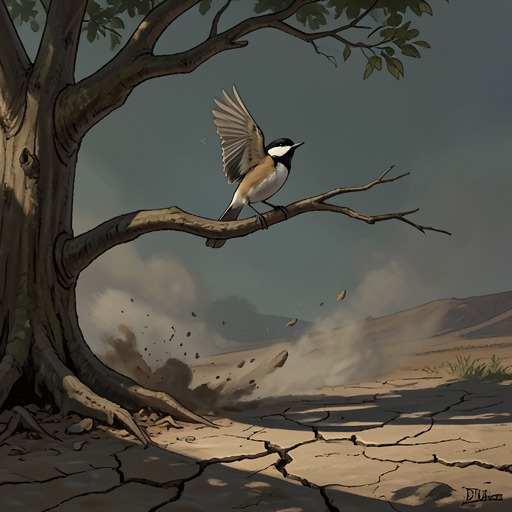
The Earthquake BirdThe Earthquake bird is Lucy Fly’s name for a distant, elusive sound associated with earthquakes. Neither Lucy nor the people who hear it can identify its source, and the novel never settles whether it is an actual bird, another kind of noise, or something misheard in the half-conscious moments around sleep. Its importance lies in that uncertainty: as Lucy listens for an explanation, the sound becomes a way of registering how fear and memory color what she hears.
First Hearing and Naming
The sound enters the narrative on the morning Lucy is arrested. An earthquake wakes her from deep sleep: coat hangers strike the wardrobe, plates rattle in the kitchen, and the floor creaks beneath her. At first she does not understand that the room is moving. What tells her is a faint, tinny voice carried from outside, which she hears in the wind. The tremor itself is not unusual in Tokyo, where such quakes occur regularly. Lucy emphasizes that she is recording the order of events, not claiming that the earthquake caused or foretold her arrest.
Her reaction nonetheless shows how ordinary seismic movement has become charged with fear. Since Lily Bridges’s death and Teiji’s disappearance, Lucy has grown nervous. She gets beneath the wardrobe’s clattering hangers, puts on a cycling helmet, and reaches for a flashlight kept taped to the wall. She checks that her whistle and earthquake water are with her before crouching in the corner. The sound belongs to a practical emergency, but it also arrives in a life already shaped by loss and uncertainty.
Lucy gives the noise its name while explaining it to Lily Bridges. She has heard it during earthquakes and cannot tell what produces it. Teiji thinks it may be an old night bird jolted from its perch; another possible impression is metal being knocked against something. Lily likens it to a boot kicking a tin can in the distance. These descriptions remain possibilities rather than answers. The name Earthquake bird preserves the mystery instead of resolving it, giving an indistinct sound a memorable identity without proving that a bird is there.
A Sound That Resists Explanation
The sound is difficult to investigate because it seems to vanish as soon as Lucy becomes fully alert. She says that concentrating on it only makes her more confused: it is hard to judge in the middle of the night, and by the time she can focus, the noise has stopped. The fact that Teiji and Lily have heard it too offers some reassurance that she may not be dreaming, but it does not establish what they heard. Shared perception narrows the question without answering it.
Lucy privately notices a more unsettling detail: the sound seems to begin just before the shaking. She does not tell Lily this. The timing may be a mistake, or perhaps part of a recurring dream, and Lucy acknowledges that certainty is impossible in the middle of the night. If the sound really comes first, she wonders whether it is a warning or a symptom of the earthquake. Even as a warning, it would offer almost no time to act. The possible foreknowledge therefore sharpens the unease without becoming useful knowledge.
This distinction between what Lucy hears and what she can establish is central to the motif. The earthquake is physically felt; the sound’s source and timing remain uncertain. Lucy records impressions, tests them against other people’s accounts, and then questions her own recollection. The reader receives no independent explanation that would settle the matter. Instead, the sound makes the boundary between observation, dream, and fear difficult to hold in place.
Trains, Rain, and the Return of Loss
The Earthquake bird also belongs to a wider pattern of sounds that recall absent people. Lucy remembers being with Teiji beneath a railway bridge as rain fell and trains passed overhead. Their encounter there joins the vibration of the Yamanote Line to physical intimacy; later, Lucy returns beneath railway bridges to feel the trains pass and weeps because Teiji is no longer with her. She cries for Lily as well. The trains are not identified as the bird’s source, but their repeated rattling and shaking give the novel another sound through which a present sensation can reopen a remembered scene.
Near the end, Lucy describes a neighborhood earthquake drill that was calm, orderly, and considered successful by the municipal authorities. She remains nervous about tremors, though less than before, and values living near the station partly because the trains shake the buildings with such force that they can conceal movements from beneath the earth. This practical observation turns the soundscape into a problem of attention: when familiar mechanical noise masks seismic movement, listening cannot guarantee that danger will be recognized in time.
A later noise in the sky recalls Lucy’s old apartment, but she distinguishes it from the Earthquake bird because it is daytime; in her experience, the bird came only at night. The sound nevertheless brings back images of Lily crouching under a table and hunched in a shed, the unidentified woman whose remains were scattered in the bay, and Sachi. Those memories gather around a sound that Lucy cannot confidently identify. Before she can listen closely, another train arrives, and she is left with the noise’s emotional associations rather than its source.
Unresolved Presence
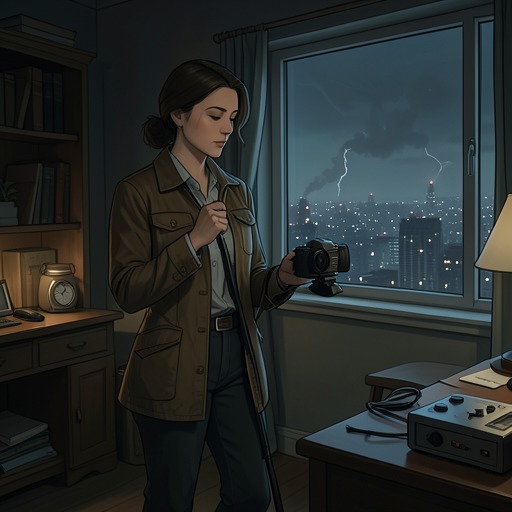
The final recurrence shifts from the uncertain sound before an earthquake to an unmistakable camera click and the whirr of film advancing. Lucy looks for Teiji among the trees and bushes, listens for his footsteps, and cannot tell which direction the clicking comes from. Rain begins to fall, recalling the earlier scene beneath the railway bridge. The camera sound is not identified as the Earthquake bird; its significance comes from how the novel places it beside that earlier pattern of elusive sounds and remembered absences.
Lucy hopes the warmth of the house and the presence of her close friends will keep her safely indoors, yet she also feels that Teiji is waiting outside. The scene offers no firm confirmation of what she perceives. In that unresolved ending, the Earthquake bird’s logic persists even without the named sound: an impression may feel like a warning, a memory may arrive as if it were present, and careful listening may still fail to distinguish evidence from fear. The expression thus binds the novel’s earthquakes to its larger uncertainty about what Lucy knows, what she remembers, and what remains beyond her reach.