Kameyama
The Earthquake BirdKameyama is the older police interrogator who questions Lucy Fly about Lily Bridges’s disappearance. Seen almost entirely through Lucy’s wary, sardonic account, he is both a physical presence across the interview table and the voice of an investigation trying to distinguish what can be established from what Lucy chooses to say. His questions repeatedly bring the case back to the same points: the last known conversation, the argument witnessed by a neighbor, and the identity of the body recovered from Tokyo Bay. He is persistent, but the narrative gives no independent account of his private motives or history.
Identity and Introduction
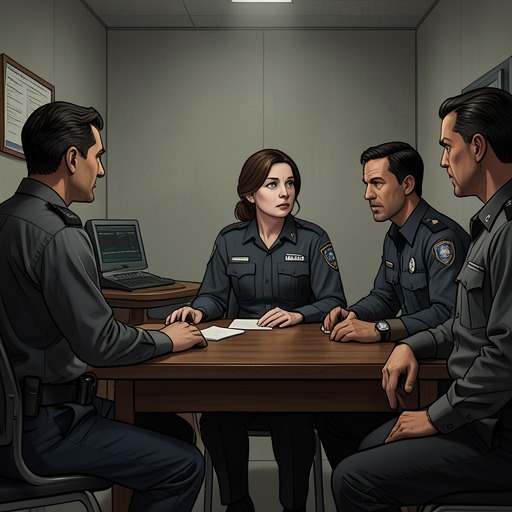
Lucy first describes Kameyama as an old, fat man. After the interpreter leaves, Kameyama shows her to a chair in a small room and sits opposite her. At first, he looks everywhere except at her face. Lucy interprets the moment when he finally fixes his eyes on her as a reversal: once he looks, he seems unable to look away. She attributes that effect to her eyes, a judgment filtered through her own self-conscious narration rather than an explanation supplied by Kameyama.
His name is established when he briefly leaves and a younger officer, Oguchi, enters. Lucy reads the kanji on their name badges and identifies the older officer as Kameyama, glossing the name as meaning turtle mountain. The scene gives him no stated rank or biography. His defining role is procedural: he is the investigator who returns to question Lucy, while Oguchi remains in the room during part of the interview.
Questioning Lucy
Kameyama opens by asking Lucy to tell him about the night Lily disappeared. When Lucy asks which night he means, he defines it as the night after which Lily was never seen again and notes that, as far as the police know, Lucy was the last person Lily spoke to. The question immediately establishes the stakes of the interview without establishing what happened after that conversation.
A neighbor’s account supplies a more specific line of inquiry. The neighbor reportedly saw Lily at Lucy’s apartment door and saw Lucy speak angrily with her. Lucy responds that the witness presumably saw what she has already described. Kameyama does not accept that answer as the end of the matter. Lucy compares his stare to a teacher waiting patiently for a child to confess; under that pressure, she adds that she went after Lily about five minutes later because she had forgotten to tell her something. Kameyama follows up by asking whether she spoke to Lily again. The exchange shows his method in miniature: he returns to the sequence of events and asks Lucy to account for the interval and the second encounter.
Kameyama also asks why Lily came to Lucy’s apartment. Lucy says that she does not know, while withholding from him the background she does know: Lily had come to Japan to escape her controlling former boyfriend, Andy. Lucy’s narration says the police already knew this information from earlier statements by her and Bob. That distinction matters to the interview: Kameyama’s questions meet not only gaps in Lucy’s memory, but deliberate decisions about what she will disclose again.
Persistence and Pressure
At a later stage, Kameyama puts his elbows on the table and clasps his hands beneath his chin. He says he has asked the same question ten times and asks again what caused the argument with Lily that the neighbor witnessed. Lucy answers that she was angry, a response that gives him little new information. His repeated question marks the conflict between the investigation’s demand for a coherent account and Lucy’s control over the pace and content of her answers.
Lucy recognizes that her silence is frustrating him. She cracks her fingers one by one as Kameyama leans back with a grunt, tired of waiting. Her narration acknowledges that she is causing annoyance, but says she is not yet in the mood to talk. She also cannot clearly recall what happened that night and says she must recover it bit by bit before she can tell him. Kameyama eventually changes tack and tries another question. The scene presents his persistence alongside the limits of interrogation: repeated prompting does not itself make Lucy’s memory clear or her account complete.
The Body and the Case
Kameyama later challenges Lucy’s apparent willingness to believe that the remains found in Tokyo Bay belonged to Lily. He observes that friends and relatives commonly resist identifying an unconfirmed corpse as someone they love, whereas Lucy seems unusually ready to accept the identification. His question unsettles the assumption that had shaped the case. The recovered torso and matching limbs had no hands and therefore no fingerprints; the police could not officially identify the remains, even though the press and others treated them as Lily’s.
He then makes the decisive correction: the Tokyo Bay body is unidentified, and Lily’s body has instead been found in an unused shed behind a gas station a few minutes from Lucy’s home. Kameyama tells Lucy that Lily was strangled. The new location and manner of death alter the meaning of the evidence that had made Lucy look suspicious, including the neighbor’s account of Lucy leaving after Lily. He also points out that Lucy could not plausibly have dismembered a body elsewhere in Tokyo in the short interval described. His challenge is not an exoneration by itself; it exposes how the mistaken identification had encouraged a conclusion beyond what the forensic evidence could support.
Narrative Role and Outcome
Kameyama’s interview provides the procedural frame through which Lucy’s account of Lily’s disappearance is tested. Yet readers encounter his questions through Lucy, whose humor, evasions, and judgments shape his portrayal. His patient stare can seem to promise a confession, while the later interview makes clear that patience and repetition cannot guarantee truth. Lucy eventually gives investigators a fluent, detailed account of killing Lily, but identifies that account as invented. The case against her remains circumstantial, and the police find no fingerprints or DNA on Lily’s body; she is released without charges.
The evidence does not state that Kameyama personally decides Lucy’s release, nor does it provide a final assessment from him. His significance lies instead in the questions that bring the case’s uncertainties into focus. He insists on the missing conversation and the disputed body identification, but Lucy’s eventual confession demonstrates the danger of treating a complete story as proof. In the interview, Kameyama seeks a reliable sequence of events; the narrative leaves that reliability unsettled.