Keio Plaza Hotel
The Earthquake BirdKeio Plaza Hotel is the site of Lucy Fly and Teiji’s first encounter: not inside its rooms, but on the wet pavement outside, where Teiji photographs a puddle and Lucy steps into his frame. The hotel’s glass, lights, and imposing scale make it a striking urban backdrop, while the encounter turns that public space into the beginning of an intimacy that moves away from the building almost at once.
Setting and Appearance
The hotel stands among the skyscrapers of Nishi-Shinjuku, a district Lucy sees less as a futuristic spectacle than as a collection of very tall hotels, banks, and government offices casting long shadows. On the evening she passes it, steady rain has left the pavement slick. Lucy walks without an umbrella, which she considers cumbersome and dangerous on crowded streets, and is the only person she notices doing so.
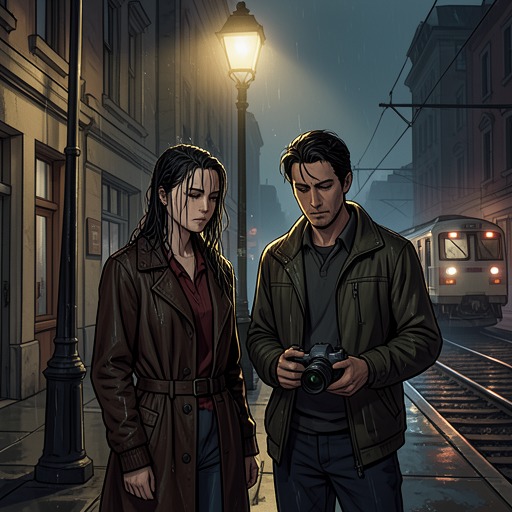
Outside the hotel, streams of people carrying umbrellas pass a young man who bends over a puddle to photograph it. Water runs over his hair and face, but he appears not to notice. Lucy is struck by his delicate fingers, sharp shoulders, and transparent brown eyes; against the neon-dark city, she imagines him as made of water and ice. The hotel’s scale and spectacle recede as her attention fixes on this solitary figure and the small patch of water before him.
The Puddle and the First Photograph
The puddle holds a divided reflection of Keio Plaza Hotel: bright windows and lights on one side, darkness and floating cigarette butts on the other. Lucy reads the stubby ends as people jumping from the hotel windows, while Teiji studies the water through his camera. The contrast between what she sees and what he seeks makes the puddle more than a reflection of the building: it is the first sign of their different ways of looking.
Lucy steps close enough for the tips of her shoes to enter the water and appear over the hotel’s reflected image. Teiji continues moving around the puddle, then raises his head to search her face before looking at her through the viewfinder. He takes a picture that includes her feet, and then another of her. Lucy remembers these as the first photographs he made of her, though she never sees them. By stepping into his composition, she turns an act of observation into an encounter between them.
From the Hotel to Teiji’s Apartment
Lucy understands the moment as intimate and imagines that a deeper intimacy must follow: she has invited herself into the photograph, and Teiji has captured her in it. The recollection leaves some details uncertain; she does not remember whether they spoke or exactly when she knew where they were going, though she believes they walked together in silence.
They do not stay at the hotel. Lucy considers a room there beyond what they could afford, and the two walk for about twenty minutes to Teiji’s apartment in Shin-Okubo. The route carries them away from the illuminated towers and into a different Tokyo of old houses, small apartment buildings, narrow gray streets, shops, bars, and cheap eating houses lit by orange lanterns. They pass other puddles, but Teiji takes no more photographs until they reach his apartment. The hotel therefore marks the beginning of the encounter, while the walk away from it leads into the private space where their intimacy continues.
Place in Lucy’s Memory
Lucy later recounts meeting Teiji while looking back from the uncertainty of her present, using remembered places to trace how the past became the present. The hotel remains attached to a precise image: Teiji bent over rainwater, the building broken across its reflection, and Lucy’s feet entering the frame. The first photographs are never recovered for her to see, so the moment survives through her memory rather than through the images themselves.
During a later night walk around Tokyo, Lucy returns in thought to Shinjuku and the spot where she first saw Teiji. She reflects on the possibility that Teiji’s attachments to Sachi, Lucy, and Lily followed one another like stations along a track; this is Lucy’s conjecture, not a confirmed account of his relationships. The remembered meeting place thus connects the hotel scene to her later sense of loss, while the walk around the Yamanote Line turns the city’s stations and past encounters into a personal map. The hotel’s significance lies less in any later visit than in its enduring place at the origin of that map.