Lucy Fly's Estrangement from Her Family
The Earthquake BirdLucy Fly’s estrangement from her family is both a departure and a boundary she chooses to maintain: she leaves Yorkshire for Japan without explaining herself, then decides that she will speak to her mother, Miriam Fly, only if Miriam makes the first move. Years later, an unexpected letter from her brother Jonathan Fly briefly brings the family back into view, but does not dissolve that distance.
Family Background and Departure
By the time Lucy leaves home, the family has already been altered by absence and grief. Most of her brothers have moved away, and their departure has pushed Lucy and Miriam Fly uncomfortably close. George Fly has died, two years after Noah Fly, and the account links George’s death to grief for Noah; it also notes that George died in the arms of a woman who was not Miriam. The surviving family is therefore presented not as a secure home Lucy is simply abandoning, but as a household marked by losses and difficult proximity.
Lucy’s choice of Japan grows from a longer desire for distance. As a girl, she studies maps and languages and becomes fascinated by the possibility of learning a language no one around her can read or speak. After leaving Yorkshire, she goes to London to study Japanese. Japan appeals partly because it is farther from England, almost as far as she can travel without turning back toward home. The account describes her departure as bringing relief on all sides, without tears or an explanation. That quietness matters: the separation is not staged as a final argument, but as a long-planned escape whose emotional terms remain largely unspoken.
The Silence She Maintains
After university, Lucy leaves for Japan and does not contact Miriam Fly. She sets a clear condition for any renewed communication: she will speak to her mother only if Miriam calls or writes first. Miriam never does. Lucy’s move abroad thus becomes more than geographical separation; it is a rule governing who must take the first step, and a refusal to repair the relationship unilaterally.
The estrangement is not described as a simple declaration of hostility. Lucy gives no explanation for leaving because, in her view, none is needed. Her silence also persists after she has made a life in Tokyo: she works as a translator and editor, and years pass without news from her brothers. In the same period, her life is organized around chosen distances and attachments elsewhere. She wanders the city alone and, when she meets Teiji, finds that she cannot bear to walk away from him and be alone again. The contrast does not establish that her family estrangement causes her later relationships, but it places her capacity for closeness beside a sustained refusal to return to family contact.
Jonathan Fly’s Letter
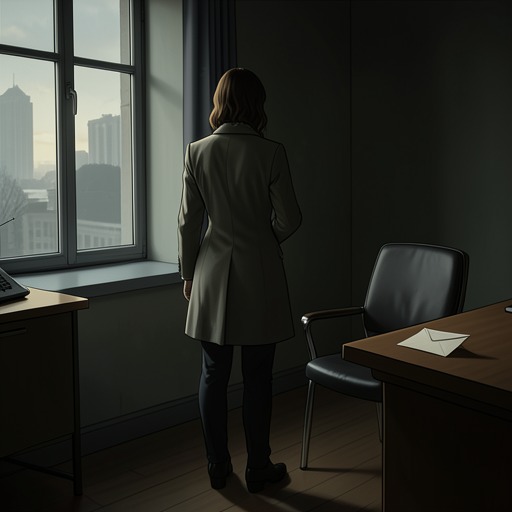
The family’s silence is interrupted when Lucy finds a British-stamped envelope at work. Its handwriting is unfamiliar, and she briefly wonders whether the letter might come from Lizzie, the only person in Britain she knows has her work address. Instead, the writer is Jonathan Fly, one of her remaining brothers. Lucy has heard nothing from any of them since before she left home, so she assumes the letter may be a joke or may announce a death.
Jonathan explains that Lizzie gave him Lucy’s address after they met at Waterloo Station. He says the family has received no news from Lucy for a long time and hopes she is well. His message also recalls that Lucy and Lizzie used to be close. The letter is therefore a genuine attempt to reach Lucy, but its arrival does not instantly restore intimacy: she is startled by the contact and wary of what may lie behind it.
Lucy’s reaction is divided. She laughs at a doggerel poem by Miriam Fly, suspecting it was written less as a message to her than as an expression of wanting someone to arrive with a casserole. She is less amused by Jonathan’s apparent effort to befriend her as part of a broader attempt to befriend God long enough to obtain a job. Even so, the airmail envelope and its stamps prompt some gratitude. Lucy puts the letter in a drawer and decides to do nothing for the present, perhaps reconsidering a Christmas card months later. She wonders whether Jonathan has passed her address to Miriam, hopes he has not, and says in her private reflections that she wishes her mother no ill and hopes her arthritis is not too painful. That qualified concern coexists with a firm decision not to visit her and not to receive more poems.
Distance, Return, and Narrative Significance
Lucy’s later movement through Tokyo offers a formal counterpoint to the one-way departure from Yorkshire. She follows the Yamanote Line on foot, station by station, through places associated with different parts of her life. When she walks through Shinjuku, the district where she first met Teiji, her attention turns to another past relationship and to the possibility that the women in Teiji’s life followed one another like stations along a track. The walk eventually brings her back to Gotanda, where she began: she has circled Tokyo rather than travelled home.
That urban return should not be mistaken for a reconciliation with her family. It shows how Lucy can revisit familiar places and memories while continuing to hold the boundary she set with Miriam Fly. Her estrangement is sustained not by a single dramatic rupture but by repeated non-contact: she leaves without explanation, waits for her mother to initiate, and declines to turn Jonathan’s letter into a visit. The distinction between circling a city and returning to a family gives the silence its particular force. Lucy can move through the past, but movement alone does not make her go back.