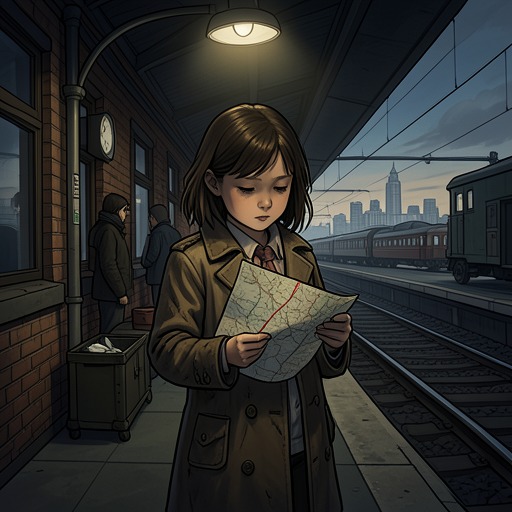
Lucy Fly's departure for Japan
The Earthquake BirdLucy Fly's departure for Japan is both a geographical break and a decision to make distance her form of freedom. She leaves Yorkshire, studies Japanese in London, and travels on without an explanation to her mother; the language she has pursued and the city she enters become the foundations of her adult life, while the estrangement she carries from home remains unresolved.
The Impulse to Leave
As a teenager, Lucy found a model for escape in maps and languages. While her friend Lizzie imagined illnesses from a medical dictionary, Lucy kept the family's modest collection of maps and atlases beneath her bed, studying a different country each night by flashlight. At the British Museum, seeing the Rosetta Stone, she recognized what seemed to her the limitation of an education centered on the Roman alphabet. Its hieroglyphics suggested a message beyond the languages available to the people around her: she should learn one that no one she knew could read, much less speak.
That desire was not simply intellectual. Lucy's friendship with Lizzie offered a private world, including their invented version of French, but it could not provide complete separation from other people. The maps let Lucy imagine a more radical remove. Long after she left, she would understand Japan's distance from England as part of its appeal: it was almost as far away as she could go without beginning to circle the globe back toward home.
Study and the Choice of Japan
Lucy left Yorkshire for London to study Japanese. London appealed as the exact opposite of the small town she had endured, and Japanese appealed after she weighed the writing systems: Chinese required more than six thousand characters, while Japanese used two or three thousand. The decisive argument, however, was geographical. Japan lay slightly farther from England, and that distance mattered to her.
At university, Lucy's studies and habits changed together. She discovered that alcohol and sex suited her better than the food she had previously lived on; her grades rose, kanji became easier to learn, and practicing the characters became pleasurable. After three years, she was ready to graduate. The education gave her a practical command of Japanese, but the choice of language also fulfilled the childhood wish for a private territory inaccessible to the people she had known at home.
Leaving Without an Explanation
By the time Lucy left her university residence for Japan, she had made contact with her mother conditional: she would speak to Miriam Fly only if Miriam called or wrote first. Miriam did neither. Lucy therefore departed without needing to explain the decision to her. The account presents no tearful farewell; after most of the brothers had already left home, Lucy and Miriam had been left uncomfortably close, and the separation brought relief on both sides.
The family history surrounding the departure is already marked by absence. George Fly had died of grief for Noah Fly two years earlier, in the arms of a woman who was not Miriam. Lucy's move thus follows losses and estrangements rather than a reconciled family parting. Her silence toward Miriam is not an interruption that the journey repairs: it is one of the conditions under which she leaves.
A Life Built in Tokyo
In Japan, Lucy found an apartment and worked for several companies, editing documents and translating presentations and instruction manuals. Eventually she settled into a position at a small industrial translation company, where she put Japanese sentences into English, reorganizing their word order and supplying articles, plurals, and specificity. The work made her chosen language the means of her livelihood, even though she lacked training in the engineering and electronics behind many of the documents.
Tokyo also gave her the scale and anonymity she had sought. After Mrs. Yamamoto's string quartet disbanded, Lucy wandered the city on Sunday evenings; following the railway from station to station brought her to Shinjuku, where she first saw Teiji photographing a puddle outside the Keio Plaza Hotel. She later recalled being unable to walk away from him, despite not having thought of herself as lonely. The departure's consequence was therefore more than residence in a distant country: it placed Lucy in the city where a chance encounter could become an intimate attachment, and where familiar routes would later hold the memories of both connection and loss.