Lucy Fly–Miriam Fly Mother–Daughter Relationship
The Earthquake BirdThe Lucy Fly–Miriam Fly Mother–Daughter Relationship is shaped by a mismatch established at Lucy’s birth: Miriam had expected another son, while Lucy grows up determined to escape the family home. Their separation is not resolved by distance or by the possibility of a belated welcome. Years after Lucy leaves, a letter from her brother Jonathan Fly brings news of Miriam’s illness and poetry; Lucy receives it with a mixture of amusement, gratitude, caution, and continuing refusal to return.
Birth and Early Expectations
Lucy is born in Scarborough in 1965, the youngest of eight children and the only girl. Her mother, Miriam, had spent years imagining a family life centered on men. Her own father died during the war, she had two sisters and no brothers, and she had been educated at all-girls’ schools. As an adult, she regarded the attention of men and the company of her seven sons as a kind of compensation for that childhood. Lucy’s arrival therefore unsettles a role Miriam had assumed was hers: she had expected an eighth boy, whom she would have called Jonah.
The birth scene makes the disappointment concrete. Lucy is born at home in darkness after the bedroom bulb goes out; her father, George Fly, fetches a replacement from the outside loo, while Miriam sees a daughter where she had expected a son. The midwife calls the baby lovely, but Miriam sees a scrawny infant with crow-like eyes. Her response is not presented as simple cruelty: she is in pain, recognizes that this is her last child, and turns immediately toward the practical demands of family life. She considers the name Linda, meaning beautiful, but instead accepts Lucy, meaning light, after the broken bulb and George’s repair become part of the circumstances of the birth. The name’s brightness sits against a beginning marked by Miriam’s inability to welcome the child she actually has.
A Daughter Outside the Expected Role
Miriam’s disappointment persists in the ordinary texture of Lucy’s childhood. Family routines continue, and Lucy is allowed to wear boys’ clothes, but her brothers do not see much point in her. They use her as a cannonball to test the greenhouse glass, while Miriam finds her little help with domestic work: Lucy breaks dishes, drops hot plates, and cannot cook. Miriam’s expectations are practical and gendered. When Lucy struggles with pastry, her mother warns that she will never get anywhere or marry if she cannot make it.
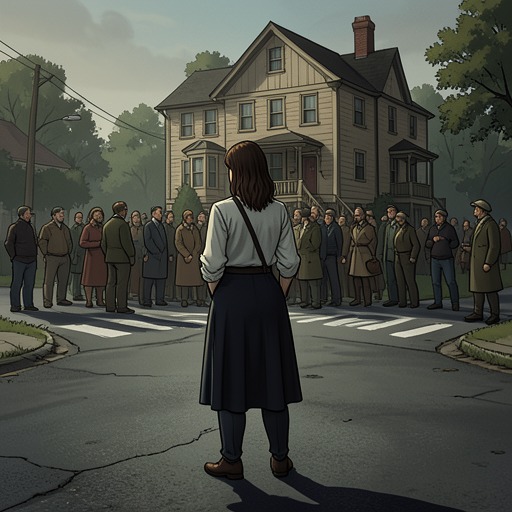
Lucy’s response is inward but decisive. She tells herself that she will get away. That resolve gives the mother-daughter relationship an early pattern: Miriam measures Lucy against a conventional future of domestic competence and marriage, while Lucy imagines a life elsewhere. When Lucy is seven, the family moves from Scarborough to a flatter coastal town farther down the coast, where Miriam complains of isolation. On Sundays the family eats picnics in the wind and swims in the cold North Sea. Lucy avoids the breakwater games that her brothers play and retreats to read on the promenade bench. Miriam does not approve. Their difference is not confined to arguments about household skills; it also appears in how each inhabits the same family surroundings.
Departure and Chosen Distance
As Lucy grows older, leaving becomes more than a private wish. After studying maps and languages, she goes from Yorkshire to London to study Japanese. The choice is bound up with distance: Japan lies farther from England than the other options Lucy considers, and she wants a language no one around her can read or speak. By then, most of her brothers have left home, bringing Lucy and Miriam uncomfortably close. George has also died, two years after Noah Fly, and the family’s old arrangement has changed. Lucy’s departure brings relief on both sides; there are no tears and no explanation.
Lucy makes that separation explicit by deciding that she will speak to Miriam only if Miriam calls or writes first. Miriam does neither. When Lucy leaves her university residence for Japan, she does not contact her mother, and the silence becomes a sustained condition rather than a temporary break. Lucy establishes a working life as a translator and editor in Japan, while the relationship remains outside her daily life. Her later habits of wandering alone through Tokyo and forming attachments elsewhere give the estrangement a broader setting, but the evidence does not show her seeking reconciliation with Miriam during those years.
News from Home and an Unanswered Welcome
The estrangement is disturbed by a letter from Jonathan, who has encountered Lucy’s old schoolfriend Lizzie at Waterloo Station and obtained Lucy’s address from her. He reports that Miriam’s arthritis is bad, though her mind remains sharp, and that his wife, Felicity, visits her on Tuesdays and Sundays with food. He also says that Miriam has become a poet and has had pieces printed in the local Recorder. This news offers Lucy a picture of her mother continuing to live and create, but it comes through her brother, not directly from Miriam.
Jonathan encloses a poem he believes concerns Lucy and Miriam’s wish that she return. Its speaker describes a haunted home and a garden of tombs, then imagines an open door through which the absent daughter might come, bringing light. The poem makes welcome imaginable while also carrying an admission of fault. Lucy delays before reading it, opening and refolding the sheet and sitting at her desk for about twenty minutes. When she finally reads it, she laughs aloud and decides it is more likely about Miriam wanting Felicity to appear with one of her casseroles than about Lucy coming home. The interpretation deflects the poem’s possible appeal without proving that Miriam did not mean it for her.
Lucy’s response to Jonathan is similarly divided. She is unconvinced by his account of his religious conversion and suspects that his attempt at friendship is tied to his wish to befriend God and obtain a job through the church. Still, she feels some gratitude for receiving his airmail letter. She puts it in a drawer rather than answering, resolving to revisit the decision in a few months and perhaps send a Christmas card. She hopes Jonathan has not given her address to Miriam, wishes her mother no ill, and hopes the arthritis is not too painful. But she has no intention of visiting and does not want more poems.
The Relationship’s Unresolved Form
The later contact does not undo the original pattern so much as reveal its terms more clearly. Miriam’s possible invitation reaches Lucy through a brother and a poem; Lucy can acknowledge its emotional possibility while interpreting it away. Her concern for Miriam’s pain coexists with a firm boundary against returning. Neither an explicit reconciliation nor a final severance occurs in this episode: Lucy leaves open the remote possibility of a Christmas card, but takes no immediate action.
The relationship is defined by asymmetry as much as by distance. Miriam’s early expectations are visible in her disappointment at Lucy’s birth and in her insistence on skills associated with marriage, while Lucy’s account of herself is oriented toward departure, private study, and a life in Japan. In adulthood, the mother’s wish for the absent daughter appears only indirectly, and the daughter’s response remains private and conditional. The poem’s open door therefore becomes a pointed image of the relationship: an invitation may exist, but Lucy does not walk through it.