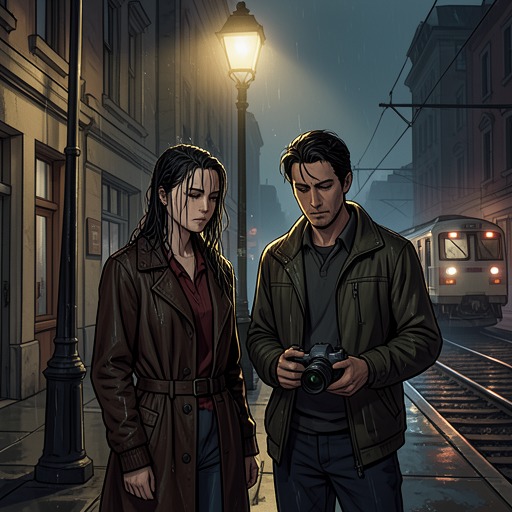
Lucy and Teiji's first encounter
The Earthquake BirdLucy and Teiji's first encounter begins with a photograph: on a rainy Tokyo night, Lucy steps into the frame of a young man studying a puddle outside the Keio Plaza Hotel. Their wordless attention to one another gives way to a walk across the city and their first sexual intimacy in his apartment. Recalled later by Lucy, the meeting is both the start of their relationship and a scene already shaped by the uncertainties of memory: she can describe the images and sensations that remain, but not reliably reconstruct how they spoke or chose where to go.
The rainy streets of Shinjuku
Lucy is wandering central Tokyo after Mrs. Yamamoto's string quartet has disbanded, leaving her without her usual Sunday-evening activity. The skyscrapers of Nishi-Shinjuku hold little appeal for her from street level: they are, in her view, hotels, banks, and government offices that cast long shadows. Rain falls steadily, and she walks without an umbrella, which she finds cumbersome and dangerous among pedestrians. Her clothes can dry, and she considers her skin waterproof.
Outside the Keio Plaza Hotel, a young man stands apart from the stream of umbrella-carrying pedestrians. He bends over a puddle, photographing it as water runs across his hair and face. Lucy is arrested by the contrast between his still, absorbed attention and the movement around him. She sees his delicate fingers, sharply outlined shoulder blades, and transparent brown eyes, and imagines him as something made of water and ice. The scene's first attraction is therefore visual: before she knows anything about him, Lucy regards him as a striking presence in the neon-dark city.
The photograph and the approach
Lucy moves toward the puddle to see what has captured the photographer's interest. In its surface, the hotel is split between illuminated windows and darkness; cigarette butts float in the water. Lucy sees the blunt ends as people jumping from the hotel, an imaginative projection that differs from the deeper attention she attributes to the photographer. He continues shifting around the puddle with his camera to his eye, apparently absorbed in composing the image.
Lucy steps forward until the toes of her shoes enter the water and reflect against the hotel. The photographer includes her feet in the shot, then raises his head and searches her face as though something remains missing from the image. He looks at her again through the viewfinder and takes another picture. Lucy later identifies these as the first photographs he took of her, though she never sees them. The camera makes their initial contact at once intimate and indirect: he looks at her by photographing her, while she deliberately places herself within the scene he is observing.
Lucy interprets this small exchange as an invitation and an opening. Because she has entered his photograph, she imagines that she has been admitted into his world, and that a deeper intimacy should follow. This is her retrospective understanding of the moment, not a clear account of an explicit agreement: she cannot remember whether they spoke or when she learned where they were going. She believes they walked together in silence. The missing conversation leaves the encounter suspended between a vivid sense of mutual attraction and an unrecorded transition from looking to going home together.
From the hotel district to the apartment
The pair leave the high-rise landscape for the back streets of Tokyo. They do not take a room at the Keio Plaza Hotel, which Lucy regards as unaffordable, but head instead to Teiji's apartment in Shin-Okubo, about a twenty-minute walk away. The route carries them from neon towers into a different city of old houses tucked between small apartment buildings, narrow gray streets, tiny shops, bars, and inexpensive eating houses lit by orange lanterns. Cats hiss at dogs barking from balconies. Although they pass more puddles, Teiji takes no further photographs on the way to his apartment.
That walk is the encounter's unspoken middle: Lucy remembers its surroundings more securely than the words, if any, exchanged between them. The camera that first brought them into contact falls quiet as they move through the city. At the apartment door, she remembers hearing Teiji's key turn in the lock. The narrative thus gives the transition a sequence of concrete thresholds—the puddle, the back streets, the key—without filling in the conversation that might ordinarily explain how two strangers came to share a destination.
The first night together
In the lamplight, with the curtains open, Teiji takes one final photograph: Lucy's naked body, kneeling on the bed and leaning back as she waits for his touch. She is not troubled by being seen through the camera. To her, its gaze seems kinder than a naked eye, which can blink or sneer; the camera's judgment, she thinks, is deferred until the film is developed. The photograph extends the encounter's governing tension between being looked at and being known. Lucy welcomes the image-making even as she remains unsure what Teiji sees in her.
After taking the picture, Teiji closes his eyes. Lucy imagines that he keeps the image of her body framed beneath his eyelids, but presents this as a belief she likes to hold, not as something she can know. They have sex, and the remembered scene shifts from the camera's fixed image to bodily movement. When their breathing slows, Lucy remains above him for a while, wondering how easily the night has unfolded; afterward, she feels pink and sore, with an emotion unusually close to joy. Her recollection preserves this feeling as the encounter's consequence, while leaving its ease itself somewhat mysterious.
Memory and the beginning of a relationship
Lucy later places the meeting within a wider pattern of solitary movement through Tokyo. She had not considered herself lonely, and she had been walking from station to station along the Yamanote Line; Shinjuku is where that wandering brings her to Teiji. Yet when she sees him, she cannot bear to walk away and be alone again. The contrast does not cancel her earlier claim that she was not lonely. It shows how a meeting can make a previously unrecognized desire for company suddenly legible.
In the time that follows, Lucy and Teiji develop a way of being together that does not depend on fluent conversation. They exchange what she calls silent conversations through invisible gestures, walk the streets, and spend time at his uncle's noodle shop. While Teiji serves customers or takes out rubbish, Lucy reads Japanese literature and practices kanji in a notebook, repeating the strokes until she can write them as confidently as her own name. They spend whole weekends in bed, and their favorite outings are warm nights in the rain, when Teiji teaches her words for different kinds of rainfall. These later details make the first meeting's silence feel less like an obstacle than the beginning of a shared language, one formed through gestures, study, photography, and weather.
The encounter also returns to Lucy during a later night-long walk around Tokyo, when memories of Teiji and Lily have left her hurt and restless. As she reaches Shinjuku, she thinks of Sachi, whose story she associates with the small theater where Teiji found her, and wonders whether Teiji moved from Sachi to Lucy and then to Lily without a pause. The first meeting, once recalled as a sudden passage from a puddle-side photograph to intimacy, becomes one point in a sequence Lucy cannot fully verify. Its vivid images remain, but the gaps in what she remembers leave the beginnings of the relationship open to revision.