Lucy invents a confession to killing Lily
The Earthquake BirdLucy Fly’s invented confession turns her jealousy and exhaustion into a persuasive account of Lily Bridges’s murder, although Lucy insists that the account is fiction. Its apparent completeness contrasts with the uncertainty of her actual memories and helps explain why she accepts the role of murderer even while denying the killing.
Interrogation and the Shape of the Confession
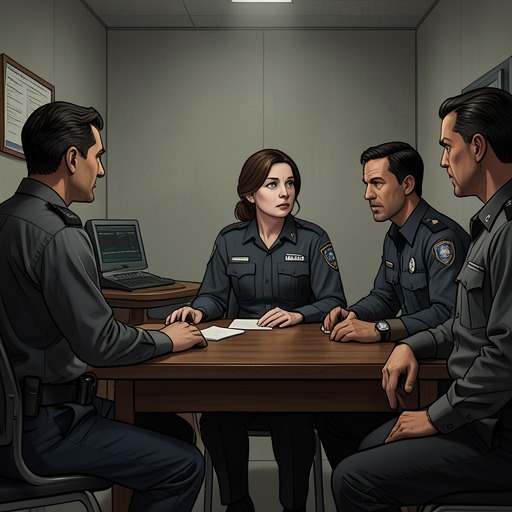
At first, Lucy does not answer the officers. Kameyama waits while she tries to recover the night in fragments, because she says the events have blurred in her memory; Oguchi fidgets beside him as the silence stretches. Lucy recognizes that the officers’ patience is wearing thin, but she is not yet ready to speak. The questioning turns to her possible guilt, which she connects in her thoughts to having caused Noah’s death, before the officers return to Lily’s case.
When the officers come back with Suzuki, an older, larger investigator, he describes Lily as a young, innocent woman. Lucy rejects that description but says she did not kill her and could never have done that to Lily. Later, however, Lucy begins talking at length, presenting the officers with the account she believes they want. She attributes the imagined killing to jealousy of Lily, rage at her betrayal, and her obsessive love for Teiji. In the story she tells, a pair of stockings becomes the weapon; Lily, still trusting Lucy as a friend, is caught off guard and smiles before Lucy kills her and drags her warm body to a hiding place. The fluency and detail make the account sound like a confession, but Lucy identifies it as a story she has spun, not a memory of killing Lily.
The Confession and the Limits of Guilt
Lucy’s invented account sits beside a genuine admission of violent feeling, but she draws a sharp line between wanting Lily dead and killing her. She says she wanted to wring Lily’s neck and hurt her in return for the betrayal, yet insists she never wanted to stab or dismember her, and that throwing body parts into Tokyo Bay never crossed her mind. The distinction does not make Lucy’s anger harmless; it makes the confession’s vivid details more unsettling, because its apparent certainty belongs to a fabricated story rather than to the crime she says she did not commit.
Lucy’s decision to let that story stand is bound up with a more difficult account of responsibility. Tired and distrustful of her own ability to keep people safe, she reasons that resisting arrest is pointless if she might kill again. She also considers how her choices helped bring Lily into danger: she introduced Lily to Teiji, persuaded her not to return to Britain, and believes that refusing Lily’s phone call may have led to her coming to Lucy’s street that night. Her plea, “Not guilty, but not not guilty,” preserves the difference between murder and these failures without resolving the moral unease between them. Lucy says the truth may emerge at trial, but for the present accepts being treated as the murderer.
Evidence, Release, and the Confession’s Collapse
A day later, Lucy learns that she will be released without charges. The case against her was circumstantial, and investigators found neither a fingerprint nor a DNA sample on Lily Bridges’s body. More decisively, after newspaper reports identified Lucy, police received an envelope containing two photographs. The first showed Lily at a McDonald’s near Lucy’s home on the night of the murder, two hours after Lily had been seen at Lucy’s front door. A cashier recognized Lily and recalled that she and her Japanese male friend seemed distressed and had difficulty communicating; Lily left her cheeseburger untouched but drank her Coke. The image places Lily alive after the visit at the center of Lucy’s invented confession, making its account of an immediate killing untenable.
The police also separate Lucy’s brief venture outside from Lily’s death. She had been out for only about ten minutes, with her stockings over one shoulder, and her neighbor reported hearing no further departure that night. Investigators therefore conclude that the outing had no connection to the murder. The confession’s concrete details had made it sound complete, but the independent evidence breaks its apparent sequence apart: Lucy’s story supplied a murder narrative, not proof that she killed Lily.
The Confession as Performance
Lucy’s account functions not only as a claim about the past but as a performance shaped for its listeners: she says she is telling the officers what they want to hear, and their satisfaction marks the story’s immediate effect. By agreeing, for the moment, to occupy the role of murderer, she makes a coherent identity out of uncertainty without making that identity true. The episode therefore separates the force of an utterance in the interrogation room from its evidentiary force; Lucy’s words can persuade the officers while remaining a fabrication, and the later decision to release her shows that the role she assumed cannot settle the facts.