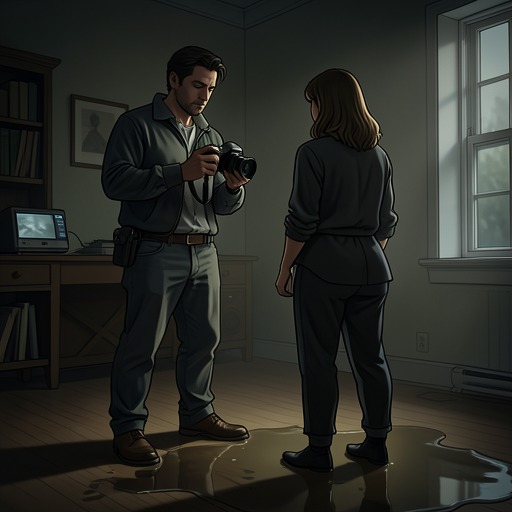
Lucy looks through Teiji's photographs without permission
The Earthquake BirdLucy looks through Teiji's photographs without permission in a remembered scene that turns his private archive into evidence of a life Lucy does not know. Her search begins as an attempt to fill the years before their relationship; it ends with the discovery of Sachi, a woman whose changing appearance in the photographs raises questions Teiji has never answered.
The search for Teiji’s hidden years
About twenty minutes after Teiji leaves, Lucy goes to his apartment. She knows where he keeps a spare key: in a crack in the wall beside the front door. She retrieves it and lets herself in, acting on a suspicion that has become impossible for her to set aside. Teiji’s room is familiar to her, down to its nooks, specks, and stains, but the photographs remain forbidden territory. That contrast makes the intrusion more than simple curiosity: Lucy feels at home in the space while crossing a boundary within it.
The boxes contain envelopes and folders arranged in neat piles. Lucy opens the first box, which holds Teiji’s childhood photographs, but closes it again; at this moment, childhood is not what she wants to know. The second box chronicles his life since arriving in Tokyo. Near the top are pictures he has taken of Lucy. She imagines that the bottom contains his final days at high school and his first days in the restaurant, but she digs instead through the middle. She does not want to see his arrival in Tokyo. She wants the intervening years before he met her—the stretch of his life that has remained unshared.
That choice gives the archive a shape defined as much by absence as by what it contains. Lucy passes over both the childhood she could inspect and the imagined beginning of Teiji’s Tokyo life, searching for a narrower, more intimate gap. The photographs offer a record, but not an explanation: Lucy must arrange what she sees into a story without knowing what Teiji has left out.
The woman in the photographs
At first the images show familiar subjects in Teiji’s work: water, pavement, train stations, and tunnels. Then Lucy finds a young woman looking through a bus window. She has a soft, round face, deeply set eyes, and a bob brushing her chin; her tired, angry expression makes her seem less like a posed subject than someone unwillingly caught by the camera. Lucy wonders whether she was Teiji’s lover before Lucy herself.
Lucy follows the pictures backward to the earliest one she finds of the woman. It shows her onstage alone, in a soldier’s uniform with a gun over her shoulder, her mouth open in a silent shout beneath the theater lights. The stage and walls are black, and the woman is only a small figure in the frame. Lucy cannot tell whether Teiji went to the play because he knew the performer or encountered her there by chance. The uncertainty matters: the photographs establish that he watched her, but not when or why their connection began. Before the theater image, Lucy finds only a few pictures of a man at the noodle shop, smiling stiffly at the camera with damp, red eyes.
Following the woman forward again, Lucy sees several more theater photographs, with different costumes obscuring her face. Other pictures place her in coffee shops, parks, by a riverside, and at parties. As the sequence continues, theater images become less frequent and party scenes more common; the woman appears sitting on worn tatami or on a bed. To Lucy, her face grows fatter and paler, and she looks increasingly sad. Her tight-fitting clothes become crumpled and stained. The change is visible across the images, but its causes are not: the archive records deterioration without supplying the circumstances behind it.
The last picture Lucy manages to see shows the woman lying face-down on the pavement with her head turned to one side. The corners of her mouth are raised, but Lucy cannot decide whether she is grimacing or smiling. She wonders what the woman is doing and thinks she must be drunk. The photograph leaves her with an image that resists a confident reading, just as the sequence as a whole leaves her with observation in place of knowledge.
Interruption and disclosure
Teiji enters without making a sound, or Lucy is too absorbed to hear him. Standing behind her, he says, “They’re private.” His flat voice makes the boundary explicit. Lucy is caught with the photographs open and cannot face him. She knows she should not have looked, but acknowledges to herself that she is sorry only to have been caught, not to have seen what she did. The distinction exposes how strongly her desire for access has overridden her respect for Teiji’s privacy.
The scene does not end with Teiji taking the photographs away or with Lucy abandoning her question. He pushes the open box into a corner, draws her to the bed, and sits beside her. Holding her chin, he watches her for minutes. Lucy cannot tell what he is looking for and worries about what he might see. Although his expression is sad, Lucy thinks he may be angry as well as sorry for her. The quiet physical closeness follows the discovery rather than resolving it; the photographs have made intimacy and concealment present at once.
Unable to get the scowling woman out of her mind, Lucy asks, “Who was she?” Teiji answers, “Sachi.” When Lucy asks where Sachi is now, he says, “I don’t know. She’s gone.” The name confirms that the woman belongs to Teiji’s past, but his brief answer does not explain the relationship or what happened to her. For Lucy, the search has achieved one decisive disclosure while preserving the larger absence that prompted it.
Narrative significance
The photographs function as a partial biography assembled without Teiji’s consent. Their sequence allows Lucy to trace a woman’s presence and apparent decline, but it cannot establish the story behind either. Instead of yielding a complete account, each image sharpens the difference between seeing and knowing: Lucy can scrutinize faces, clothes, locations, and poses, yet she has to guess at motives, relationships, and events beyond the frame.
The encounter also shifts the balance between Lucy’s imagined Teiji and the person whose sealed boxes she opens. She has wanted to know what happened in the years before he met her; finding Sachi shows that those years hold attachments and experiences not organized around Lucy. Her intrusion brings a name into their conversation, but it does not make Teiji’s past transparent. The box is pushed aside, and Teiji says Sachi is gone; the immediate scene closes with Lucy nearer to one fact and still outside the fuller story.