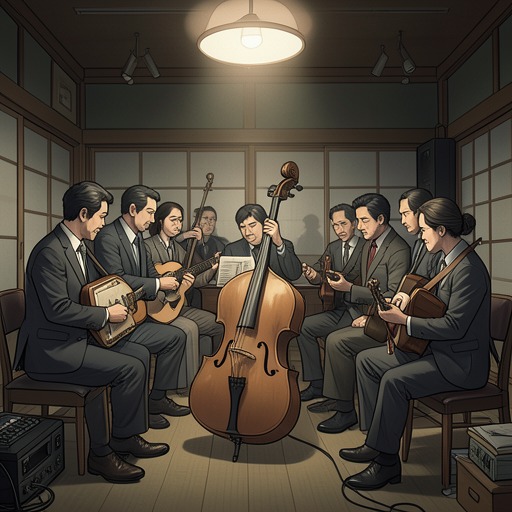
Lucy’s Secondhand Cello
The Earthquake BirdLucy’s Secondhand Cello is the instrument that reconnects Lucy with music after years away from playing, carries her into a small Tokyo string group, and is accidentally involved in Mrs. Yamamoto’s death. Its history turns on a stark reversal: a gift that offers Lucy pleasure and companionship becomes an object she can no longer bear to touch or retrieve.
Acquisition and the return to music
Not long after arriving in Tokyo, Lucy mentions her past cello playing to a high-school girl she teaches privately. Two weeks later, the student’s mother gives her an old cello that the family no longer has room to keep. Lucy is touched by the gesture, but receiving the instrument also brings an unwelcome weight of responsibility: she has not played for years and suddenly has a cello of her own again.
She practices in her apartment for several weeks, but her neighbor responds to each session by turning on a vacuum cleaner and opening her windows and doors. The noise overwhelms the cello. Lucy believes that, had the neighbor simply complained, she would have ignored her and continued playing; instead, the repeated disruption makes practice untenable, and she gives up. The instrument’s return to Lucy’s life is therefore brief at first, constrained not by a lack of musical memory but by conflict in the shared environment of the apartment building.
Giving up the physical practice does not silence the music. At work, Lucy hums and whistles the cello parts she remembers from pieces learned at school, even though she can recall those parts more clearly than the melodies. She taps out the rhythm by opening and shutting the photocopier, to the annoyance of her Western colleagues. The cello is absent from these scenes, but its music persists in Lucy’s habits: what she cannot play aloud at home keeps sounding through her at work.
A place in the ensemble
Natsuko notices Lucy’s preoccupation with music and tells her about a group formed by Mrs. Yamamoto, Natsuko’s former calligraphy teacher. Mrs. Yamamoto plays violin with Mrs. Ide on second violin and Mrs. Katoh on viola. Their previous cellist has died of a brain tumor, and the three women would be glad to have Lucy join them. They do not give concerts, and Natsuko describes them as good without being so brilliant that Lucy would feel intimidated.
Lucy initially doubts that she will fit. She is at least twenty years younger than the youngest member, Mrs. Ide; her conversational Japanese is limited, even though she can translate works by Mishima and Tanizaki; and she worries that she cannot replace the former cellist. The practical question is how to transport the cello across Tokyo every week. Natsuko reports that Mrs. Yamamoto will let Lucy keep it in her spare bedroom, making participation possible by giving the instrument a regular place to stay.
Lucy carries the cello by train from Gotanda to Nippori on the Yamanote Line, heading into an older, quieter part of Tokyo. On the way, she stops at Yanaka Cemetery to rest and consult her map. There she leans the cello against a stone lantern beside a grave with purple and white orchids. This brief pause places the instrument among objects associated with care and remembrance, before it becomes part of Lucy’s new musical routine.
For several years, Lucy plays with the group almost every Sunday. The rehearsals become the high point of her week; by Wednesday or Thursday she is already looking forward to them. The cello is no longer merely a gift that she has struggled to use. It enables a lasting practice and a dependable connection with the three older women, in a life whose weekly rhythm Lucy assumes will continue.
The accident and its aftermath
That routine ends when Mrs. Katoh telephones Lucy on a Sunday as she is about to leave for practice. There will be no rehearsal that day, and there will be no more rehearsals: Mrs. Yamamoto has had an accident. After a previous session, Lucy carried the cello upstairs to the spare bedroom as usual, but, for a reason she cannot fathom, placed it behind the bed rather than next to the wardrobe. Mrs. Yamamoto does not notice it while dusting the wardrobe. She trips backward over the instrument, strikes her head on the floor, and is found by her husband no longer breathing.
Lucy calls the cello a deadly trap, while making clear that neither she nor Mrs. Yamamoto knew it had been left in a dangerous position. The harm does not arise from an intended act: the instrument’s changed location, inconspicuous behind the bed, becomes consequential during an ordinary task. Its physical presence, once a means of making music, abruptly enters the story as the cause of a death.
Afterward, Lucy does not want to play again or meet Mrs. Ide and Mrs. Katoh. She makes no contact with them and never asks to retrieve the cello from the Yamamotos’ spare room. Mrs. Yamamoto’s death upsets her more than she expected, almost as if she had lost a lifelong friend. The instrument remains behind with the memory of both the ensemble and the accident, and Lucy turns away from the object as well as the relationships and activity attached to it.
Significance
The cello’s changing role gives a concrete form to the instability of Lucy’s renewed musical life. At first it is a generous but burdensome gift; then it is frustrated by the neighbor’s noise, made useful through the ensemble’s offer of storage, and incorporated into years of Sunday rehearsals. Finally, a small alteration in where Lucy leaves it changes its meaning irreversibly. The same instrument that made companionship possible becomes inseparable from a death Lucy did not intend.
The accident also marks a limit to Lucy’s ability to preserve a valued routine by force of habit. She had expected the Sundays to go on, yet after Mrs. Yamamoto’s death she cannot simply resume playing with the surviving members or reclaim the cello. Her refusal to retrieve it leaves the instrument physically in the spare bedroom and emotionally bound to the loss. Its path through the novel is not a story of musical accomplishment so much as one of attachment, ordinary material circumstances, and the sudden consequences of an unnoticed object.