Miriam Fly
The Earthquake BirdMiriam Fly is Lucy Fly’s mother and the center of a household organized around the expectation that she would bear sons. Her response to Lucy’s birth, and the domestic future she prescribes for her daughter, help explain the distance Lucy feels from home and her early determination to leave it. Years later, a letter from Jonathan Fly presents a different image of Miriam: physically limited by arthritis, still sharp-minded, and writing poems that have appeared in print.
Identity and Family Background
Miriam gives birth to Lucy in 1965 in the family’s house in Scarborough, the youngest of eight children and the only girl. The birth takes place in darkness: the bedroom bulb fails just as the midwife urges Miriam to push, and George Fly replaces it with the bulb from the outside loo. The practical mishap becomes part of Lucy’s naming, since the midwife suggests Lucy, meaning light, while George is changing the bulb. George leaves the room without looking at the newborn and waits downstairs for the news.
Miriam had expected another son. She had seven boys already and regarded producing males as her established role and entitlement. Her reaction is not described as cruelty, but as disappointment sharpened by the fact that she had considered a girl scarcely possible. When the midwife presents the baby as a lovely girl, Miriam sees a scrawny child with crow-like eyes instead. She briefly considers Linda, the name she herself had wanted as a child, but rejects it as a cruel paradox and accepts Lucy. Her first practical thought is that the baby might help fold the bedsheets; even in this moment, she imagines the child through the work she could perform.
Expectations and Lucy’s Childhood
Miriam’s own childhood helps frame her investment in men and sons. Her father died during the war; she grew up with two sisters and no brothers, and attended all-girls’ schools. The only men she spoke with were bus conductors and the coal man. As an adult, she felt that she had finally secured the attention and central place she had wanted, and her seven sons formed part of that fulfillment. Lucy’s arrival therefore unsettles not just a wish for one more boy but Miriam’s sense of the family role she had earned.
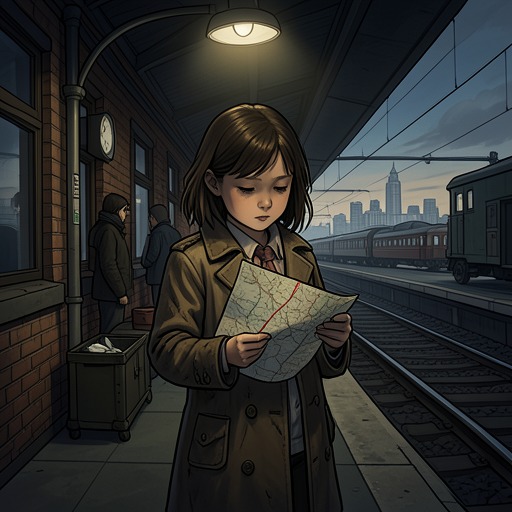
The household’s routines barely change after Lucy is born. Tuesdays bring shepherd’s pie and Fridays fish fingers; Lucy wears boys’ clothes and receives no special treatment. Her brothers do not see much use for her, except as a cannonball when they test the greenhouse glass. Miriam, meanwhile, finds Lucy clumsy as a helper: she breaks the dishes she washes and drops hot plates from the oven, and she cannot cook despite trying. The mismatch between Miriam’s expectations and Lucy’s abilities becomes explicit when Miriam warns that Lucy will never get anywhere or marry if she cannot make pastry. Lucy answers inwardly with a resolve to get away.
When Lucy is seven, the family moves from Scarborough to a small, flat coastal town farther down the coast. Miriam complains of its isolation. Sundays there mean sandy picnics in the wind and swims in the rough, cold North Sea. Lucy’s brothers play on the breakwater, while Lucy takes a book to a promenade bench, preferring reading to being thrown against the jagged wood. Miriam disapproves of this retreat. The difference is small but telling: where the boys occupy the family’s rough play, Lucy seeks distance and solitude, and her mother does not affirm that choice.
Later Life and Poetry
Much later, Jonathan’s letter to Lucy reports that Miriam does not get about much because of arthritis, though her mind remains sharp. Jonathan’s wife, Felicity, visits every Tuesday and Sunday with food, including casseroles and apple crumble. These practical details place Miriam within a pattern of regular family care, a contrast with the childhood household in which Lucy’s attempts to be useful were met chiefly as failures.
Jonathan also tells Lucy that Miriam has become something of a poet and has had several pieces printed in the local Recorder. The surviving account identifies one poem, Evenings With No Comfort, on a separate folded sheet. Lucy opens the paper, folds it again without reading, sits at her desk for about twenty minutes, then slowly opens it and begins. The account establishes both Miriam’s late creative activity and Lucy’s hesitation before encountering it; it does not disclose the poem’s contents here. Miriam’s later appearance is consequently mediated by a letter and a poem rather than by a direct scene with her daughter.
Narrative Significance
Miriam’s characterization is built through contrast across time. At Lucy’s birth, her attention is fixed on the son she expected and the domestic labor the daughter might eventually provide; in Jonathan’s report, she is an elderly woman with an active mind and a published creative life. The later information complicates the childhood portrait without erasing its consequences. Miriam’s disappointment and admonitions make home feel like a place Lucy must escape, while her poetry suggests dimensions of her life that Lucy has not necessarily known or witnessed.
The narrative also gives the family’s history through sharply specific domestic details: a borrowed lightbulb, pastry and bedsheets, a broken dish, an unread folded poem. Those objects connect Miriam’s expectations to the conditions in which Lucy grows up, then return the reader to the distance between them years later. Miriam matters not as a simple antagonist but as the parent whose limited vision of her daughter helps set Lucy’s early course, while the later letter leaves open how much of Miriam herself remains unseen.