Mrs. Katoh
The Earthquake BirdMrs. Katoh is a viola player who leaves her husband and son on Sado Island to live alone in Tokyo, describing her departure as self-imposed exile. First introduced through Mrs. Yamamoto’s string quartet, she later becomes Lucy’s unexpected advocate and host: the person who urges Lucy toward Sado, then offers her a home after her arrest. Her story connects chosen exile, the uncertain promise of escape, and the quiet work of caring for someone who has nowhere else to go.
Identity and the Quartet
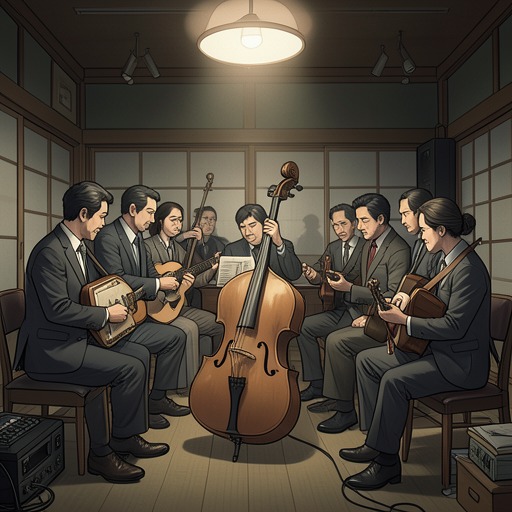
Mrs. Katoh belongs to a small amateur string quartet organized around Mrs. Yamamoto, who plays violin. Mrs. Ide plays second violin, and Mrs. Katoh plays viola. The group needs a cellist after its previous player dies of a brain tumor; through Natsuko, Lucy learns that the women would welcome her as a replacement. Mrs. Yamamoto offers to keep Lucy’s cello in her spare bedroom, making it possible for her to travel across Tokyo to rehearse. The quartet’s welcome turns an initially tentative invitation into a place for Lucy: after playing with the women, she feels supported and recognizes herself as a full part of the ensemble.
Lucy’s first impression of Mrs. Katoh is precise and physical. She is small, with frizzy gray hair and birdlike features. Her eyes move rapidly from one person or object to another, and a nervous giggle trails her words and gestures. The giggle falls away when she plays the viola. That contrast makes music a setting in which her restless manner gives way to concentration, and it introduces her not merely as a comical presence but as a musician whose attention changes when she is playing.
The quartet also gives its members room to disclose fragments of their histories. Mrs. Ide recounts her family’s postwar journey back to Japan and the disappearance of her younger sister. Mrs. Katoh offers a different kind of displacement: she says she left her husband and son on Sado Island a few years earlier and came to Tokyo alone. Her account is brief, and Lucy never discovers what prompted the departure. The unexplained reason remains a limit on what Lucy—and the reader—can know about her.
Sado Island and Self-Exile
Mrs. Katoh describes her departure through the language of exile. Sado Island has historically been a place to which people were banished; she reverses that pattern by leaving the island herself. Yet her account is not simply a rejection of home. She praises Sado as beautiful and remote, a place easily forgotten despite its qualities, and encourages Lucy to visit if the opportunity arises. The island thus enters Lucy’s imagination through a person who has left it but still speaks of it with affection.
When Lucy later remembers Sado, she understands its geography through the shifting idea of unlucky directions. From Kyoto, the island could be considered northeast and therefore inauspicious; from Tokyo, it lies northwest, a direction Lucy associates with bad luck. Mrs. Katoh had left the island in search of better fortune, and Lucy speculates that its many temples might protect it from harmful spirits. She even wonders whether Mrs. Katoh’s persistent giggle could function as a similar protection, while acknowledging that she does not know when or why it began. These are Lucy’s conjectures, not explanations Mrs. Katoh supplies.
Lucy carries the recommendation beyond the quartet. After Mrs. Yamamoto’s death, she stops playing and loses contact with Mrs. Katoh and Mrs. Ide; she does not even ask for her cello back from the Yamamoto home. But Sado remains with her as a destination. Although she had imagined going there alone, she eventually travels with Lily Bridges and Teiji. Looking back, Lucy says she cannot thank Mrs. Katoh for introducing her to the island, because of what the journey has come to mean for her. The advice therefore acquires an irony absent from Mrs. Katoh’s generous description: an invitation to a beautiful place becomes entangled with Lucy’s painful experience there.
Advocate and Host
Mrs. Katoh re-enters Lucy’s life during her detention after the disappearance of Lily Bridges. Lucy expects accusation and begins defending herself over Mrs. Yamamoto’s accidental death, explaining that she moved the cello without knowing Mrs. Yamamoto would trip over it. Mrs. Katoh does not come to condemn her. She says Mrs. Yamamoto had been clumsy and had herself expected an accident one day, then makes clear that this is not the reason for the visit. She has read the newspaper reports, dismisses them as nonsense, and tells Lucy that she intends to help secure her release.
Her reassurance is compassionate but does not erase the difference between their perspectives. Lucy tells her she does not want to be free, because she hopes to be convicted of murder. Mrs. Katoh nevertheless offers a next step: if Lucy cannot return to Britain, she can stay at Mrs. Katoh’s house in Tokyo. The offer is specific and domestic, not an argument about Lucy’s guilt. Mrs. Katoh points to the loneliness of Lucy’s apartment and its despicable neighbor and noisy cars, and proposes her own home as an alternative. Lucy agrees chiefly to keep her happy, still wishing to be convicted; the acceptance is therefore not yet a declaration of recovery or trust.
The practical outcome comes soon after. Lucy is released without charges when the case proves circumstantial and investigators find no fingerprints or DNA on Lily’s body; new evidence also emerges. Mrs. Katoh’s promise that Lucy will be free soon is followed by an actual place to go. At her house, Lucy lies on the balcony while Mrs. Katoh cooks dinner, with fish and ginger frying in the kitchen. They have invited Natsuko and Bob, and their reunion gives Lucy a way back into ordinary companionship. Natsuko has taken over Lucy’s important translations, and both she and Bob know Lucy is innocent; there is no need for explanations or apologies before they can share food and drink.
Care, Home, and Narrative Significance
Mrs. Katoh’s hospitality continues beyond the first dinner. Lucy plans to return to work when ready and imagines staying with her; Mrs. Katoh says her house is large enough for two. She looks after Lucy by making a fuss, cooking, running a bath to the right temperature each night, and laying out a clean towel. These repeated acts give the offer of shelter substance. After arrest has isolated Lucy from her former life, care arrives not as a verdict on the case but as food, warmth, and a place where she can remain.
Mrs. Katoh’s own history complicates the idea of home that she offers. She has left a husband and son behind on the island she still calls beautiful, and she insists she will not return. Her Tokyo life is a chosen exile, while Lucy’s proposed return to Britain seems to Lucy like a return to a place where everyone is a ghost. Mrs. Katoh does not resolve that difference or explain her own departure; instead, she makes room for Lucy within the life she has built away from Sado. The novel leaves her original reasons for leaving undisclosed, but makes the consequences of her later choice visible in the care she provides.
Her importance rests on a quiet reversal. The person whose recommendation leads Lucy toward a journey she later regrets becomes, after that journey and Lucy’s arrest, one of the people who can receive her. The nervous giggle that once marked Mrs. Katoh in the quartet accompanies neither a full account of her past nor a solution to Lucy’s troubles. What she offers is more concrete: confidence in Lucy when the newspapers cast suspicion on her, a home in Tokyo, and the steady rituals of looking after someone. In a story shaped by departures and uncertain belonging, Mrs. Katoh makes refuge an action rather than a promise.