Photography, Observation, and Absence
The Earthquake BirdPhotography, Observation, and Absence is the novel’s recurring practice of looking, keeping, and interpreting images. Teiji’s photographs can make an encounter feel intimate, turn a private collection into contested territory, and offer police evidence without settling the question of guilt. The camera records what falls within its frame; what it means, who controls it, and what remains outside it are less certain.
The camera as an act of encounter
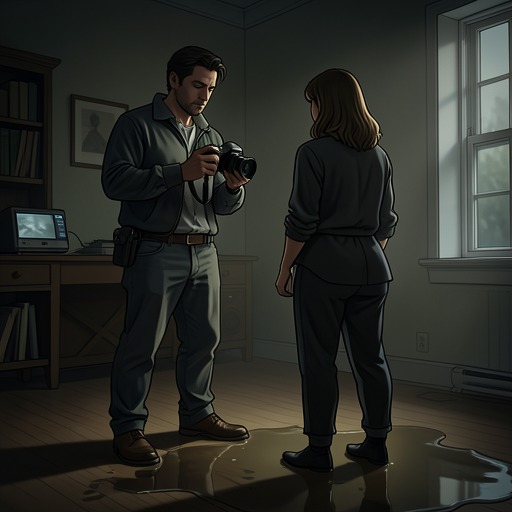
After Mrs. Yamamoto’s string quartet disbands, Lucy wanders through rainy central Tokyo and stops outside the Keio Plaza Hotel. Teiji is photographing a puddle while the crowd passes under umbrellas. Lucy steps into the water’s reflection, placing the tips of her shoes over the reflected hotel. Teiji keeps his camera to his eye, then photographs her face and feet. Lucy never sees those first pictures. Their absence matters: she remembers the act of being framed and imagines it as an intimate invitation, but the image itself remains inaccessible.
The scene establishes a difference between what Teiji sees and what Lucy can infer. The puddle divides the hotel’s bright windows from darkness and floating cigarette butts; Lucy sees the butts as people jumping from windows, while Teiji appears to look deeper. The camera does not resolve the difference between observation and projection. Instead, it gives Lucy a place inside Teiji’s viewfinder while leaving her unable to know exactly what he saw.
Private images and unequal intimacy
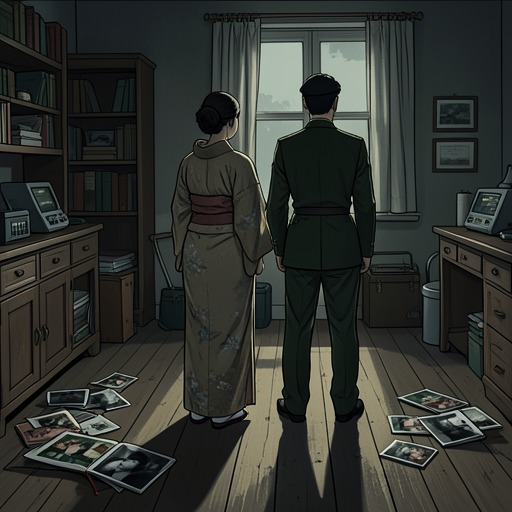
Later, Lucy enters Teiji’s apartment with a spare key hidden in a crack beside the front door and searches the boxes of photographs he has never shown her. She passes over his childhood pictures and looks through the images from his Tokyo years, finding a sequence of a woman first seen through a bus window. Earlier photographs show her performing in a theater; later ones place her at parties, on worn tatami, and on a bed. Her clothes become crumpled and stained, and her expression increasingly sad. The final image Lucy sees shows the woman lying face-down on pavement, her expression impossible for Lucy to distinguish as a grimace or a smile.
Teiji enters and tells her, “They’re private.” Lucy is caught looking, but she acknowledges that being caught, rather than having looked, is what makes her sorry. The archive is therefore not simply a record of Teiji’s life: it is a boundary he controls, and Lucy’s unauthorized viewing exposes both her desire to know him and the limits of what she can learn from his pictures. The photographs give her a visual chronology, but not the woman’s story or the circumstances behind each image.
The camera also mediates Lucy and Lily’s closeness. While Lily struggles with noodles in Teiji’s restaurant, he photographs the two women together and gives the print to Lucy a couple of weeks later, wrapped in carefully folded newspaper. Lucy repeatedly reads the newspaper for a message, although she knows none was intended. She is pleased that Teiji did not make a copy for Lily: she prefers to imagine the photograph as a picture of herself with Lily as an addition, rather than an image of two equals. She keeps the print in a box for things she cannot bring herself to throw away, and later sees the shutter’s click—not the photograph’s visible contents—as the point at which trouble began. The image shows only the women at a table; Lucy’s retrospective account makes the act of taking it carry the foreboding.
Images as evidence and as limits
After Lucy tells Teiji about Brian Church’s suicide, his photography changes in her perception. On their walk to the station, he takes a picture, but the shutter no longer seems part of his familiar, unconscious movement. He peers through the viewfinder, moves around preoccupied, frowns, and finally takes the photograph with apparent resignation. Lucy cannot know what he is thinking. She considers several possibilities, including that her account has brought a painful past back into their relationship, but the camera records no explanation of his reaction.
Photographs later enter the police investigation into Lily’s death. After newspaper coverage of Lucy’s arrest, an envelope arrives containing two images. One shows Lily at a McDonald’s near Lucy’s home on the night of the murder, two hours after she was seen at Lucy’s door. A cashier recalls that Lily and a Japanese man seemed distressed and had difficulty communicating; Lily left her cheeseburger untouched but drank her Coke. The photograph places Lily alive at a later point that night and helps show that Lucy’s brief excursion outside was unrelated to her death.
The second image shows a woman confined within close brown walls, her head lolling and her eyes empty. The police find no fingerprints on either photograph and do not know that Teiji took them; Lucy believes he did. She reads the pictures as showing that she did not kill Lily, but they do not prove that Teiji did. Her questions about whether he waited for Lily, what passed between them, and whether he killed her remain suspicions, not facts established by the images. The photographs can unsettle the case against Lucy without identifying Lily’s killer.
The absent photographer
When Teiji leaves for Hokkaido, he leaves a roll of undeveloped film on the shop counter. Soutaro has the film developed in the hope of finding a clue, but the pictures show deserted beaches, railway tracks without trains, boarded-up buildings, and abandoned trash cans. He turns the prints over and examines them with old three-dimensional glasses before giving up and throwing them away. The images record places, but offer Soutaro no explanation of Teiji’s departure. Their emptiness becomes a form of absence: the photographs survive where their maker’s intentions do not.
That absence persists after Teiji disappears. Lucy hears a camera click and the film winding on among the trees and bushes near her home. She looks for Teiji and listens for footsteps, but sees no one; the sound seems to echo from every direction. Rain begins to fall as she turns toward the house, while she remains convinced that Teiji is waiting outside. The final photographic sound makes the camera seem at once a possible trace of his presence and a reminder that no image, sighting, or explanation confirms it. Across the novel, photography preserves selected surfaces while leaving the person behind the camera—and the lives beyond the frame—uncertain.