Sado Island
The Earthquake BirdSado Island is a remote island in the Sea of Japan that enters the novel through stories of exile and a promise of escape. Mrs. Katoh, who left her husband and son to live alone in Tokyo, describes it as beautiful and easily forgotten; Lucy Fly carries that image into her own plans. What begins as a place Lucy imagines visiting alone becomes the destination she proposes to Lily Bridges, and the journey is ultimately made with Lily and Teiji as her companions.
Setting and Historical Identity
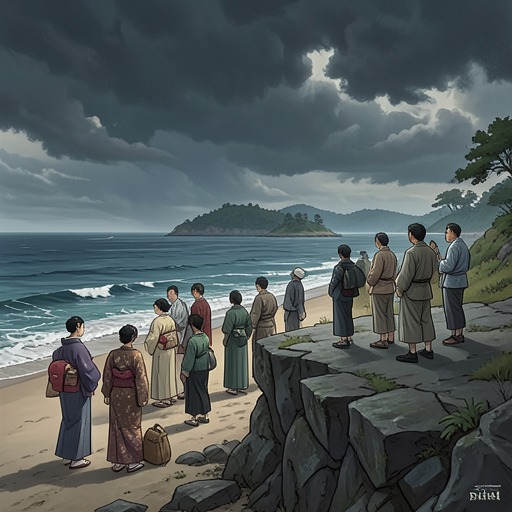
Mrs. Katoh presents Sado Island as both a particular place and a repository of displacement. It lies in the Sea of Japan, apart from the Tokyo life to which she has withdrawn, and she calls it remote, beautiful, and Japan’s secret jewel. Her description gives the island an unusual double character: it is not merely a scenic destination but a place whose distance and history have accumulated meaning.
That history is one of exile. Mrs. Katoh explains that people were sent to Sado Island for centuries as criminals or as people deemed politically undesirable. She reverses that inherited direction of movement in her own account: rather than being sent there, she left the island and settled in Tokyo. The island’s identity therefore reaches Lucy not as a neutral item of travel information but through a story about departure, chosen isolation, and the traces of older forms of punishment.
Mrs. Katoh’s Connection to the Island
Mrs. Katoh is from Sado Island. A few years before Lucy meets her, she left her husband and son and came to live alone in Tokyo. Her explanation is brief and emphatic: she says she exiled herself and will never return. She does not tell Lucy what made her leave, and Lucy never learns the reason. That silence places a limit around the island’s personal history: its significance is clear, but the circumstances behind Mrs. Katoh’s departure remain undisclosed.
The women’s connection begins through music. Lucy plays cello with Mrs. Katoh, Mrs. Ide, and Mrs. Yamamoto, and their regular sessions become the high point of her week. After Mrs. Yamamoto dies, Lucy stops playing and loses contact with the other women. Yet one part of that musical friendship persists: Sado Island. Mrs. Katoh has spoken of it many times, and Lucy keeps thinking about the place after the quartet has ended. In this way, the island outlasts the gathering that first brought it into her life.
From Private Plan to Shared Journey
Lucy’s first plans place her on Sado Island alone. She intends to visit one day and imagines the trip as a solitary undertaking. That expectation changes when Lily is in Japan and Lucy becomes reluctant to see her return to Hull and Andy. Lucy believes that Lily has experienced escape and that going back to a life she regards as captivity would be a bad decision. Her wish to keep Lily in Japan is therefore both protective and personally entangled: she has grown used to Lily’s presence and does not want her to leave.
Lucy turns to Sado Island as a destination suited to this situation. She thinks of its history as a place of exile and sees the island as fitting for two modern-day exiles. She calls Lily back and invites her to come. In making the case, Lucy draws on what she has read and what Mrs. Katoh told her: the island has temples and clear blue sea, and it lies beyond Tokyo. She also suggests spending time in Niigata and the mountains, contrasting that prospect with the small hill they climbed in Yamanashi. The invitation converts a long-held, solitary plan into a shared journey. When Lucy finally goes, Lily and Teiji are her traveling companions, not the absent company she had originally imagined.
Exile, Movement, and Narrative Significance
Sado Island gathers several kinds of departure without making them equivalent. Mrs. Katoh’s self-imposed exile is bound to an unexplained break with her former life; the island’s older history involves people sent there against their will; Lucy’s description of herself and Lily as modern exiles is an imaginative analogy, offered while she tries to prevent Lily’s return to England. The island gives Lucy a language for escape, but it cannot resolve the differences between these stories or reveal what Mrs. Katoh left behind.
The destination also contrasts with Lucy’s recurring movement through Tokyo. After Mrs. Yamamoto’s death, she wanders the city alone; later, after the rupture with Lily and Teiji, she follows the Yamanote Line on foot through the night, covering a marathon’s distance and eventually returning to Gotanda, where she began. That circular walk passes through places dense with personal memories, but ends at its starting point. Sado Island, by contrast, is imagined as a crossing away from the city. Its importance lies partly in this change of scale: a remembered place beyond Tokyo becomes the means by which Lucy tries to turn other people’s uncertain futures into a journey they can take together.