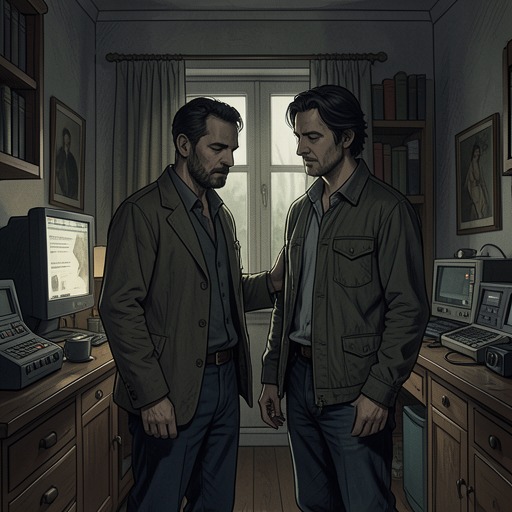
Teiji Matsuda and Sachi
The Earthquake BirdTeiji Matsuda and Sachi are connected by an earlier relationship that Lucy Fly can reconstruct only in fragments. Sachi appears as a woman Teiji once found at a small theater and who later walked out of his life; Lucy does not know how long passed before she herself entered it. That gap matters: Sachi’s place in the sequence is clear enough to unsettle Lucy, but not clear enough to explain Teiji’s past or establish what became of Sachi.
An Earlier Relationship, Seen in Fragments
Lucy’s knowledge of Sachi is mediated by absence. While walking through Shinjuku, Lucy realizes that the small theater where Teiji found Sachi might be only a street or a block away. The possible closeness of the place sharpens the imagined closeness of the events: Sachi walked out, and at some later, unknown point Lucy met Teiji. Lucy had pictured Sachi as belonging to a remote past, like the photographs buried in a box, but recognizes that this sense of distance may be misleading.
The circumstances of Lucy and Teiji’s first meeting give that comparison a precise point of reference. Soon after Mrs. Yamamoto’s string quartet disbanded, Lucy was wandering in central Tokyo on a rainy Sunday evening. Outside the Keio Plaza Hotel, she saw Teiji studying and photographing a puddle. Their first encounter began when his photograph included Lucy’s feet reflected in the water. Later, Lucy and Teiji built a closeness that often needed no spoken conversation: they walked together, spent time at his uncle’s noodle shop, and shared whole weekends in bed. Their favorite outings were warm, rainy nights. Against this remembered intimacy, Sachi becomes not an abstract predecessor but the unknown beginning of a possible pattern.
Lucy’s Reconstruction of the Sequence
During an all-night walk around Tokyo, Lucy follows the Yamanote Line and passes places associated with different periods of her life. In Shinjuku, near where she first saw Teiji, she thinks again of Sachi and wonders how much time separated Sachi’s departure from Lucy’s arrival. She imagines that Teiji might have moved from Sachi to Lucy and then from Lucy to Lily Bridges as if the three women were consecutive stations along a track.
The image makes Lucy’s walk a way of thinking through relationships as well as a physical circuit of the city. Each station returns her to a remembered place or attachment, while the railway’s sequence offers a stark model for how one relationship might follow another. But Lucy presents this as a possibility, not as knowledge about Teiji’s intentions or the actual timing of his relationships. The route organizes her suspicion; it does not prove it.
Photographs and Unresolved Questions
The photographs associated with Sachi deepen the uncertainty. Lucy recalls imagining Sachi’s photographs buried in a box, a physical trace of a past that Teiji had not explained. Later, considering photographs that she knows Teiji took, Lucy wonders what happened to Sachi and whether Teiji’s relationships with the women in his life might be connected to his habit of keeping images. She raises the possibility that a woman could become something to preserve in a collection, but does not claim that the photographs establish what happened to Sachi.
Sachi’s significance therefore lies partly in what remains unknown. Lucy places her before herself and Lily in a possible succession, then checks her own inference against the limits of the evidence. The relationship is a source of unease rather than a resolved account of Teiji’s past: its locations and fragments persist, while its duration, ending, and consequences remain unclear.